

Imagine a patient walks into your clinic with a severe urinary tract infection. It’s a routine case. You reach for the standard first-line antibiotic-only to find the shelf empty. The backup option is also gone. Now you’re forced to choose between waiting days for delivery or prescribing a powerful, last-resort drug that carries higher risks of side effects and accelerates global resistance. This isn’t a hypothetical scenario from a dystopian novel. It is happening right now in hospitals across the United Kingdom, the United States, and Europe.
We are facing a silent but escalating public health emergency: antibiotic shortages. These aren't just minor supply hiccups; they represent a structural failure in our global pharmaceutical system with direct, dangerous consequences for how we treat infections. As of late 2024 and early 2025, data shows that antimicrobials are 42% more likely to face shortages than any other class of drugs. When these medicines vanish, patients suffer, clinicians scramble, and the clock ticks louder on the threat of untreatable superbugs.
The Scale of the Crisis: By the Numbers
To understand why this matters, we need to look at the hard data. The World Health Organization (WHO) released its Global Antibiotic Resistance Surveillance Report (GLASS) for 2025, painting a stark picture. In 2023, one in six laboratory-confirmed bacterial infections worldwide was resistant to available treatments. For urinary tract infections specifically, that number jumps to one in three. But resistance is only half the problem. The other half is access.
According to the European Court of Auditors (ECA) Special Report 19/2025, shortages of antimicrobial agents rank second among all pharmaceutical classes globally. In the European Economic Area alone, 28 countries reported antibiotic shortages, with 14 labeling them as 'critical.' In the United States, the situation is equally dire. The FDA documented 147 active antibiotic shortages as of December 2024, marking a ten-year high in supply disruptions.
| Metric | Data Point | Source |
|---|---|---|
| Resistance Rate (Global Bacterial) | 1 in 6 infections | WHO GLASS 2025 | Shortage Likelihood vs. Other Drugs | 42% higher | Clinical Infectious Diseases (CID) |
| US Active Shortages (Dec 2024) | 147 antibiotics | US FDA |
| EEA Countries with Critical Shortages | 14 out of 28 | ECA Report 19/2025 |
These numbers aren't static. They are climbing. Between 2018 and 2023, antibiotic resistance rose in over 40% of the pathogen-antibiotic combinations monitored by the WHO, with an average annual increase of 5-15%. We are losing the battle against bacteria while simultaneously running out of the weapons needed to fight them.
Why Are Antibiotics Disappearing?
You might wonder why we can't just make more antibiotics. The answer lies in a toxic mix of economics, manufacturing fragility, and geopolitical instability. Antibiotics are largely generic drugs. The market for generic antibiotics is fiercely competitive, primarily dominated by manufacturers in India and China. Since 2015, prices for these generics have dropped by 27%, creating razor-thin profit margins.
At the same time, regulatory compliance costs have skyrocketed by 34% over the same period. Manufacturers simply don't have the financial incentive to invest in the rigorous, sterile facilities required to produce injectable antibiotics. The European Court of Auditors noted that because of low worldwide market prices, "manufacturers have little incentive to make the required investments." When a factory fails inspection or faces a raw material shortage, there are often no backup suppliers ready to step in immediately.
Geopolitical events exacerbate this fragility. Brexit serves as a prime example for the UK. Drug shortages in the United Kingdom surged from 648 in 2020 to 1,634 in 2023, according to the ECA. Supply chains that once flowed seamlessly across borders now face bureaucratic delays, customs checks, and logistical bottlenecks. This isn't just about politics; it's about physics. A delayed shipment of penicillin G benzathine-a drug that has been in short supply since 2015-means real people go without treatment.
The Clinical Impact: Forced Substitutions and Rising Resistance
When first-line antibiotics like amoxicillin disappear, doctors don't stop treating patients. They adapt. But adaptation comes with a heavy cost. Clinicians are forced to use broader-spectrum antibiotics, such as carbapenems or colistin, which are reserved for severe, multi-drug-resistant infections. Using these powerful drugs for routine conditions like simple UTIs or mild pneumonia is clinically inappropriate and dangerous.
Here is the catch: every time you use a broad-spectrum antibiotic unnecessarily, you train bacteria to resist it. If third-generation cephalosporins become unavailable-and remember, over 40% of E. coli strains are already resistant to them globally-clinicians must jump to stronger drugs. This accelerates the development of resistance in those last-resort medications. We are essentially burning through our most valuable medical assets to cover for gaps in basic supply.
The impact on usage patterns is measurable. Following the EMA announcement of an amoxicillin shortage in January 2023, CIDRAP analysis showed a 55% reduction in amoxicillin use across 22 databases and a 69% drop in amoxicillin-clavulanate use across 16 databases. Patients weren't getting better care; they were getting different care, often with worse outcomes. In the US, 78% of hospital pharmacists reported modifying treatment protocols due to shortages in the past year, with 62% noting increased patient complications as a result.
Voices from the Frontlines
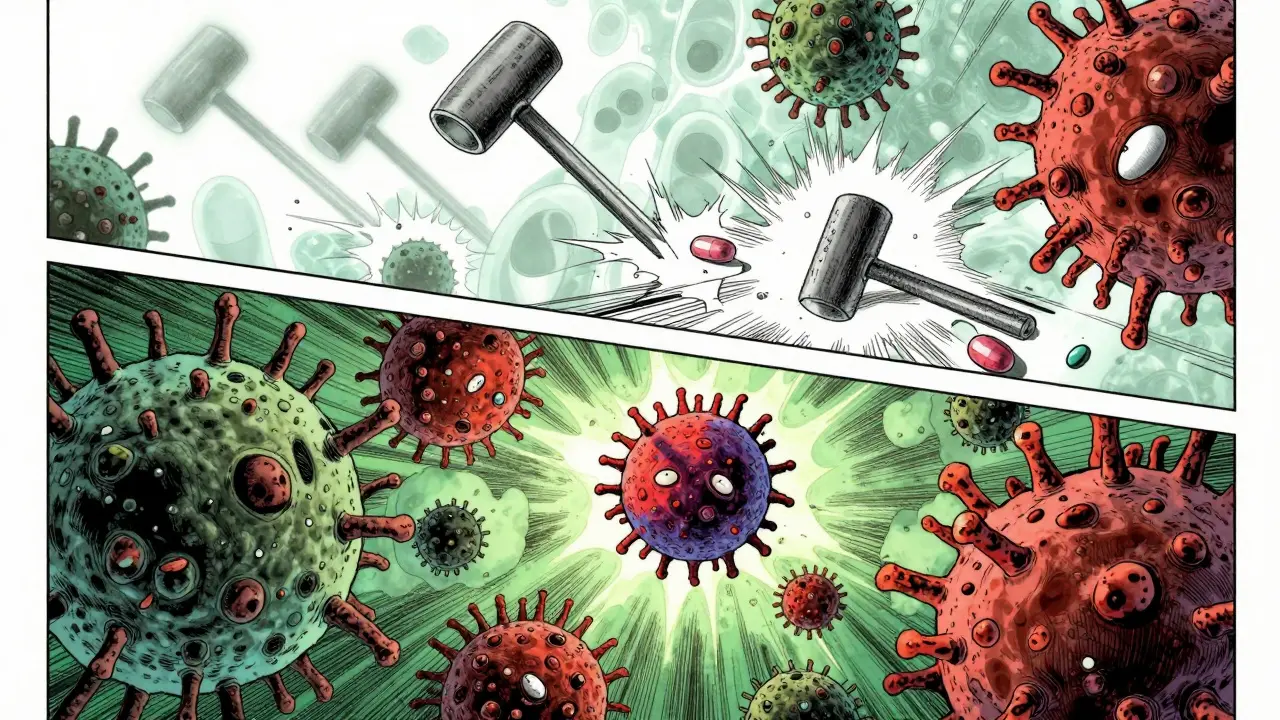
Statistics tell us what is happening, but stories tell us how it feels. Dr. Sarah Chen, an infectious disease specialist in California, shared her experience on the American Public Health Association forum in 2025. She described having to prescribe colistin-a toxic, last-resort antibiotic-for a routine urinary tract infection because first-line treatments were unavailable. "It’s like using a sledgehammer to crack a nut," she said, "but the nut is stuck, and we have no hammer left."
In the UK, a physician on Reddit described the post-Brexit reality: "Since Brexit, our hospital has had to ration amoxicillin, forcing us to use broader spectrum antibiotics that increase resistance risk." This sentiment echoes across borders. In rural Kenya, a nurse reported on the WHO discussion forum that when penicillin isn't available, patients are sent home without treatment, "knowing they might die from what should be a simple infection." In Mumbai, a mother recounted her child’s pneumonia treatment being delayed by 72 hours due to azithromycin shortages, leading to intensive care admission.
These aren't isolated incidents. They are symptoms of a broken system. The disparity is also glaring. While high-income countries can sometimes mitigate shortages through importation, low- and middle-income countries (LMICs) face a "syndemic" of resistance and under-treatment. In LMICs, 70% of antibiotics are already inaccessible. For these populations, a shortage isn't an inconvenience; it's a death sentence.

Hospital Strategies: Stewardship and Survival
Healthcare systems are not sitting idle. Hospitals are implementing Antimicrobial Stewardship Programs (ASPs) to manage scarcity. These programs monitor usage patterns, identify potential shortage impacts early, and enforce strict guidelines on when and how antibiotics are prescribed. Johns Hopkins Hospital, for instance, reduced unnecessary broad-spectrum antibiotic use by 37% during shortages by integrating rapid diagnostic testing. This allows doctors to pinpoint the exact bacteria causing an infection and target it precisely, rather than guessing.
However, setting up these systems takes time-typically 6-12 months. And even then, challenges remain. Rationing decisions are made in 89% of US hospitals. Therapeutic substitution complications occur in 76% of cases. Pharmacy teams report a 22% increase in workload per pharmacist as they manually track inventory and source alternatives. Regional sharing networks, like the one established in California in 2024, have shown promise, reducing critical shortage impacts by 43% across participating hospitals. But these are band-aids on a gaping wound.
The Path Forward: Policy and Investment
Solving antibiotic shortages requires more than just better hospital management. It demands systemic change at the global level. The WHO announced a five-point action plan in October 2025, including the establishment of a Global Antibiotic Supply Security Initiative by 2027, backed by $500 million in initial funding from G7 nations. The European Commission is rolling out its Pharmaceutical Strategy for Europe, aiming to address shortages by 2026. The US FDA approved two new manufacturing facilities for critical antibiotics in January 2025, expected to alleviate 15% of current shortages by Q3 2025.
Yet, long-term projections remain grim. The Review on Antimicrobial Resistance predicts that without significant intervention, global antibiotic shortages will increase by 40% by 2030, potentially causing 1.2 million additional deaths annually from currently treatable infections. Industry analysts predict a 22% increase in antibiotic development funding through 2027, but warn that manufacturing infrastructure investments will lag, potentially worsening shortages in the short term.
We need to treat antibiotics not as commodities, but as essential public goods. This means guaranteeing stable markets for manufacturers, investing in local production capabilities, and strengthening supply chain transparency. Until then, clinicians will continue to play triage in a war we didn't start but must win.
What are the most common antibiotics currently in short supply?
As of late 2024 and early 2025, chronic shortages affect several key antibiotics. Penicillin G benzathine has been scarce since 2015 due to manufacturing issues and market economics. Amoxicillin, both alone and in combination with clavulanate, faced significant shortages starting in 2023, impacting millions of prescriptions globally. Third-generation cephalosporins and azithromycin have also experienced intermittent but severe supply disruptions, particularly in the US and parts of Europe.
How do antibiotic shortages contribute to antimicrobial resistance?
Shortages force clinicians to substitute first-line, narrow-spectrum antibiotics with broader-spectrum, last-resort drugs like carbapenems or colistin. Overusing these powerful agents for routine infections accelerates bacterial evolution, leading to strains that are resistant to even the strongest medications. This creates a vicious cycle where effective treatments become less effective faster, leaving fewer options for severe infections.
Why are antibiotics more likely to face shortages than other drugs?
Antibiotics are mostly generic drugs with very low profit margins. Prices have dropped by 27% since 2015, while regulatory compliance costs have risen by 34%. This economic pressure discourages manufacturers from maintaining multiple production sites or investing in robust supply chains. Consequently, when one factory fails, there are few backups, making antibiotics 42% more likely to face shortages compared to other drug classes.
What is the WHO doing to address antibiotic shortages?
The WHO launched a five-point action plan in October 2025, including the Global Antibiotic Supply Security Initiative, funded by $500 million from G7 nations. The goal is to improve surveillance, strengthen manufacturing resilience, and ensure equitable access. Additionally, the WHO tracks resistance and usage through its GLASS system, providing data to guide policy and stewardship efforts globally.
How are hospitals managing the lack of first-line antibiotics?
Hospitals are increasingly relying on Antimicrobial Stewardship Programs (ASPs) to optimize use. Strategies include rapid diagnostic testing to target specific bacteria, regional sharing networks to redistribute stock, and strict rationing protocols. However, many institutions still resort to therapeutic substitution with broader-spectrum drugs, which increases patient risk and drives further resistance.