
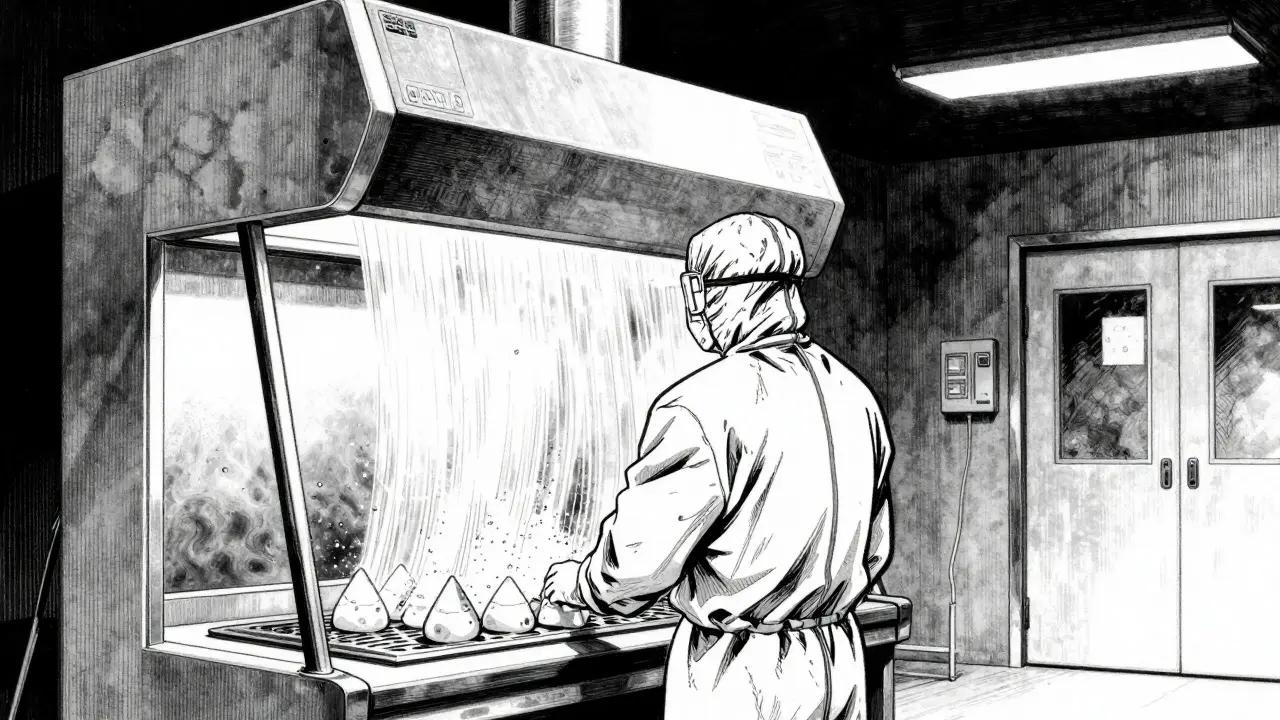
When you pick up a bottle of generic ibuprofen or an insulin pen at the pharmacy, you expect it to work exactly like the brand-name version. You trust that the medicine is pure, potent, and free from hidden contaminants. That trust doesn't happen by accident. It is built in highly controlled environments known as cleanrooms. These facilities are not just 'clean' in the everyday sense; they are engineered ecosystems where every particle of dust, microbe, and fluctuation in humidity is monitored and managed. For generic drug manufacturers, meeting strict cleanroom standards is not optional-it is the legal and scientific bridge that proves their product is bioequivalent to the original reference drug.
If environmental controls fail, the consequences can be severe. We have seen outbreaks linked to contaminated compounded medications and massive recalls due to microbial growth in injectables. Understanding how these standards protect your health requires looking under the hood of pharmaceutical manufacturing. Let’s break down what these standards are, why they matter specifically for generics, and how regulators ensure safety without compromising accessibility.
The Foundation of Cleanroom Classifications
Cleanrooms are categorized by how many particles they allow in the air. The global benchmark for this is the ISO 14644-1 standard, which defines classes based on particle counts per cubic meter of air. However, pharmaceutical manufacturing often uses a more specific grading system derived from Good Manufacturing Practices (GMP).
| Grade | ISO Equivalent (At Rest) | Key Particle Limit (≥0.5μm) | Typical Use Case |
|---|---|---|---|
| Grade A | ISO Class 5 | 3,520 particles/m³ | Sterile filling, aseptic processing |
| Grade B | ISO Class 5 (Rest) / ISO Class 7 (Op) | 352,000 particles/m³ (Rest) | Preparation of sterile products |
| Grade C | ISO Class 7 | 3,520,000 particles/m³ | Non-sterile preparation, component washing |
| Grade D | ISO Class 8 | 35,200,000 particles/m³ | Packaging, non-critical stages |
Grade A is the most stringent. It requires unidirectional laminar airflow-think of it as a river of filtered air moving in one direction to sweep contaminants away. This grade is mandatory for critical operations like filling vials with injectable drugs. Grade B surrounds Grade A areas, acting as a buffer zone. Grades C and D are used for less critical steps, such as preparing raw materials or packaging finished pills. The European Union’s GMP Annex 1, significantly revised in August 2023, enforces these grades strictly, while the U.S. Food and Drug Administration (FDA) focuses on the overall Contamination Control Strategy (CCS), though it generally aligns with these ISO equivalents.
Why Generics Face Unique Scrutiny
Generic drugs must demonstrate bioequivalence to the Reference Listed Drug (RLD). This means they must deliver the same amount of active ingredient into a patient’s bloodstream over the same period. If a generic manufacturer’s cleanroom allows microbial contamination or particulate matter to enter the product, the drug’s stability and safety change. Even if the active ingredient is correct, impurities can cause allergic reactions or reduce efficacy.
The challenge for generic makers is economic. Brand-name innovators often operate with gross margins of 70-80%, allowing them to absorb high facility costs. Generic manufacturers typically operate on 15-20% margins. Building and maintaining a Grade A cleanroom costs between $250 and $500 per square foot. For a small generic producer making low-cost essential medicines, this infrastructure represents a massive capital expenditure. Yet, regulators do not lower the bar. An Abbreviated New Drug Application (ANDA) submission must prove that the generic was made under conditions identical in quality to the innovator’s. If the FDA finds environmental monitoring deficiencies-which accounted for 42% of complete response letters for sterile generics in 2022-the application is rejected.
Key Environmental Controls Beyond Particles
Particle count is only part of the story. A cleanroom is a complex system managing multiple variables simultaneously. Here are the critical controls that protect drug quality:
- Air Filtration: High-Efficiency Particulate Air (HEPA) filters, specifically H13 or H14 class, capture 99.95% to 99.995% of particles as small as 0.3 micrometers. These filters are tested regularly for leaks.
- Pressure Differentials: Cleanrooms maintain positive pressure relative to adjacent corridors. This ensures that when a door opens, air flows out of the cleanroom, preventing dirty hallway air from rushing in. A typical differential is 10-15 Pascals.
- Temperature and Humidity: Most pharmaceutical processes require temperatures between 18-26°C and relative humidity between 30-60%. Too much humidity can cause powders to clump or tablets to degrade. Too little can generate static electricity, attracting dust.
- Microbial Monitoring: Settle plates and active air samplers check for viable organisms. In Grade A areas, the limit might be as low as 1 Colony Forming Unit (CFU) per plate. In Grade D, it can be up to 200 CFU.
- Personnel Protocols: Humans are the biggest source of contamination. Workers undergo rigorous gowning procedures, certified through 40-60 hours of training. Every movement is designed to minimize shedding skin cells and fibers.
Regulatory Frameworks: FDA vs. EU GMP
While the goal is the same-patient safety-the regulatory approaches differ slightly. The FDA’s Current Good Manufacturing Practices (cGMP), codified in 21 CFR Parts 210 and 211, emphasize performance-based outcomes. They don’t always specify exact ISO classes but require facilities to prevent contamination. The EU’s EudraLex Volume 4, particularly Annex 1, is more prescriptive, explicitly linking GMP grades to ISO classes.
This divergence creates complexity for global manufacturers. A company producing generics for both markets must design facilities that meet the stricter of the two requirements. Recently, there has been a push toward harmonization. The International Council for Harmonisation (ICH) develops guidelines like ICH Q7 for Active Pharmaceutical Ingredients (APIs) to create a unified global standard. As of 2026, the FDA has indicated it will align more closely with the EU’s 2023 Annex 1 revisions, particularly regarding continuous monitoring and risk management strategies.
The Human Factor and Common Pitfalls
You can build the best HVAC system in the world, but if a technician sneezes without proper protection or walks too quickly, disrupting airflow, the cleanroom fails. Industry surveys reveal that personnel behavior is the leading cause of deviations. Gowning errors, improper hand hygiene, and rapid movements account for nearly half of all environmental excursions reported by generic manufacturers.
Another common pitfall is inadequate validation. Initial cleanroom validation takes 3-6 months and costs up to $500,000. It involves proving that the room performs as designed under worst-case scenarios. Many smaller firms cut corners here, leading to FDA Form 483 observations during inspections. These observations list violations found during an inspection and can lead to warning letters or import alerts if not resolved. In fiscal year 2022, cGMP-related issues represented 63% of all FDA warning letters.
Future Trends: Automation and Cost Reduction
The future of cleanroom standards lies in automation. Robotics and AI-powered monitoring systems are beginning to replace human presence in critical zones. By removing people from Grade A areas entirely, manufacturers can drastically reduce contamination risks. McKinsey & Company projects that increased automation could lower operational costs by 25-30% by 2028. This shift is crucial for generic manufacturers, who need to maintain profitability while adhering to rising standards. Additionally, single-use systems are gaining traction, reducing the need for extensive cleaning and sterilization of reusable equipment, thereby lowering the risk of cross-contamination.
What happens if a generic drug manufacturer fails cleanroom standards?
Failure to meet standards can result in FDA Form 483 observations, warning letters, import alerts, or consent decrees. Severe cases may lead to product recalls, as seen in the 2022 Aurobindo Pharma case, which resulted in a $137 million recall of sterile injectables due to inadequate monitoring.
Are cleanroom standards different for oral solids versus injectables?
Yes. Sterile injectables require Grade A/B environments to prevent microbial contamination that could cause sepsis. Oral solids typically require Grade C/D environments, as the stomach acid provides a secondary barrier against microbes, though particulate control remains important for dosage accuracy.
How often are cleanrooms inspected by regulators?
Inspection frequency varies. High-risk facilities, such as those producing sterile products, are inspected more frequently, often annually. Lower-risk facilities may be inspected every 2-3 years. The FDA’s GDUFA III program has increased resources for inspecting generic drug facilities, leading to more rigorous and frequent reviews.
Why do generic drugs cost less if the manufacturing standards are the same?
Generics save money because they do not bear the initial R&D costs of discovering the drug. While their manufacturing facilities must meet the same quality standards, competition among multiple generic suppliers drives prices down. The high fixed costs of cleanrooms are spread across larger volumes of production.
What is the role of HEPA filters in cleanrooms?
HEPA (High-Efficiency Particulate Air) filters remove 99.97% of airborne particles, including bacteria and viruses. In pharmaceutical cleanrooms, H13 or H14 class filters are used to ensure that the air supplied to critical areas is virtually particle-free, protecting the drug product from external contamination.