
You've tried the SSRIs. You've tried the SNRIs. Maybe you even tried a mood stabilizer or an atypical antipsychotic as an add-on. But that heavy fog of depression is still there, stubborn and unyielding. If two or more standard antidepressants haven't worked for you, you're part of the roughly 30% of people with major depressive disorder who face treatment-resistant depression (TRD). For years, the only option was to keep guessing with new pills and waiting weeks for them to work. Now, we have something different: rapid-acting treatments like ketamine and esketamine.
These aren't your average antidepressants. They don't just tweak serotonin levels; they target glutamate, a neurotransmitter involved in brain plasticity. This shift in mechanism allows them to potentially lift mood within hours or days, not weeks. But here's the catch: while both drugs come from the same chemical family, they are distinct tools with different delivery methods, side effects, and costs. Choosing between them isn't just about what works best on paper-it's about what fits your life, your budget, and your tolerance for dissociation. Let's break down exactly how these two options compare so you can have a smarter conversation with your psychiatrist.
What Exactly Are Ketamine and Esketamine?
To understand the difference, you have to look at the chemistry. Ketamine is a racemic mixture, meaning it contains two mirror-image molecules: R-ketamine and S-ketamine. It has been used as an anesthetic since the 1970s. When used for depression, it is typically administered intravenously (IV) at subanesthetic doses-much lower than what you'd get during surgery.
Esketamine is the purified S-enantiomer of ketamine. Because it isolates one specific molecule, it behaves differently. It is approved by the FDA under the brand name Spravato® specifically for adults with TRD or those with major depressive disorder with acute suicidal ideation. Unlike IV ketamine, which is often used "off-label" for depression, Spravato is an FDA-approved nasal spray. This distinction matters for insurance coverage and legal prescribing standards.
The key takeaway? Esketamine is essentially a refined version of ketamine, designed to be easier to administer and potentially safer regarding certain side effects, but it might not pack quite the same punch for everyone.
How Do They Work Differently?
Both drugs act on the NMDA receptors in the brain, blocking them to increase glutamate release. This surge triggers a cascade of events that helps repair neural connections damaged by chronic stress and depression. Think of it less like putting a bandage on a wound and more like rebuilding the scaffolding of the house.
However, the delivery method changes the experience significantly:
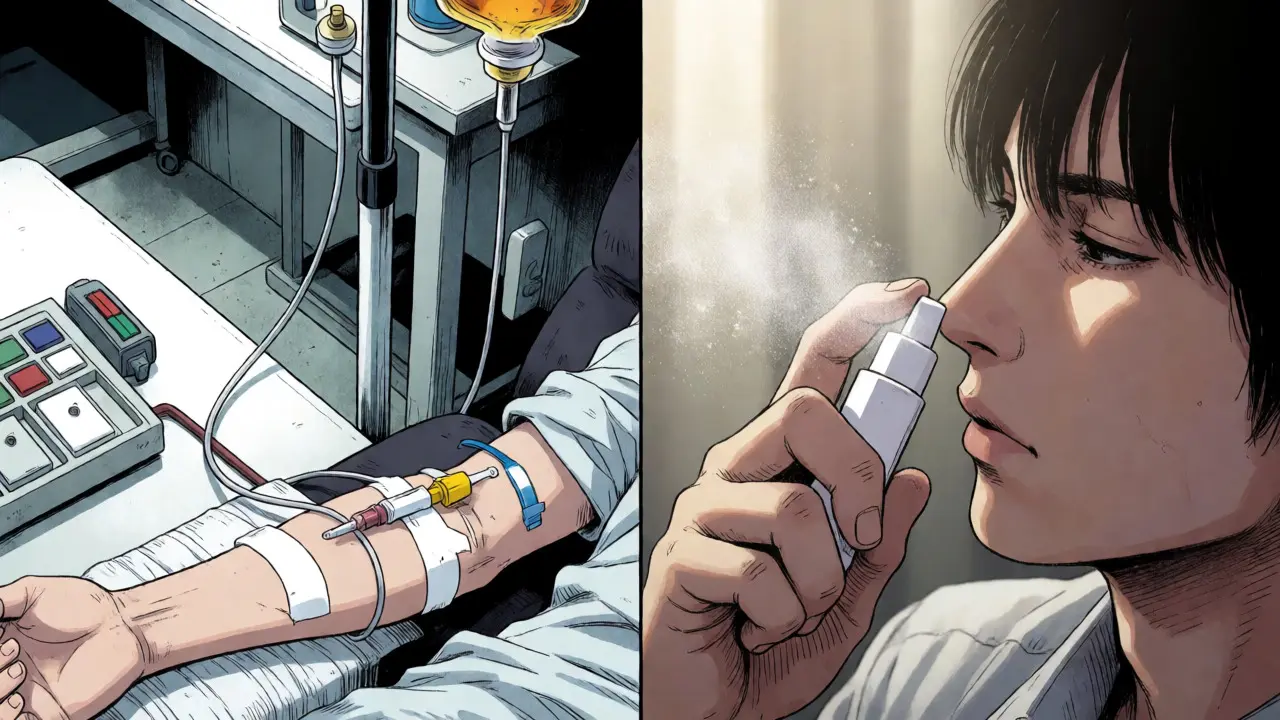
- Intravenous (IV) Ketamine: Goes straight into the bloodstream. The effects hit fast, often within 40 minutes. Because it bypasses the digestive system, the dosing is precise. You feel the dissociative effects strongly, which some patients find unsettling, but others see as a sign the medicine is working.
- Intranasal (IN) Esketamine: Absorbed through the nose lining. It takes longer to reach peak concentration in the blood. The onset is slower, usually requiring two sessions before noticeable improvement. The dissociation is generally milder because you're getting only the S-isomer, which is less potent in causing hallucinations than the full racemic mix.
A recent study from Harvard-affiliated Mass General Brigham compared 153 patients directly. They found that IV ketamine reduced depression scores by nearly 50%, while intranasal esketamine reduced them by about 40%. While both helped, the IV route showed faster and stronger initial results.
Comparing Efficacy and Speed
If you need relief *now*, speed matters. Here is how the two stack up based on clinical data and patient reports:
| Feature | IV Ketamine | Intranasal Esketamine (Spravato) |
|---|---|---|
| Administration | IV infusion over 40 minutes | Nasal spray in clinic |
| FDA Status for Depression | Off-label use | FDA-approved (since 2019) |
| Onset of Action | Rapid (hours to days) | Moderate (days to weeks) |
| Efficacy Score Reduction | ~49% | ~40% |
| Dissociation Rate | Higher (~42%) | Lower (~29%) |
| Typical Course | 6-8 infusions | Induction phase (twice weekly) then maintenance |
Notice the efficacy gap. In real-world settings, IV ketamine tends to outperform esketamine in head-to-head comparisons. However, "better" depends on your definition. If you tolerate dissociation poorly, the milder profile of esketamine might make it the "better" choice for adherence, even if the raw symptom reduction is slightly lower.
Safety, Side Effects, and Monitoring
Neither drug is a casual pill you take at home. Both require strict medical supervision due to potential side effects like elevated blood pressure, dizziness, nausea, and dissociation. You cannot drive yourself home after treatment; you must stay in the clinic for at least two hours post-administration.
Dissociation is the big hurdle for many. With IV ketamine, this feeling of detachment from your body or reality is more pronounced. Some patients describe it as a "trip," though it's usually brief. Esketamine users report less intense dissociation, making it a friendlier option for those anxious about losing control during treatment.
Long-term safety data is still evolving. Most studies focus on short-term outcomes (weeks to months). We know that repeated exposure can lead to bladder issues (cystitis) in rare cases, particularly with high-frequency IV use. Blood pressure spikes are common but manageable. The DEA classifies both substances as Schedule III controlled substances, acknowledging their abuse potential, though dependence risk in therapeutic settings appears low when monitored correctly.
Cost and Insurance Reality
This is often the deciding factor. Because IV ketamine is off-label for depression, insurance companies are hesitant to cover it. Many clinics offer cash-pay rates ranging from $400 to $800 per infusion. A typical course of six to eight infusions could cost you between $2,400 and $6,400 out of pocket.
Spravato (esketamine), being FDA-approved, has much higher insurance acceptance. About 67% of commercial plans cover it, compared to only 38% for IV ketamine. Even with copays, Spravato is often cheaper for insured patients. However, if you lack good insurance, the cumulative cost of twice-weekly visits for induction plus monthly maintenance can add up quickly.
Pro Tip: Before starting, ask your provider for a detailed estimate including the cost of the medication itself versus the administration fee. Some clinics bundle these, while others charge separately. Also, check if your plan requires prior authorization-this process can take weeks, delaying your start date.

Which One Is Right for You?
There is no one-size-fits-all answer. Your psychiatrist will weigh several factors:
- Severity and Urgency: If you are in acute crisis or have severe suicidal ideation, IV ketamine’s rapid onset might save lives. Its superior efficacy makes it a strong candidate for severe TRD.
- Tolerance for Dissociation: If the idea of feeling "out of it" terrifies you, start with esketamine. The milder side effect profile improves compliance.
- Logistics: Can you commit to twice-weekly visits for four weeks for Spravato? Or do you prefer fewer, longer IV sessions? IV requires venous access, which some people dislike. Nasal spray avoids needles but requires proper technique to ensure absorption.
- Insurance Coverage: Check your benefits first. If IV ketamine isn’t covered, can you afford the cash price? If Spravato is covered, is the formulary tier reasonable?
Experts are divided. Dr. John Krystal from Yale suggests IV ketamine for severe, life-threatening cases where speed is critical. Conversely, Dr. Christine Denny from Columbia University notes that esketamine’s convenience and safety profile suit long-term maintenance better. It’s a trade-off between potency and tolerability.
Access and Availability
Geography plays a huge role. Ketamine clinics have exploded in number, growing from 142 in 2020 to over 1,000 in 2025. However, access remains uneven. Only about 12% of US counties have certified Spravato centers, and IV ketamine availability is even sparser in rural areas. If you live outside major metropolitan hubs like Manchester, London, New York, or Chicago, you might need to travel for treatment.
Furthermore, not all psychiatrists prescribe these therapies. Many general practitioners avoid them due to liability concerns or lack of training. Look for providers affiliated with academic medical centers or specialized mood disorder clinics. They are more likely to have the infrastructure for safe monitoring and the expertise to manage complex cases.
Can I take ketamine or esketamine alongside my current antidepressant?
Yes, and you usually must. Esketamine (Spravato) is FDA-approved specifically for use in conjunction with an oral antidepressant. Most protocols for IV ketamine also recommend continuing your baseline antidepressant to maintain stability once the rapid relief wears off. Stopping other meds abruptly can lead to withdrawal or relapse.
How long does the relief last?
It varies. Without maintenance, relief from a single dose may fade within days to weeks. Most patients undergo an induction phase (multiple doses) followed by maintenance therapy (e.g., once every 1-4 weeks). Studies show about 56% of IV ketamine responders maintain remission at six months with regular boosters. Esketamine similarly requires ongoing maintenance to prevent relapse.
Is ketamine addictive?
Ketamine has abuse potential and is a Schedule III controlled substance. However, addiction rates in clinical trials for depression are low when administered in a controlled setting. The risk increases with unsupervised, recreational use. Always follow your doctor’s dosing schedule strictly to minimize dependency risks.
Why is IV ketamine considered "off-label" if it works?
FDA approval is specific to the formulation and indication. Ketamine was approved as an anesthetic. While research supports its use for depression, the manufacturer hasn't pursued a formal label change for depression for the generic IV form. Esketamine (Spravato) underwent a separate rigorous trial process specifically for depression, earning its official indication.
What happens if I miss a scheduled session?
Consistency is key for building neuroplasticity. Missing a session during the induction phase can delay progress. During maintenance, gaps might allow symptoms to return. Contact your provider immediately if you miss an appointment; they may reschedule you sooner to keep momentum going.