

Imagine you are in the hospital after a terrifying reaction to a new prescription. Your skin is peeling, your throat feels tight, or you are experiencing severe internal pain. The doctors stabilize you, discharge you with a warning, and update your medical record. But here is the trap: that warning often says 'Avoid entire class of drugs.'
This blanket ban can leave you vulnerable months or years later when you need treatment for a common infection or chronic condition. You might be told there are no options left because one specific pill caused trouble before. Is this necessary? Sometimes, yes. Often, no.
Understanding when to truly avoid a medication family is a group of drugs that share similar chemical structures or mechanisms of action versus when you can safely take a different drug from that same group is critical for your health. It requires looking past the label and understanding the biology behind the reaction.
Identifying the Type of Reaction
Not all bad reactions are created equal. To decide if you must avoid an entire family of medications, you first need to know what happened to your body. Medical professionals categorize adverse drug reactions (ADRs) into two main types, and the distinction changes everything.
Type A reactions are predictable and dose-dependent. Think of these as side effects that happen because the drug does its job too well or affects systems it wasn't meant to touch. For example, if a non-steroidal anti-inflammatory drug (NSAID) causes stomach bleeding at a high dose, switching to a different NSAID might not solve the problem because they all share that mechanism. However, sometimes switching within the class-like moving from ibuprofen to a COX-2 inhibitor-can mitigate the risk without abandoning the whole family.
Type B reactions are unpredictable and often immune-mediated. These are true allergic responses. If your immune system mistakenly identifies a molecule as a threat, it launches an attack. This is where the concept of avoiding a medication family becomes complex. If you have a mild rash to amoxicillin, you likely do not need to avoid all penicillins. But if you experience anaphylaxis-a life-threatening drop in blood pressure and airway swelling-the stakes change dramatically.
- Mild reactions: Itching, minor rashes, nausea. Usually allow for continued use of the class with monitoring or switching agents.
- Moderate reactions: Widespread hives, significant gastrointestinal distress. Require evaluation but may not mandate total class avoidance.
- Severe reactions: Anaphylaxis, breathing difficulties, organ involvement. Often trigger automatic class-wide bans until proven otherwise.
The Danger Zone: Severe Cutaneous Adverse Reactions
There are specific scenarios where avoiding the entire medication family is not just recommended-it is mandatory. These involve Severe Cutaneous Adverse Reactions (SCARs). SCARs are rare but devastating conditions that affect the skin and internal organs.
The most feared of these are Stevens-Johnson syndrome (SJS) and toxic epidermal necrolysis (TEN). In these conditions, the skin detaches from the underlying tissue, leading to massive fluid loss and infection risk. TEN has a mortality rate of 30% to 50%. Another serious condition is DRESS (Drug Reaction with Eosinophilia and Systemic Symptoms), which involves fever, rash, and inflammation of internal organs like the liver or kidneys.
If you have experienced SJS, TEN, or DRESS, you must permanently avoid the implicated drug class. The European Medicines Agency notes that six drug classes cause 95% of TEN cases: antibacterial sulfonamides, anticonvulsants, allopurinol, NSAIDs, nevirapine, and corticosteroids. Cross-reactivity in these severe immune responses is high. Taking a 'different' drug from the same family could trigger another episode, potentially fatal.
| Reaction Type | Symptoms | Avoid Entire Family? | Action Required |
|---|---|---|---|
| Mild Rash | Localized itching, small spots | No | Switch agent within class or monitor |
| Anaphylaxis | Swelling, difficulty breathing, shock | Yes (usually) | Allergy testing required; carry epinephrine |
| SJS/TEN | Blistering, skin detachment | Yes (Permanent) | Lifetime avoidance; genetic testing possible |
| DRESS | Fever, organ inflammation, rash | Yes (Permanent) | Lifetime avoidance; specialist follow-up |
Cross-Reactivity: The Myth vs. Reality
One of the biggest hurdles patients face is the fear of cross-reactivity. This is the phenomenon where an allergy to one drug triggers a reaction to another drug in the same family due to similar chemical structures. While real, it is often overstated.
Take beta-lactam antibiotics, which include penicillins and cephalosporins. For decades, doctors believed that if you were allergic to penicillin, you had a high risk of reacting to cephalosporins. Recent data shows the actual cross-reactivity rate is between 0.5% and 6.5%, depending on the specific drugs involved. Many patients labeled as 'penicillin allergic' can safely take cephalosporins after proper evaluation.
Similarly, sulfa drugs (sulfonamides) have a reputation for high cross-reactivity, estimated at around 10% among sulfonamide-containing antibiotics. However, not all drugs with 'sulfa' in the name are the same. Diuretics and some diabetes medications contain sulfa groups but rarely cross-react with antibiotic sulfas. Understanding these nuances prevents unnecessary restrictions.
In contrast, aspirin-exacerbated respiratory disease (AERD) shows high cross-reactivity. About 70% of patients with AERD will react to other NSAIDs like ibuprofen or naproxen. Here, avoiding the entire NSAID family is a practical and safe strategy.

The Problem of Mislabeling
A significant portion of medication family avoidance stems from incorrect labels in electronic health records (EHRs). Studies suggest that up to 95% of patients labeled with a penicillin allergy do not actually have a true IgE-mediated allergy. They may have had a viral rash as a child, mistaken for a drug reaction, or experienced mild nausea that was incorrectly coded as an allergy.
This mislabeling has real consequences. When a doctor sees 'Penicillin Allergy' in your chart, they avoid prescribing amoxicillin, even though it is often the first-line, most effective, and cheapest treatment for many infections. Instead, they may prescribe broader-spectrum antibiotics, which contribute to antibiotic resistance and carry higher risks of side effects like C. diff infection.
The Asthma and Allergy Foundation of America found that 42% of patients with drug allergy labels experience treatment delays, averaging 3.2 days for appropriate therapy. This delay isn't just inconvenient; it can worsen outcomes.
Steps to Challenge Your Restrictions
If you believe your medication family avoidance is too broad, you are not stuck. There are established protocols to 'de-label' you from false allergies.
- Review your history: Write down exactly what happened. What symptoms did you have? How soon after taking the drug did they start? Did you require emergency care? Vague memories like 'I got sick' are hard to evaluate. Specific details like 'Hives appeared 30 minutes after dose' are actionable.
- Consult an allergist: General practitioners often lack the time or tools for detailed drug allergy workups. An allergist can perform skin prick tests or intradermal tests to check for IgE-mediated sensitivity.
- Consider a drug challenge: If skin tests are negative or inconclusive, a supervised oral drug challenge may be performed. Under medical supervision, you take small, increasing doses of the suspected drug. Success rates for beta-lactam challenges in low-risk patients are 70-85%.
- Update your records: Once cleared, ensure your primary care provider and pharmacy update your EHR. Remove the old 'allergy' flag and replace it with 'Tested Negative for [Drug] Allergy.'
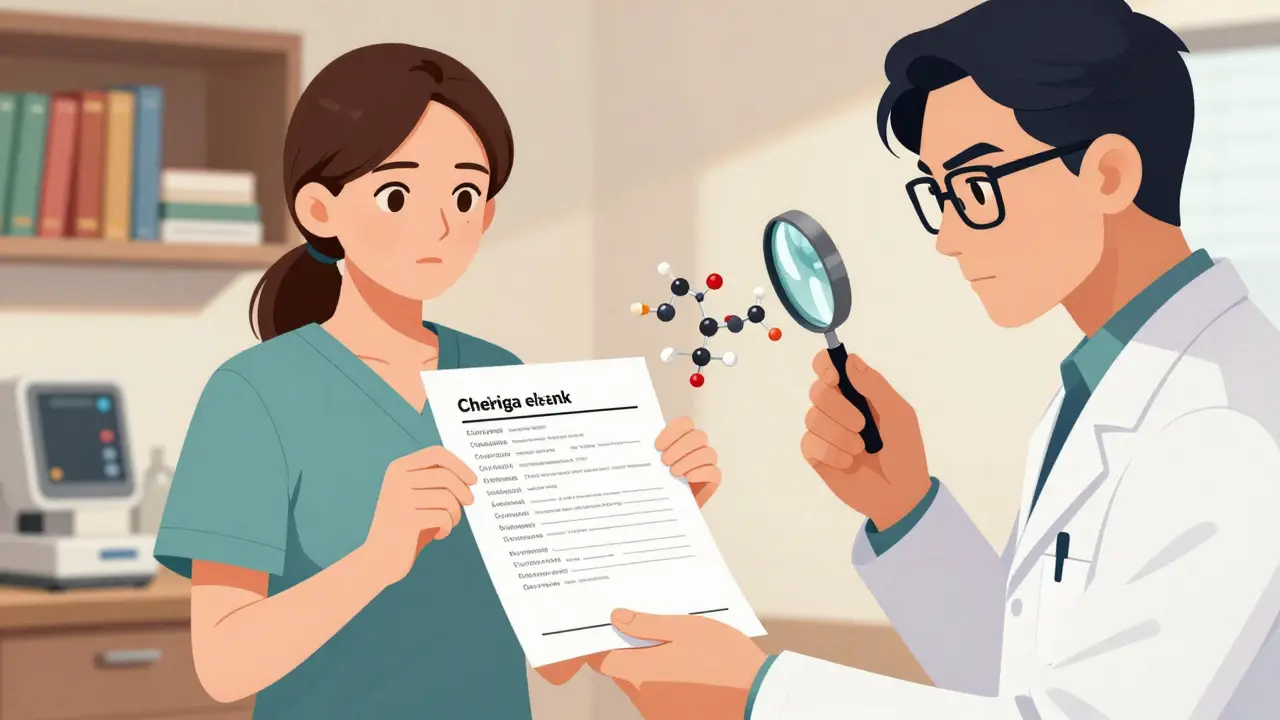
Navigating Future Prescriptions
Until you undergo formal testing, how should you handle new prescriptions? Communication is key. Do not simply say 'I'm allergic to X.' Instead, describe the reaction. Say, 'I had a severe blistering rash with Drug Y,' or 'I experienced anaphylaxis with Drug Z.'
This helps the prescriber assess risk. If you had a mild rash, they might choose a different agent within the same class or add an antihistamine. If you had anaphylaxis, they will avoid the class entirely.
For those with confirmed severe allergies, carrying an epinephrine auto-injector is crucial. The AAAAI recommends this for 90% of anaphylaxis cases. Additionally, wearing a medical alert bracelet ensures that in an emergency, responders know exactly which medication families to avoid.
Technology is also catching up. New diagnostic tools, such as component-resolved diagnostics, improve specificity from 60% to 89% compared to traditional skin testing. Genetic testing, like checking for the HLA-B*57:01 marker before prescribing abacavir, allows 95% of previously avoided patients to safely receive the drug. As these tools become more common, the era of blanket medication family bans is slowly ending, replaced by precision medicine.
Conclusion
Avoiding a medication family after a severe reaction is a safety measure, not a life sentence. By distinguishing between mild side effects and true immune-mediated emergencies, and by challenging outdated labels through professional testing, you can regain access to the full range of therapeutic options available to you. Don't let a vague label limit your health care. Seek clarity, seek testing, and advocate for your precise medical needs.
How long do I need to avoid a medication family after a severe reaction?
For severe cutaneous adverse reactions like Stevens-Johnson syndrome (SJS) or toxic epidermal necrolysis (TEN), avoidance is typically permanent. For IgE-mediated anaphylaxis, avoidance is usually lifelong unless you undergo successful desensitization or allergy testing proves the label was incorrect. For mild reactions, you may never need to avoid the family, only the specific drug.
What is the difference between a side effect and an allergic reaction?
Side effects are predictable pharmacological actions, such as drowsiness from antihistamines or stomach upset from NSAIDs. They do not involve the immune system. Allergic reactions are immune-mediated, involving antibodies like IgE or T-cells, and present with symptoms like hives, swelling, wheezing, or anaphylaxis. Side effects may allow switching within a drug family; allergies often require stricter avoidance.
Can I take a different antibiotic if I am allergic to penicillin?
Often, yes. Many people labeled 'penicillin allergic' can safely take cephalosporins, another class of beta-lactam antibiotics. The cross-reactivity rate is low (0.5-6.5%). However, if your reaction was severe (anaphylaxis or SJS), you should consult an allergist before trying any beta-lactams. Non-beta-lactam alternatives like macrolides (e.g., azithromycin) are also commonly used.
What should I do if I suspect a drug reaction?
Stop taking the medication immediately and contact your healthcare provider. If you experience difficulty breathing, swelling of the face or throat, or widespread hives, call emergency services right away. Keep a record of the drug name, dose, and timeline of symptoms to help your doctor determine the cause and severity.
Is genetic testing available for drug allergies?
Yes, for certain drugs. For example, testing for the HLA-B*57:01 gene variant can predict hypersensitivity to abacavir (used for HIV) with 99% negative predictive value. Similarly, HLA-B*15:02 testing is recommended for carbamazepine in populations at higher risk. These tests help prevent severe reactions before the drug is ever taken.