

Medication errors are not just a statistic; they are a daily reality that keeps pharmacists and nurses up at night. In the United States alone, these mistakes contribute to approximately 250,000 deaths annually. For anyone working in pharmacy practice, the systematic process of preparing, dispensing, and managing medications to ensure patient safety and therapeutic efficacy, this number is unacceptable. The core problem isn't usually malice or incompetence-it’s system failure. That’s why frameworks like the National Patient Safety Goals (NPSGs) exist.
The NPSGs, developed by The Joint Commission, a healthcare accrediting body established in 1951 that sets standards for hospitals and other healthcare organizations, are not just bureaucratic checkboxes. They are a survival kit for patients. Specifically, the goal focused on using medicines safely targets the entire lifecycle of a drug, from the moment it is ordered to when it is monitored in the patient’s body. If you are looking to reduce dispensing errors, mistakes made during the preparation and distribution of medications that can lead to patient harm, understanding these goals is your first step toward building a safer environment.
Why Traditional "Five Rights" Aren't Enough
You’ve likely heard the "Five Rights" of medication administration: right patient, right drug, right dose, right route, and right time. It sounds simple, doesn’t it? But here’s the hard truth: relying solely on individual memory and vigilance is flawed. According to the Institute for Healthcare Improvement (IHI), 83% of medication errors occur even when clinicians believe they have confirmed all five rights. Why? Because humans get tired, distracted, and interrupted.
This is where the shift from individual responsibility to system design becomes critical. The NPSGs force organizations to look beyond the person holding the syringe and examine the processes surrounding them. For example, instead of blaming a nurse for a wrong-dose error, a system-based approach asks: "Was the pump programmed correctly? Was the label clear? Was there a barcode scan required?" This mindset shift is what separates good pharmacy practices from great ones.
| Framework | Focus Area | Enforcement Level | Key Limitation |
|---|---|---|---|
| National Patient Safety Goals (NPSGs) | System-wide protocols & accreditation | Mandatory for accredited facilities | Can create a false sense of security if treated as a checklist |
| ISMP Best Practices | Specific high-risk scenarios (e.g., promethazine, opioids) | Voluntary consensus recommendations | Adoption varies; requires proactive implementation |
| Five Rights of Administration | Individual clinician verification | Cultural standard | Fails under cognitive load or distraction; 83% error rate persists |
Core Patient Safety Goals for Medication Use
The Joint Commission’s NPSG.03 focuses specifically on using medicines safely. Let’s break down what this actually means for your daily workflow in the pharmacy or clinical setting.
- Label Medications Correctly (NPSG.03.04.01): This seems basic, but it’s a major source of errors. Every medication container, solution, and device must be labeled clearly. In perioperative settings, labels must include the drug name, strength, and concentration. Crucially, the font size must be at least 10-point for readability. Unlabeled syringes in operating rooms are still a violation, with 27% of ORs failing this standard despite strict rules.
- Reduce Harm from Anticoagulants (NPSG.03.05.01): Blood thinners are high-alert medications. Standards require standardized practices for monitoring International Normalized Ratio (INR) levels, documenting therapeutic ranges, and educating patients. Facilities aim for 95% compliance on these protocols, measured quarterly.
- Prevent Errors with High-Alert Medications: These are drugs that carry a higher risk of causing significant patient harm when used in error. Examples include insulin, heparin, and concentrated electrolytes. The ISMP identifies specific interventions, such as double-checking doses and using specialized packaging.
In 2025, the NPSGs updated their focus to address emerging risks. One major change involves automated dispensing cabinets (ADCs). Overrides-when a pharmacist or nurse bypasses the system to retrieve a drug-are now strictly monitored. Target override rates should stay below 5%. When overrides exceed this threshold, facilities see 3.7 times more medication errors. This isn’t about slowing down care; it’s about ensuring that every exception has a valid reason and is documented.
The Role of Technology in Preventing Errors
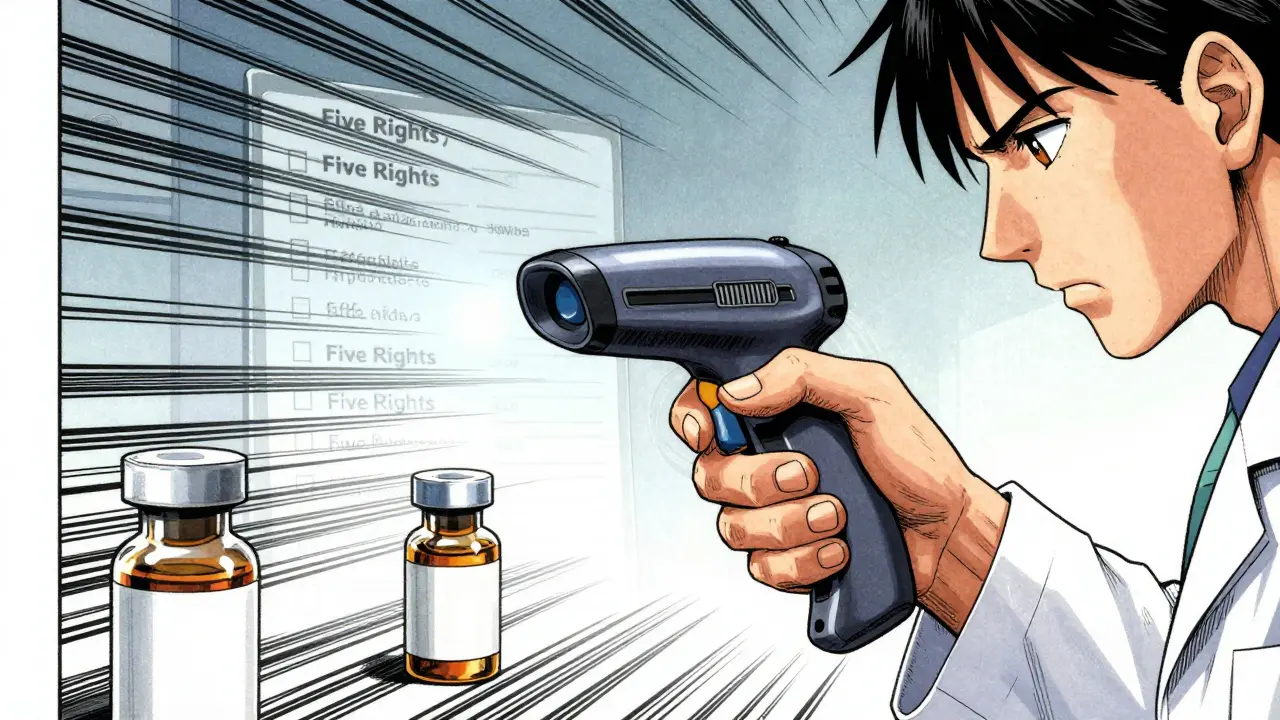
Technology is your best ally in fighting human error, but only if implemented correctly. Barcode-assisted medication administration (BCMA) is a prime example. Studies show that implementing BCMA can reduce wrong-drug errors by 86%. However, it’s not a magic bullet. One hospital director noted that while errors dropped, nurse workflow time increased by 7.2 minutes per dose. This highlights a key trade-off: safety often costs time. To make it work, you need adequate staffing and training.
Electronic Health Records (EHR) integration is another pillar. Clinical decision support systems (CDSS) embedded in EHRs can flag potential allergies, interactions, or dosing errors before a prescription is even filled. In 2025, AI-powered CDSS is becoming more common. Pilot programs at Mayo Clinic showed a 47% reduction in potential adverse drug events using predictive AI tools. This technology doesn’t replace the pharmacist; it augments their ability to catch subtle issues that might slip through manual review.
Automated dispensing cabinets also play a role, but they require careful management. The 34% of pharmacists reporting override rates above 5% often cite emergencies or "stat" medications as the cause. The solution isn’t to ban overrides but to analyze them. Are certain drugs being overridden frequently? Is the par level too low? Proactive risk assessment of these patterns can prevent future errors.
Implementation Challenges and How to Overcome Them
Knowing the goals is one thing; living them is another. Implementation typically takes 12-18 months. Here’s where most organizations stumble:
- Insufficient Training: 38% of facilities report less than 4 hours of annual medication safety training per staff member. This is inadequate. Effective training requires 8-12 hours per clinician, covering root cause analysis, risk assessment, and change management. Consider getting ASP® certification for pharmacy leaders to ensure expertise.
- Culture of Blame vs. Culture of Safety: Staff won’t report near-misses if they fear punishment. You need a leadership-driven culture where errors are seen as learning opportunities. The Model Strategic Plan for Medication Safety emphasizes creating this environment as its first long-term goal.
- Poor Documentation: You must maintain error reports, training records, and quarterly performance metrics. Aim for a minimum 90% documentation completeness rate. Without data, you can’t measure improvement.
A practical tip: Use the ECRI Institute’s self-assessment worksheet to evaluate your current status against ISMP best practices. Facilities scoring above 85% on this assessment achieve 63% fewer medication-related adverse events. It’s a concrete way to benchmark your progress.

Pediatric and Special Populations
Children are not small adults. Their physiology differs significantly, making them more vulnerable to dosing errors. The Pediatric Medication Safety Model addresses this by requiring weight-based dosing protocols and specialized training. In neonatal and intensive care units, medication error rates are three times higher than in adult units. Double-checking high-risk medications is mandatory in these settings.
Success stories prove this works. Children’s Hospital of Philadelphia reduced weight-based dosing errors by 91% by implementing standardized protocols and double-check requirements. If you work with pediatric populations, ignore this at your peril. Standardize your forms, use smart pumps with pediatric libraries, and never rely on mental math for critical doses.
The Future of Medication Safety
We are moving toward a more integrated, predictive model of safety. The World Health Organization’s Global Patient Safety Action Plan 2021-2030 calls for universal adoption of medication safety standards by 2030. Currently, only 63% of high-income countries meet these standards, leaving a huge gap globally.
Artificial intelligence will continue to expand its role. Beyond detecting errors, AI will predict which patients are at highest risk based on historical data. Transition-of-care reconciliation is another frontier. Medication errors spike when patients move between hospital, home, and clinic. The ISMP is expanding its best practices to include 25 specific interventions by 2026, focusing heavily on these transitions.
Finally, patient engagement is no longer optional. Facilities with robust patient involvement programs report 42% fewer medication errors. Teach patients to ask questions, to verify their medications, and to understand their treatment plans. They are the final checkpoint in the safety chain.
What are the National Patient Safety Goals (NPSGs)?
The NPSGs are annual objectives developed by The Joint Commission to address critical areas of patient safety. They cover six primary areas, including identifying patients correctly, improving staff communication, and using medicines safely. Compliance is mandatory for Joint Commission-accredited organizations, which represent 96% of U.S. acute care facilities.
Why are the "Five Rights" of medication administration considered insufficient?
While the Five Rights (right patient, drug, dose, route, time) are a cultural standard, they rely heavily on individual vigilance. The Institute for Healthcare Improvement notes that 83% of medication errors occur even when clinicians confirm all five rights. This highlights the need for system-level interventions like barcode scanning and standardized protocols rather than relying solely on human memory.
How do automated dispensing cabinet (ADC) overrides affect patient safety?
ADC overrides allow staff to bypass system controls to retrieve medications. While necessary in emergencies, high override rates indicate systemic issues. Facilities with override rates exceeding 5% experience 3.7 times more medication errors. The 2025 NPSGs emphasize keeping override rates below 5% through proactive risk assessment and proper inventory management.
What is the recommended timeline for implementing medication safety goals?
The Joint Commission recommends a 12-18 month implementation timeline. This includes 2-4 weeks for initial assessment, 8-12 hours of training per clinician, and 6-12 months for full system integration. Rushing this process often leads to poor adoption and continued errors.
How does technology help reduce dispensing errors?
Technology like Barcode-Assisted Medication Administration (BCMA) reduces wrong-drug errors by 86%. Electronic Health Records (EHR) with Clinical Decision Support Systems (CDSS) flag allergies and interactions. Emerging AI tools can predict adverse drug events, with pilot programs showing a 47% reduction in potential incidents. However, technology requires proper training and staffing to avoid workflow bottlenecks.
What are high-alert medications, and how should they be managed?
High-alert medications are drugs that carry a higher risk of causing significant patient harm when used in error, such as insulin, heparin, and concentrated electrolytes. Management strategies include double-checking doses, using specialized packaging, standardized labeling, and rigorous monitoring protocols. The ISMP provides specific best practices for handling these risky agents.
Why is pediatric medication safety different from adult care?
Children have unique physiological needs, making them more susceptible to dosing errors. Error rates in neonatal and intensive care units are three times higher than in adult units. Safe practice requires weight-based dosing protocols, specialized training for staff, and mandatory double-checks for high-risk medications. Standardized forms and smart pumps with pediatric libraries are essential tools.
What role does patient engagement play in medication safety?
Patient engagement is a critical safety layer. Facilities with robust patient involvement programs report 42% fewer medication errors. Educating patients to verify their medications, understand their treatment plans, and ask questions empowers them to catch errors that professionals might miss. The WHO emphasizes this as part of its global safety action plan.