
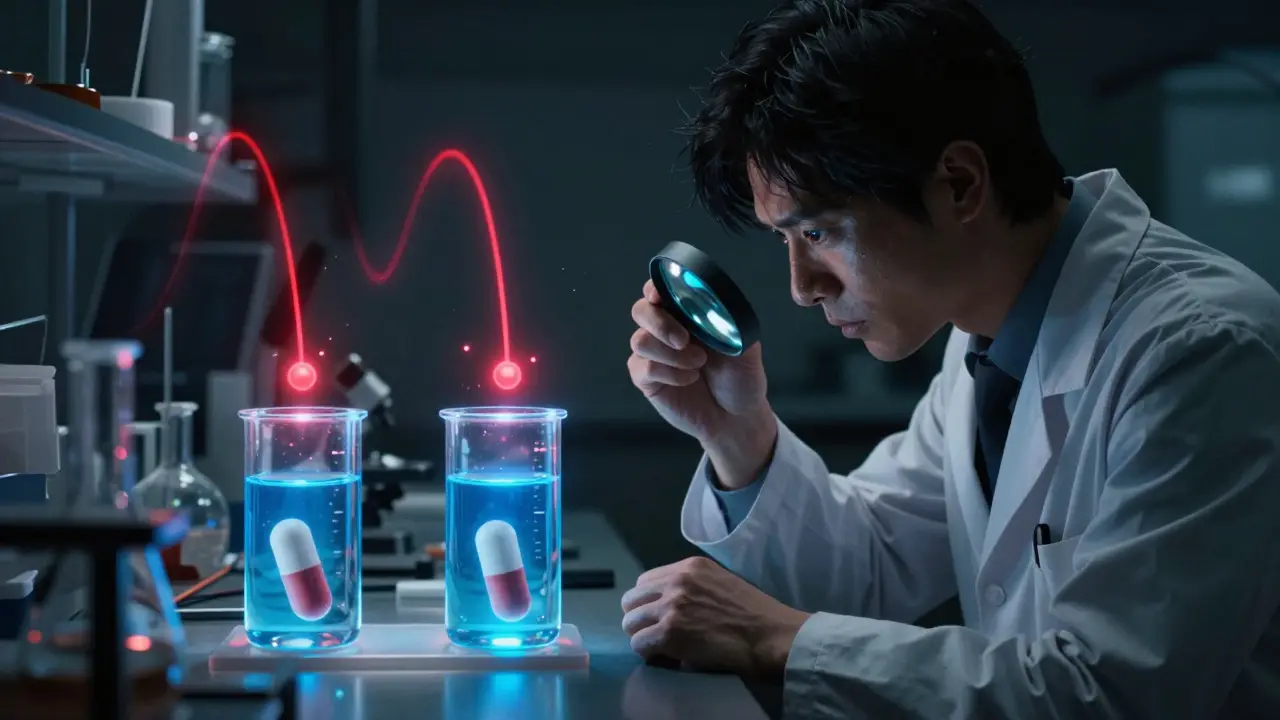
For most people, a generic drug works just like the brand-name version. But how does the FDA know it’s safe and effective without testing it in humans? The answer lies in something called a bioequivalence waiver - a smart, science-backed shortcut that lets drug makers skip expensive and time-consuming human trials under strict conditions.
What Is a Bioequivalence Waiver?
A bioequivalence waiver, or biowaiver, is when the FDA says: "You don’t need to give this drug to volunteers to prove it works the same as the original." Instead, they accept lab tests done in a beaker. Specifically, they look at how quickly and completely the drug dissolves in fluids that mimic the stomach and intestines. This isn’t a loophole. It’s based on decades of research showing that for certain drugs, dissolution in a test tube is a better predictor of how the body will absorb the drug than a human study. The FDA’s official guidance, updated in December 2017, says this is allowed when in vitro (lab) data is the most accurate, sensitive, and reproducible method available - which, for some drugs, it is.Why Does This Even Exist?
Conducting a bioequivalence study in people costs between $250,000 and $500,000 and takes 6 to 12 months. That’s a huge barrier for generic drug companies trying to bring affordable medicines to market. Imagine if every single generic pill required a full human trial. The cost would be passed on to patients - or worse, some drugs might never get approved. The biowaiver system cuts that cost and time dramatically. Between 2012 and 2016, about 15% of generic drug applications included a biowaiver request. Of those, 78% were approved - meaning nearly 1 in 10 generic drugs got to market faster because science allowed it.Which Drugs Qualify?
Not every drug can skip human trials. The FDA only allows biowaivers for immediate-release solid oral dosage forms - think tablets and capsules that dissolve quickly in the stomach. No liquids, no patches, no extended-release pills. The real key is the Biopharmaceutics Classification System (BCS). This system sorts drugs into four classes based on two things: how well they dissolve in water (solubility) and how easily they pass through the gut wall (permeability).- BCS Class I: High solubility, high permeability. These are the easiest to qualify. Examples include metformin, atorvastatin, and propranolol. If a generic version dissolves just like the brand-name drug in pH 1.2, 4.5, and 6.8 solutions, and matches dissolution rates within an f2 similarity factor of 50 or higher, the FDA accepts it.
- BCS Class III: High solubility, low permeability. These are trickier. The FDA may approve a biowaiver here - but only if the generic has the exact same excipients (inactive ingredients) and the drug isn’t absorbed in a specific part of the gut. This is rare and requires extra proof.
How Do Companies Prove It?
To get a biowaiver, a company must show the FDA that their drug dissolves the same way as the original. Here’s what they need to do:- Test at least 12 units of both the generic and brand-name drug.
- Use three different pH buffers: stomach acid (pH 1.2), small intestine (pH 4.5), and intestinal fluid (pH 6.8).
- Take samples at 10, 15, 20, 30, 45, and 60 minutes.
- Compare the dissolution profiles using the f2 similarity factor. If the number is 50 or higher, the curves are considered similar.
Real-World Impact
The savings are massive. One generic drugmaker reported saving $4.2 million over three years by using biowaivers for 12 products. Each approval was sped up by 8 to 10 months. That’s not just money - it’s patients getting access to cheaper meds sooner. In 2022, biowaivers were used in 18% of all generic drug applications, up from 12% in 2018. That’s a 50% increase in just four years. IQVIA estimates this has saved the U.S. healthcare system $1.2 billion annually by getting generics to market faster. Big companies like Teva and Mylan use biowaivers in 25-30% of their pipelines. Smaller firms use them less - often because they lack the expertise to develop the right dissolution methods. It takes a team with at least five years of formulation experience to get it right.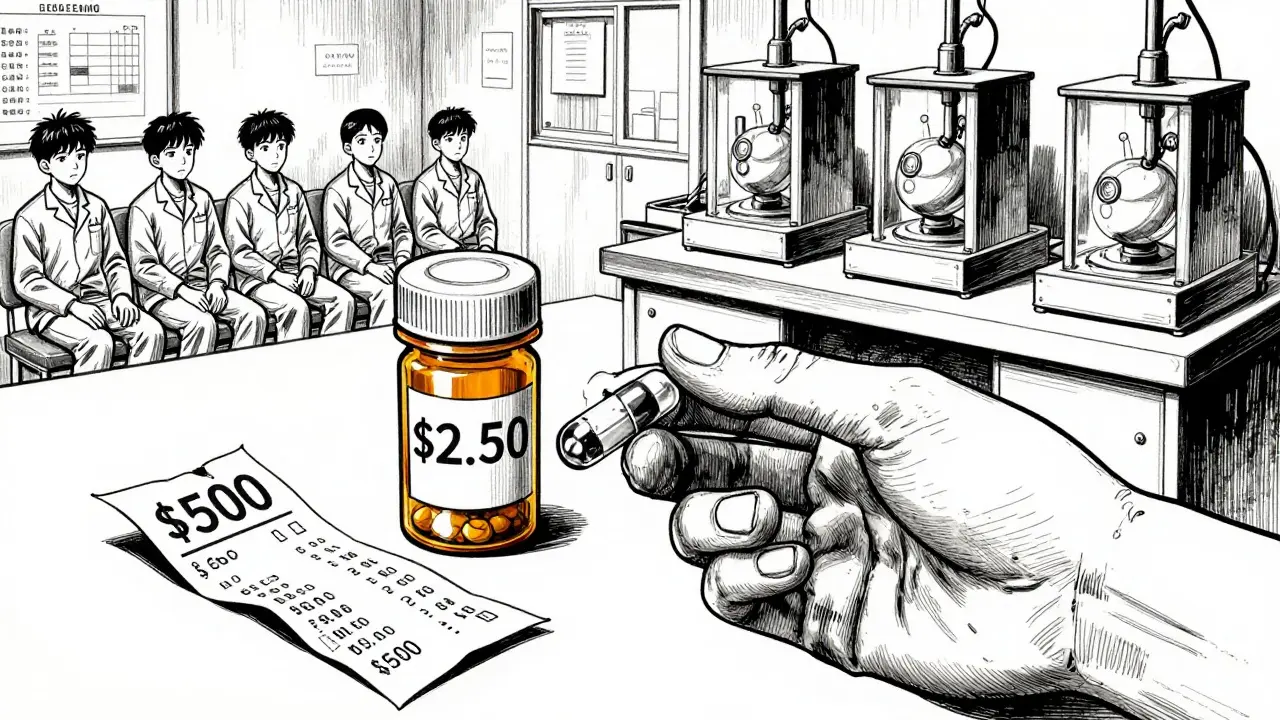
Where the System Falls Short
Despite its success, the biowaiver system has limits. Most experts agree it’s too narrow. Right now, it mostly ignores BCS Class II drugs - those that don’t dissolve well. These include many important drugs like ibuprofen, diazepam, and fenofibrate. Some scientists argue that with better dissolution methods, even these could qualify. A 2019 review pointed out that the current rules might be leaving out drugs that could be proven equivalent through advanced lab testing. The FDA itself acknowledges this. In 2022, they began a pilot program to test biowaivers for certain narrow therapeutic index drugs. And in 2023, they released a draft guidance to expand eligibility for some Class III drugs. The biggest hurdle? Inconsistency. A 2022 survey by PhRMA found that 42% of companies felt FDA review divisions applied the rules differently. One team might approve a waiver; another might demand a human study for the same drug.What’s Next?
The FDA is investing $15 million a year into improving biowaiver science through the GDUFA program. Their 2023-2027 strategic plan aims to expand biowaiver opportunities by 25% by refining the BCS criteria and building better models that predict how a drug behaves in the body based on lab data alone. By 2027, analysts predict biowaivers will be used in 25-30% of all generic drug applications. That means more affordable drugs, faster. But it also means regulators will need to keep up with science - and make sure the system stays fair, consistent, and rooted in real evidence.Final Thought
Bioequivalence waivers aren’t about cutting corners. They’re about using science to avoid unnecessary testing. When a drug dissolves predictably and reliably, human trials don’t add value - they just add cost and delay. The FDA’s system works because it trusts the data - not the process. For patients, that means generics arrive faster and cost less. For the system, it means smarter regulation. And for science, it means letting data lead - not tradition.Can any generic drug get a bioequivalence waiver?
No. Only immediate-release solid oral dosage forms (tablets and capsules) that meet specific criteria under the Biopharmaceutics Classification System (BCS) can qualify. Most commonly, this applies to BCS Class I drugs - those with high solubility and high permeability. Modified-release products, liquids, injections, and drugs with a narrow therapeutic index are generally excluded.
How much money does a bioequivalence waiver save?
A single human bioequivalence study typically costs between $250,000 and $500,000 and takes 6-12 months. Using a biowaiver can cut that cost by 90% or more. One company reported saving $4.2 million over three years by using 12 biowaivers, with each approval accelerated by 8-10 months.
What is the f2 similarity factor?
The f2 factor is a statistical measure used to compare dissolution profiles between two drug products. An f2 value of 50 or higher means the dissolution curves are similar enough to conclude the products behave the same way in the body. It’s a key requirement for FDA approval of a biowaiver.
Why are BCS Class II drugs excluded from biowaivers?
BCS Class II drugs have low solubility - meaning they don’t dissolve well in water. Their absorption in the body depends heavily on how the formulation helps them dissolve. Since lab tests can’t always predict this reliably, the FDA requires in vivo studies for these drugs. However, new research is exploring whether advanced dissolution methods could one day include them.
Is the biowaiver process the same in other countries?
Yes, largely. The U.S. FDA’s guidelines align with international standards set by the International Council for Harmonisation (ICH), particularly ICH M9, which was adopted in the U.S. in January 2021. The European Medicines Agency (EMA) and Health Canada also use similar BCS-based biowaiver frameworks.
Jonathan Noe
February 14, 2026 AT 12:32Let’s be real - this biowaiver system is one of the few times the FDA actually got something right. No human trials for Class I drugs? Of course not. We’ve had dissolution profiles nailed down since the 80s. The real question is why it took so long to scale this. Companies like Teva have been doing this for years. The fact that 78% of requests get approved? That’s not luck - that’s science working as intended.
And don’t get me started on the $4.2M savings. That’s not just corporate greed - that’s $4.2M that didn’t get passed to patients. Generic drugs aren’t ‘inferior’ - they’re identical. We just stopped pretending otherwise.
Also, the f2 factor isn’t some arbitrary number. It’s mathematically validated. If your dissolution curves don’t overlap within ±10% at every time point, you’re not bioequivalent. Period.
Jack Havard
February 15, 2026 AT 20:01This whole thing is a backdoor for big pharma to cut corners. The FDA doesn’t trust the data - they just trust the companies submitting it. And who’s auditing those dissolution tests? Nobody. It’s all self-reported. One lab’s ‘pH 6.8’ is another lab’s ‘I guessed.’
There’s no oversight. No third-party verification. Just a form and a prayer. And now we’re supposed to swallow these pills like they’re magic? Yeah right.
Kristin Jarecki
February 17, 2026 AT 02:32Thank you for this exceptionally clear and well-researched breakdown. As a pharmacologist, I appreciate how thoroughly you’ve outlined the regulatory logic behind bioequivalence waivers. The alignment with ICH M9 is particularly significant - it demonstrates global scientific consensus, not just U.S. regulatory convenience.
The BCS framework, while imperfect, remains the most robust predictive model we have for oral absorption. To dismiss it as a loophole is to misunderstand the foundational pharmacokinetic principles it’s built upon. The data speaks louder than fear.
It’s worth noting that the FDA’s rejection rate of 35% for inadequate dissolution methods is actually a sign of rigor, not failure. They’re filtering out poor science - not blocking access.
Brad Ralph
February 18, 2026 AT 12:31So we’re telling patients to trust a beaker more than a human trial? 🤔
Also, I just took a generic aspirin. I’m fine. But also… I’m still alive. So I guess that’s proof?
christian jon
February 18, 2026 AT 17:39THIS IS A SCAM. A FULL-ON, CORPORATE-LED, FDA-COMPlicit, PATIENT-EXPLOITING SCAM.
You think this is ‘science’? NO. It’s Big Pharma outsourcing safety to a 1980s dissolution machine and calling it ‘innovation.’
What happens when a generic tablet dissolves 1% slower? You don’t know. Because no one tested it on a living human. And now, millions are taking it. Millions.
Warfarin? Levothyroxine? They’re already exceptions - but what about the 50 other drugs that should be? Who’s watching? WHO’S WATCHING?!
And then you have these ‘experts’ nodding along like this is some kind of victory. It’s not. It’s a surrender. To profit. To speed. To convenience. And the patient? They’re just collateral.
Wake up. This isn’t progress - it’s negligence with a PowerPoint.
Suzette Smith
February 19, 2026 AT 03:19I get why Class II drugs are excluded - but honestly? It feels arbitrary. Ibuprofen’s been around since the 70s. We’ve got 50 years of real-world data showing it works fine as a generic. Why does a dissolution curve have to be perfect when the whole world’s been using it safely? Maybe the system just needs to catch up to reality.
Autumn Frankart
February 20, 2026 AT 07:16Did you know the FDA’s dissolution equipment is manufactured by a single company? And that company has ties to three major generic manufacturers? Coincidence? I think not.
They control the machines. They control the standards. They control the approval process. This isn’t science - it’s a closed loop. And you’re all drinking the Kool-Aid because it’s cheaper. That’s not smart. That’s surrender.
Pat Mun
February 20, 2026 AT 10:22Okay, let me just say - I’ve been following this topic for years, and honestly? This is one of the most hopeful things I’ve seen in pharma regulation. We’re talking about people who can’t afford $300 for a month’s supply of atorvastatin - and then we have a system that lets them get it for $4? That’s not just policy - that’s humanity.
I work with low-income patients. I’ve seen them skip doses because they can’t afford the brand. I’ve seen them get sicker. And then, one day, a generic shows up - same pill, same results, 90% cheaper. And it’s not because we cut corners - it’s because we finally trusted the science.
The fact that the FDA is expanding this? That’s not laziness. That’s courage. It takes guts to say, ‘We don’t need to do what we’ve always done - we can do better.’
And yes, there are flaws. The inconsistency in review? The slow adoption for Class II? Totally valid. But instead of screaming ‘fraud,’ let’s push for better methods, better funding, better training. Because this system? It’s saving lives. Every single day.
Let’s fix it - but don’t throw it out. People are counting on it.
andres az
February 21, 2026 AT 11:00The BCS classification is fundamentally flawed due to its reliance on in vitro-in vivo correlation (IVIVC) models that were developed using outdated physiologically based pharmacokinetic (PBPK) parameters. The current dissolution criteria fail to account for regional GI variability - particularly in the distal ileum and colon - where permeability dynamics shift significantly in subpopulations with metabolic polymorphisms (e.g., CYP2D6 poor metabolizers).
Furthermore, the f2 similarity factor lacks statistical power for multimodal dissolution profiles, and its acceptance threshold of 50 is empirically arbitrary. Regulatory reliance on this metric constitutes a Type II error in safety assessment - particularly for drugs with nonlinear absorption kinetics.
Steve DESTIVELLE
February 22, 2026 AT 08:13Science is not a machine. Science is a human thing. You can't reduce life to a dissolution curve. The body is not a beaker. The soul is not a pH buffer. You think you're saving money? You're losing trust.
They took away the trial. They took away the human. Now we have pills. And silence.
Stephon Devereux
February 22, 2026 AT 10:41This is exactly how regulation should evolve - not by clinging to tradition, but by letting data lead. The fact that we can predict drug absorption with lab tests better than we can with small human studies is a win for science, not a loophole.
Class II drugs are the next frontier. We’ve got new dissolution techniques now - microfluidics, predictive AI modeling, real-time in situ monitoring. These aren’t sci-fi - they’re in development right now. The FDA’s 2023 draft guidance? That’s the first step.
The real problem isn’t the waiver system. It’s that we’re still thinking in terms of ‘one size fits all.’ The future is personalized biowaivers - tailored to drug class, patient metabolism, even gut microbiome. We’re not there yet. But we’re moving. And that’s what matters.