

Have you ever looked in the mirror and noticed one eyelid seems lower than the other? Or felt like your lashes are scratching your eye every time you blink? These aren’t just minor annoyances-they could be signs of ptosis or entropion, two common eyelid disorders that affect vision and comfort. Both are more frequent as we age, but they can happen at any stage of life. Left untreated, they can lead to serious eye damage. The good news? Surgery can fix them-and it’s more effective than most people realize.
What Is Ptosis?
Ptosis is when the upper eyelid droops over the eye. It can be mild, just covering a bit of the pupil, or severe enough to block your vision entirely. You might find yourself raising your eyebrows just to see better, or your eyes feel tired even after a full night’s sleep. That’s because your eyelid muscles are struggling to hold the lid up.
The most common cause? Aging. As we get older, the tendon that connects the levator muscle (the one that lifts your eyelid) stretches out. This happens slowly, so many people don’t notice until it’s affecting daily life. But ptosis can also be congenital-present at birth-or caused by nerve damage, trauma, or even long-term contact lens wear, which increases risk by about 30% according to clinical studies.
Doctors measure ptosis using something called the margin reflex distance (MRD). A normal MRD is 4-5 mm. If it drops below 2 mm, it’s considered moderate; below 1 mm, it’s severe. A simple test using phenylephrine eye drops can tell if the muscle still has some strength. If the eyelid lifts after the drop, surgery might involve tightening the existing muscle. If not, a more complex fix is needed.
What Is Entropion?
Entropion is the opposite problem: the eyelid turns inward. It most often affects the lower lid, and in about 97% of cases, that’s where you’ll see it. When this happens, your eyelashes rub against the cornea-the clear front surface of your eye. Imagine sandpaper gently scraping your eyeball every time you blink. That’s what it feels like.
Symptoms include constant irritation, redness, watery or mucus-filled eyes, and a gritty feeling like something’s stuck in your eye. Left unchecked, this constant friction can cause corneal ulcers, scarring, and even permanent vision loss. The leading cause? Age-related changes. Around 80% of entropion cases in Western countries are due to weakening of the eyelid’s supporting structures as we age. Other causes include scarring from burns, infections like trachoma (still common in areas with poor sanitation), or previous eye surgeries.
There are four types of entropion:
- Involutional (age-related)-80% of cases
- Cicatricial (from scarring)-15% of cases
- Acute spastic (temporary, due to inflammation)
- Congenital (rare, 1 in 10,000 births)
Trichiasis-where eyelashes grow inward because of damaged follicles-is often linked to chronic blepharitis and can make entropion worse. Treatment for trichiasis alone might involve removing the lashes with electrolysis or laser, but if the lid itself is turned inward, surgery is the only long-term fix.
How Are These Conditions Diagnosed?
It starts with a simple eye exam. Your doctor will check how high your eyelid sits, how much it moves when you look up, and whether your lashes are touching your eye. They might use a slit-lamp-a special magnifying light-to get a close look at the cornea for scratches or ulcers.
For ptosis, the phenylephrine test is key. A drop is placed in the eye to temporarily stimulate the muscle. If the lid lifts noticeably, the surgeon knows the muscle still has some function. If not, they’ll need to use a different surgical approach.
For entropion, they’ll gently pull the eyelid away from the eye and see how quickly it snaps back. If it stays turned inward, that confirms the diagnosis. They’ll also check for signs of scarring, previous surgery, or infection that might be driving the problem.
Surgical Repair for Ptosis
Surgery for ptosis isn’t cosmetic-it’s functional. If your vision is blocked, insurance usually covers it. There are three main procedures:
- Levator resection: Used when the levator muscle still has decent strength (more than 4 mm of movement). The surgeon shortens the muscle to lift the lid. Success rate: 85-95%.
- Frontalis sling: For severe ptosis where the levator muscle barely works. A sling made of synthetic material or harvested tissue connects the eyelid to the forehead muscle, so you lift your eyelid by raising your eyebrows. This is common in children with congenital ptosis.
- Müller’s muscle-conjunctival resection: For mild ptosis, especially in people who respond well to phenylephrine. It’s a less invasive option that targets the small muscle underneath the eyelid.
A major advancement in recent years is the use of adjustable sutures. Introduced in 2018, this technique lets the surgeon fine-tune the eyelid height the day after surgery. If it’s still too high or too low, they can adjust it in the office-no second surgery needed. This reduces the need for revision surgery by about 25%.
Complications? They’re rare but possible. Overcorrection (lid too high) happens in 5-10% of cases. Undercorrection (lid still droopy) occurs in 3-8%. Dry eye affects 10-20%, and slight asymmetry between the two lids is seen in up to 15% of patients.

Surgical Repair for Entropion
Entropion surgery is highly effective, especially when matched to the type. For involutional entropion-the most common form-the tarsal fracture procedure is the gold standard. It involves rotating the eyelid margin outward and securing it with sutures. Success rates? 90-95%.
For cicatricial entropion (from scarring), the tarsal wedge resection removes a small section of scarred tissue and repositions the lid. This is more complex and often requires grafts.
A newer, less invasive option uses absorbable sutures to evert the lid. Recovery time drops from 4-6 weeks to just 1-2 weeks, with results just as good. The Quickert suture technique is sometimes used as a temporary fix, especially in frail elderly patients, but it only works about 60-70% of the time and isn’t meant to be permanent.
Complications are uncommon. Recurrence happens in 5-15% of cases, especially if the underlying cause (like scarring) isn’t fully addressed. Minor scarring or infection occurs in less than 5% of patients.
Related Conditions: Blepharitis and Dermatochalasis
Ptosis and entropion rarely happen alone. Many people also have blepharitis-inflammation of the eyelid margins. It’s one of the most common eyelid problems, often caused by clogged oil glands (posterior blepharitis) or bacterial buildup. Symptoms include crusty lashes, redness, and burning. It doesn’t cause ptosis or entropion directly, but it makes them worse. Managing it with daily warm compresses and eyelid scrubs is essential before and after surgery.
Another related issue is dermatochalasis: excess skin and fat hanging over the eyelid. It often accompanies ptosis and can block vision just like drooping. Surgery for this is usually combined with ptosis repair, removing the extra skin to restore a clear field of vision.
Who Needs Surgery? When to Act
Not everyone with mild ptosis or entropion needs surgery right away. If your vision isn’t affected and discomfort is manageable, conservative steps help:
- Use lubricating eye drops to reduce irritation
- Apply warm compresses twice daily for blepharitis
- Tape the eyelid up at night (for ptosis) to protect the eye
- Wear protective glasses to shield the eye from debris
But if you notice any of these, see a specialist fast:
- Rapid drooping of the eyelid (could signal a neurological issue)
- Corneal abrasion or ulcer (pain, light sensitivity, blurred vision)
- Redness, pus, or swelling that doesn’t improve
- Loss of vision or double vision
Age is a big factor. Around 5% of adults over 70 have some form of eyelid malposition. The global market for oculoplastic surgery is growing fast-projected to hit $2.7 billion by 2028-because more people are living longer and want to keep their vision clear.
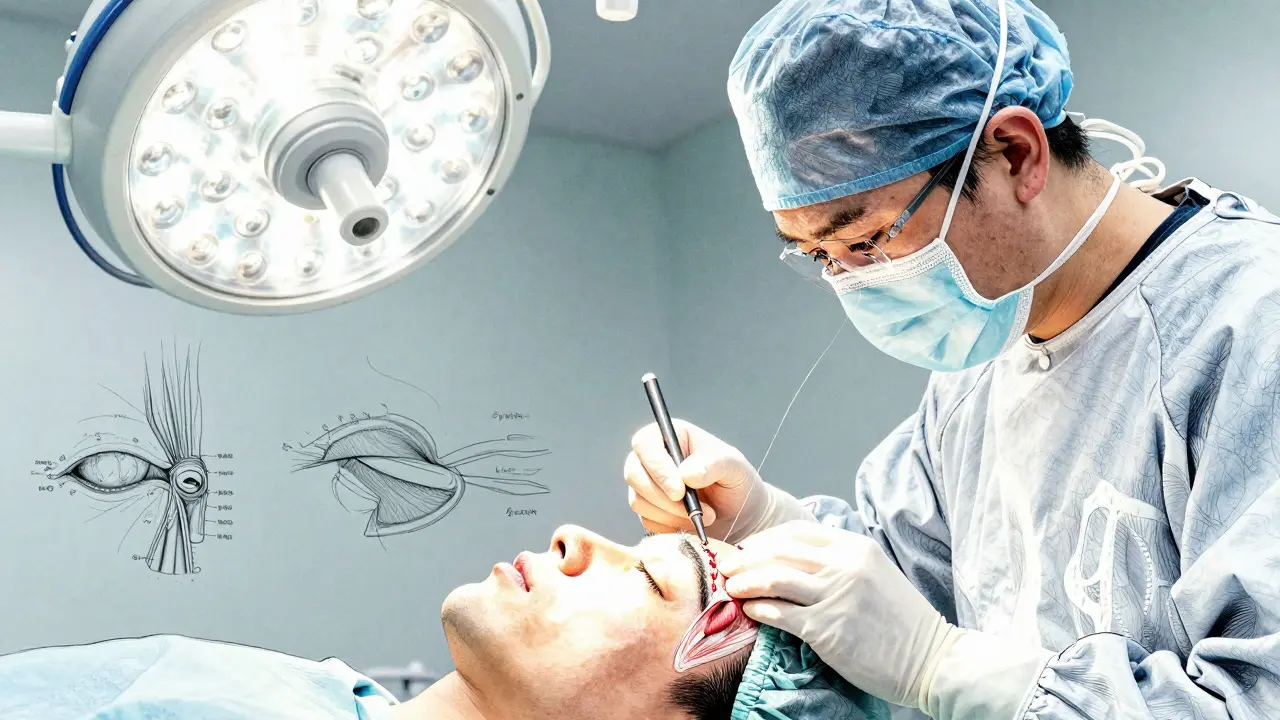
What to Expect After Surgery
Recovery is usually quick. Swelling and bruising peak in the first 48 hours and fade in about a week. Most people return to normal activities within 7-10 days. You’ll need to avoid heavy lifting, bending over, and rubbing your eyes for at least two weeks.
Follow-up visits are critical. Your surgeon will check healing, adjust sutures if needed, and monitor for dry eye or asymmetry. Most patients report dramatic improvements-not just in vision, but in confidence. No more squinting. No more constant eye irritation. Just clear sight and comfort.
Prevention and Long-Term Care
You can’t stop aging, but you can reduce your risk:
- Avoid rubbing your eyes
- Use quality contact lenses and clean them properly
- Treat blepharitis early with daily hygiene
- Protect your eyes from sun and wind with sunglasses
- See an eye specialist if you notice changes in eyelid position
Family history plays a role. If a close relative had ptosis or entropion, you’re at higher risk. Regular eye exams after age 50 can catch problems before they become serious.
Can ptosis or entropion go away on its own?
No. These are structural problems caused by weakened or misaligned tissues. While symptoms might temporarily improve with eye drops or taping, the underlying issue won’t fix itself. Without surgery, entropion can cause permanent corneal damage, and ptosis can lead to chronic eye strain or even lazy eye in children.
Is eyelid surgery covered by insurance?
Yes-if it affects your vision. For ptosis, if the eyelid covers more than 2 mm of the pupil, insurance typically covers the cost. For entropion, surgery is covered because it prevents corneal damage. Cosmetic-only procedures (like removing excess skin without vision loss) usually aren’t covered.
How long does eyelid surgery take?
Most procedures last between 30 and 90 minutes, depending on complexity. They’re done under local anesthesia with light sedation. You’ll go home the same day.
Can you have both ptosis and entropion at the same time?
Yes, especially in older adults. Aging weakens multiple structures in the eyelid. It’s common to have drooping upper lids and inward-turning lower lids together. Surgeons often fix both in one procedure.
What’s the difference between entropion and ectropion?
Entropion is when the eyelid turns inward, causing lashes to scratch the eye. Ectropion is the opposite-the eyelid turns outward, exposing the eye. Both can cause dryness and irritation, but ectropion is more about exposure, while entropion is about friction. Surgery for each is different.
Next Steps: What to Do Now
If you’re noticing changes in your eyelids, don’t wait. Book an appointment with an ophthalmologist or oculoplastic surgeon. Bring a list of symptoms: when they started, how they’ve changed, and whether anything makes them better or worse. Take a photo if you can-it helps the doctor see what you’re describing.
Early diagnosis means simpler treatment. Surgery today is safer, faster, and more precise than ever. With the right care, you can regain clear vision and comfort without long recovery or risky complications.
Timothy Haroutunian
February 21, 2026 AT 20:06Let me tell you, I didn’t realize how much I was compensating for mild ptosis until I had the surgery. For years, I’d raise my eyebrows just to read the dashboard or see the top of the TV screen. It wasn’t just annoying-it was exhausting. My neck got tight, my forehead ached, and I kept thinking I was just getting older. Turns out, my levator tendon had stretched out like an old rubber band. The phenylephrine test was wild-my lid lifted like magic after the drop. Surgery took 45 minutes, local anesthetic, no hospital stay. Now? No more squinting. No more fake forehead yoga. Insurance covered it because my MRD was 0.8 mm. Best decision I ever made.
And yeah, I didn’t need to tape my eyelid at night anymore. That was a whole other level of weird.
Also, don’t ignore dry eye after. I thought I was fine, but my cornea was screaming. Lubricants saved me.
Just sayin’-if you’re even slightly suspicious, get checked. It’s not vanity. It’s functionality.
Erin Pinheiro
February 23, 2026 AT 13:13i had entropion and i didnt even know it for like 3 years. i thought my eyes were just always watery because i cried too much. turns out my lashes were scratching my cornea like a cat with a sandpaper scratcher. i went to the doc and they said ‘you need surgery’ and i was like ‘wait, my eyelid is turned in??’ like i thought it was just dry eyes or allergies. i got the tarsal fracture thing. took 2 weeks to heal. now i dont have to blink so hard. also i still have blepharitis tho. i use the wipes but they dont work great. maybe i should do warm compresses more? idk. just saying. dont ignore it. my eye was red for like 6 months. not cute.
Michael FItzpatrick
February 23, 2026 AT 17:22What fascinates me about these conditions is how elegantly evolution betrayed us. Our eyelids-designed to protect, lubricate, and shield-are the first to unravel with age. The levator tendon stretching? That’s not a defect. That’s a biological inevitability. We’re built for reproduction, not for 80-year-old vision. And yet, modern medicine doesn’t just patch it-it re-engineers it. The adjustable suture technique? Genius. It turns surgery from a one-shot gamble into a precision calibration. We’re not just fixing anatomy anymore; we’re restoring dignity. Imagine waking up and not having to fight your own face to see the sunrise. That’s not cosmetic. That’s human. And honestly? We should treat it like healthcare, not a luxury. The fact that insurance covers it when vision’s compromised? That’s the system working. Not perfectly-but working.
Brandice Valentino
February 24, 2026 AT 09:00Ugh. I hate how everything’s ‘surgery’ now. Like, did you know that in Japan, they use acupuncture for ptosis? And in some rural clinics in Mexico, they use herbal poultices? But no, here we just cut everything open. I mean, really? A 90-minute procedure? For an eyelid? And then you have to avoid bending over for two weeks? Like, is that really better than taping it up? I’m not saying don’t do it-I’m just saying, why not try the gentler route first? Also, I read somewhere that silicone slings can migrate. Like, actually move inside your eyelid. Is that true? I don’t trust these ‘advanced’ techniques. They’re just marketing. I’d rather just wear sunglasses indoors. Less invasive. Less… surgical drama.
Larry Zerpa
February 25, 2026 AT 20:25Let’s be real. The entire narrative here is a corporate-funded illusion. ‘Surgery is effective’? Sure, if you ignore the 15% recurrence rate for entropion and the 20% dry eye complication rate. And let’s not forget: 85% of ptosis cases are age-related, meaning this entire industry is built on the vulnerability of elderly people. Insurance covers it? Only if it’s ‘vision-impairing.’ What’s that threshold? 2 mm? Who decided that? A panel of surgeons who get paid per procedure? The fact that they’re pushing adjustable sutures as a ‘major advancement’ is laughable. It’s just a band-aid on a broken system. And don’t get me started on the ‘dermatochalasis’ upsell. You get ptosis surgery, and suddenly they’re saying, ‘Oh, while you’re in there, let’s remove some extra skin.’ That’s not medicine. That’s aesthetic creep. This isn’t healthcare. It’s a revenue stream disguised as a solution.
Gwen Vincent
February 27, 2026 AT 20:07I just wanted to say thank you for writing this. My mom had both ptosis and entropion last year. She was so scared. We didn’t know what to do. This article made us feel less alone. I didn’t realize how common it was-5% of people over 70? That’s my grandma’s generation. She’s 76. She got the tarsal fracture and levator resection together. Recovery was rough, but she said the first morning she could see her garden clearly? She cried. Not from pain. From joy. I wish more people knew how much this affects daily life-not just vision, but independence. You can’t drive, read, or even watch TV if you’re constantly squinting. This isn’t a ‘cosmetic’ thing. It’s a quality-of-life thing. And honestly? The fact that we can fix it now? That’s kind of beautiful.
Nandini Wagh
March 1, 2026 AT 16:51Wow. All this surgery talk. In India, we just use a little kajal and a prayer. My aunt had entropion for 12 years. She blinked with her fingers. Then one day, she just… stopped. No surgery. No drops. Just stopped rubbing her eyes. Started sleeping with a damp cloth over them. Now? She sees fine. I’m not saying don’t do surgery-I’m saying maybe we’ve forgotten how to heal without cutting. Also, why is everyone so obsessed with ‘correcting’ natural aging? I’m 38. I have one droopy lid. It’s not a defect. It’s a story. But okay. You do you. I’ll be over here, still blinking.
Holley T
March 3, 2026 AT 16:00Actually, the article’s wrong about one thing. It says entropion is ‘most often’ in the lower lid. That’s technically true-but it’s misleading. In older women, the upper lid can invert too, especially after blepharoplasty. I had both. I went to three different ophthalmologists before one admitted it. They all assumed it was just ptosis. I had to show them photos from 2018. The upper lid entropion was causing micro-abrasions that the slit-lamp didn’t catch because it was too subtle. I had to get a tarsal wedge resection AND a modified Muller’s procedure. Took 14 weeks to fully recover. And yes, I had dry eye. And yes, I had asymmetry. But I can see. So it was worth it. Point is: if you have a history of eye surgery, don’t assume it’s just aging. Look deeper. The article doesn’t mention this. It should.
Ashley Johnson
March 3, 2026 AT 16:41They didn’t tell you the truth. This isn’t about vision. It’s about control. The eye surgeons? They partner with contact lens companies. The more people wear contacts, the more ptosis they get. The more ptosis, the more surgeries. The more surgeries, the more money. That 30% increase from long-term contact lens wear? That’s not a coincidence. That’s a business model. And the ‘phenylephrine test’? It’s just a trick to make you think your muscle is ‘weak’ so they can justify the cut. I did my own research. There are studies showing that blinking exercises and eye yoga can reverse early ptosis. But no one talks about that. Why? Because it doesn’t make money. They want you scared. They want you in the chair. Don’t be fooled. Your eyelid isn’t broken. The system is.