

Medication and Fiber Timing Calculator
Enter Your Medication
Enter your medication name to check timing with fiber supplements
How Fiber Affects Medications
Fiber supplements like psyllium can reduce medication absorption by up to 50%. To ensure your medication works effectively, take fiber at least 1 hour before or 2-4 hours after taking your medication.
Critical Medication Reference
Most Affected Medications
| Medication Type | Interaction Risk | Recommended Timing |
|---|---|---|
| Levothyroxine | Critical | 1 hour before or 2-4 hours after |
| Warfarin | Critical | 1 hour before or 2-4 hours after |
| Metformin | Moderate | 1 hour before or 2-4 hours after |
| Antibiotics (Tetracycline, Doxycycline) | Critical | 1 hour before or 2-4 hours after |
| Blood Pressure Medications | Moderate | 1 hour before or 2-4 hours after |
Important Note: If you're taking multiple medications, consider separating your fiber supplement from your entire medication regimen.
If you take fiber supplements like psyllium husk (Metamucil), methylcellulose, or inulin, and you also take daily medications, you might be at risk of reducing how well your drugs work. It’s not a myth. It’s science. And it’s happening to more people than you think.
Every year, millions of people start taking fiber supplements to help with constipation, lower cholesterol, or manage blood sugar. But few realize that fiber doesn’t just sit in your gut-it forms a thick gel that can trap medications and keep them from being absorbed. This isn’t a small issue. For some drugs, the drop in absorption can be as high as 50%. That means your blood thinner might not be thinning your blood. Your thyroid pill might not be working at all. And your blood pressure meds? They could be doing next to nothing.
How Fiber Interferes With Medications
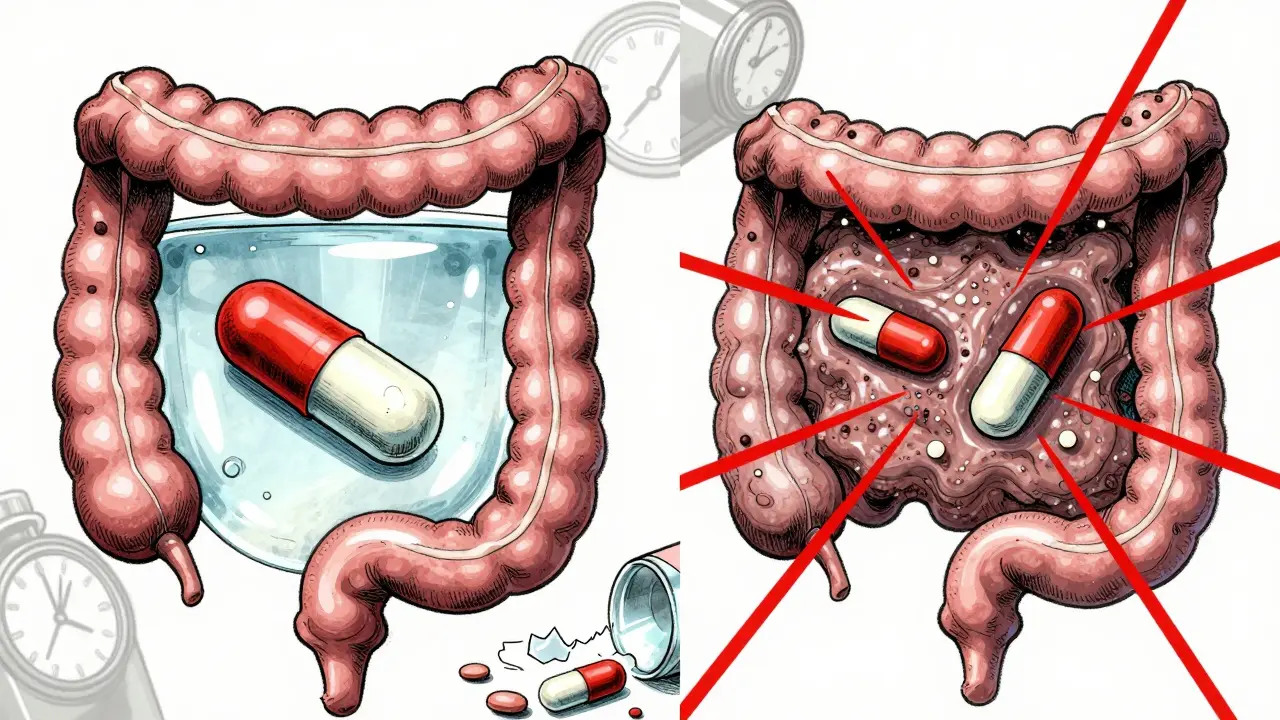
Fiber supplements, especially soluble ones like psyllium, don’t just pass through your system. When they hit water in your stomach and intestines, they swell up and turn into a sticky, gel-like substance. This gel isn’t just for bulk-it acts like a barrier. And if a pill is in that gel when it forms, the medication can’t get out.
Research from the Journal of Clinical Lipidology shows this effect can cut absorption of certain drugs by 30-50%. That’s not a guess. That’s a measured drop in blood levels. The same thing happens with levothyroxine, the thyroid hormone replacement millions rely on. A 2020 study found that when taken together, psyllium reduced levothyroxine absorption by 28.7%. Patients had to increase their dose just to get their TSH levels back in range.
It’s not just thyroid meds. Antibiotics like tetracycline, diabetes drugs like metformin, blood pressure medications, and even warfarin (a blood thinner) all show reduced effectiveness when taken with fiber. The American Pharmacists Association says this isn’t a rare edge case-it’s a common clinical problem.
Which Medications Are Most at Risk?
Not all drugs are equally affected. But some are far more vulnerable. Here’s the list you need to know:
- Levothyroxine - Used for hypothyroidism. Fiber cuts absorption by nearly 30%.
- Warfarin - A blood thinner. Fiber can make it less effective, raising clot risk.
- Metformin - For type 2 diabetes. Fiber delays absorption, which may lower blood sugar too much or too slowly.
- Tetracycline and Doxycycline - Antibiotics. Fiber binds to them like glue, stopping them from working.
- Blood pressure meds - Especially beta-blockers and calcium channel blockers. Studies show reduced peak levels when taken with fiber.
- Some antidepressants and seizure meds - Less studied, but case reports show drops in blood levels.
If you take any of these, you’re not just being cautious-you’re protecting your health.
The Right Timing: How Far Apart Should You Take Them?
Timing isn’t just about convenience. It’s about safety. And the rules are simple:
- Take fiber at least 1 hour before your medication.
- Or wait 2 to 4 hours after taking your medication.
That’s the gold standard from the Mayo Clinic, the FDA, and the American Gastroenterological Association. Why this range? Because the gel takes time to form-and time to clear. If you take fiber and a pill at the same time, the gel traps the drug right away. If you wait 4 hours, the gel has mostly passed through your small intestine, where most drugs are absorbed.
Here’s a real example: A patient on levothyroxine was struggling to get her TSH levels down. She was taking Metamucil right after her morning pill. Her doctor asked her to move fiber to 3 hours after her thyroid med. Within six weeks, her levels normalized. No dose change. Just timing.
What About Taking Fiber at Night?
You’ve probably heard: “Take fiber before bed.” It sounds easy. But it’s risky.
Research from Hilma (2023) found that 68% of people who took fiber within two hours of bedtime reported bloating, gas, or abdominal pain that disrupted sleep. The FreeRx Blog analyzed patient reports and confirmed that Metamucil taken at night caused symptoms in 30-90 minutes-right when you’re trying to fall asleep.
And if you take your meds at night? You’re doubling the risk. If your blood pressure pill or thyroid med is taken at bedtime, and you take fiber right after, you’re undoing the whole purpose.
Instead, if you want to take fiber before bed, make sure your last medication was taken at least 4 hours earlier. If you take meds in the morning, then fiber at night might be safe-but only if you’re not eating late or lying down soon after.
Special Cases: What If You’ve Had Surgery or Have IBS?
Not everyone’s gut works the same. And timing rules change.
After bariatric surgery: Your stomach is smaller. Your gut moves faster. Fiber can cause blockages if not introduced slowly. Experts recommend starting with 1-2 grams per day and waiting at least 1 hour before or 2-4 hours after every medication. No shortcuts.
If you have IBS: Fiber can make things worse. A 2022 study from Bon Secours found that 42% of IBS patients had flare-ups when taking fiber on an empty stomach. For them, fiber should be taken with meals-not before or after. And even then, soluble fiber like psyllium may still cause issues. Inulin and chicory root are often worse. Stick to low-FODMAP fibers like oat bran, and always test one at a time.
On statins: Here’s the exception. Research in PMC (2015) found that combining psyllium with a low dose of simvastatin actually lowered LDL cholesterol more than the statin alone. The fiber didn’t block absorption-it helped. But this only works with specific doses and timing: 15 grams of psyllium divided into two doses taken before meals. Don’t try this without talking to your doctor.

How to Make It Work in Real Life
Knowing the rules is one thing. Following them daily is another.
Here’s how to make it stick:
- Write it down. Make a simple chart: Medication | Time | Fiber Timing. Tape it to your bathroom mirror.
- Use phone alarms. Set two reminders: One for your med, one for your fiber. Label them clearly.
- Drink water. Always take fiber with at least 8 ounces of water. It helps the gel form properly and prevents blockages.
- Start low. Don’t jump to 10 grams a day. Begin with 1-2 grams and increase over 2-4 weeks. Your gut needs time to adjust.
- Check labels. Some fiber supplements list drug interactions right on the bottle. If it doesn’t, assume it does.
And if you’re unsure? Ask your pharmacist. A 2022 survey found that only 38.7% of patients got clear timing advice when buying fiber supplements. That’s not good enough. You have the right to know.
What’s Next? New Fiber Formulations
Science is catching up. Drug Development & Delivery reported in March 2023 that time-release fiber capsules are now in Phase 2 trials. These are designed to release fiber slowly, so the gel forms gradually and doesn’t interfere with meds. If they work, they could change everything.
But until then? The old rules still apply. Timing matters. Separation saves. And skipping this step? It’s not just inconvenient-it’s dangerous.
Can I take fiber and vitamins at the same time?
It depends. Fat-soluble vitamins (A, D, E, K) are absorbed in the small intestine, just like many medications. Fiber can interfere. To be safe, take vitamins at least 2 hours before or after your fiber supplement. Water-soluble vitamins like B and C are less affected, but it’s still better to separate them.
Does it matter if I take fiber with food?
Yes. Taking fiber with food slows down digestion, which can delay how fast your medications are absorbed. If you’re on time-sensitive meds like levothyroxine or antibiotics, it’s best to take fiber on an empty stomach-either 1 hour before or 2-4 hours after meals. But if you have IBS or digestive sensitivity, taking it with a small meal may reduce side effects. Talk to your doctor to find the right balance.
I take fiber in the morning and my meds at night. Is that okay?
That’s actually ideal. If you take your fiber supplement in the morning and your medications at night (or vice versa), you’re likely giving enough time between doses for the fiber to pass through your system. A 12-hour gap is more than enough. Just make sure you’re not eating a large, high-fiber meal right before your night meds.
What if I forget and take them together?
One mistake won’t ruin your treatment-but it can lower your drug’s effectiveness. If you accidentally take fiber and a med together, don’t panic. Don’t double up on your next dose. Just wait until the next scheduled time and return to your separation routine. If you’re on a critical med like warfarin or levothyroxine, contact your doctor. They may want to check your levels sooner than usual.
Are all fiber supplements the same?
No. Psyllium husk (Metamucil) forms the thickest gel and has the strongest interaction risk. Methylcellulose (Citrucel) forms a looser gel and is less likely to interfere. Inulin and chicory root are soluble but don’t form a strong gel-they’re safer for most people. If you’re on multiple meds, switch to methylcellulose. It’s the safest bet.
Holley T
February 24, 2026 AT 11:41Look, I get that fiber messes with meds, but let’s be real-most people aren’t taking 15 grams of psyllium daily. I’ve been on levothyroxine for 12 years and take Metamucil every morning with my coffee. My TSH? Perfect. My doctor says if your levels are stable, don’t stress. The science is real, sure, but it’s not a universal rule. People panic over studies without looking at their own labs.
Also, ‘50% reduction’? That’s from controlled trials with single doses. Real life? You’re eating oatmeal, drinking water, moving around. Your gut isn’t a lab beaker. Stop scaring folks into never taking fiber again. I’ve had zero issues. And I’m 58.
Maybe the real problem is that doctors don’t talk about this until someone’s TSH is off the charts. Then they blame the fiber. Not the dosing. Not the timing. Just ‘oh, you took fiber.’ Lazy medicine.
Ashley Johnson
February 25, 2026 AT 04:50THEY’RE HIDING THE TRUTH. FIBER ISN’T THE PROBLEM-BIG PHARMA IS. THEY WANT YOU TO TAKE TWO SUPPLEMENTS SO THEY CAN SELL YOU MORE DRUGS. PSYLLIUM IS A NATURAL THING. THEY MADE IT INTO A PRODUCT SO THEY COULD PATENT IT. YOUR THYROID MED? IT’S DESIGNED TO BE ABSORBED SLOWLY. BUT THEY TOLD YOU TO TAKE IT ON AN EMPTY STOMACH SO YOU’D HAVE TO BUY MORE MEDS LATER WHEN IT ‘STOPPED WORKING.’
I SAW A VIDEO ON YOUTUBE WHERE A DOCTOR SAID FIBER ACTUALLY HELPS ABSORPTION BECAUSE IT ‘STIMULATES THE INTESTINES.’ BUT THEY BANNED IT. WHY? BECAUSE IF YOU JUST ATE OATS AND WATER, YOU WOULDN’T NEED 12 MEDS.
ALSO-METAMUCIL IS FULL OF SUGAR. CHECK THE LABEL. IT’S NOT JUST FIBER. IT’S SUGAR + CHEMICALS. THEY WANT YOU ADDICTED. I QUIT. NOW I JUST EAT FLAXSEEDS. NO PROBLEMS.
tia novialiswati
February 25, 2026 AT 19:04YAYYYYYYYY! 🎉 So happy to see this info finally out there!! I’ve been taking Metamucil for years and was so confused why my blood pressure meds felt less effective 😅
My pharmacist actually sat me down and walked me through the timing-1 hour before fiber, 4 hours after meds-and I can’t believe how much better I feel now. No more dizziness in the afternoon! 🙌
Also, switching to methylcellulose was a GAME CHANGER. So much gentler on my tummy. I even set phone alarms labeled ‘MEDS’ and ‘FIBER’-it’s silly but it works!!
You’re doing such a good job spreading awareness. Keep it up!! 💪❤️
Lillian Knezek
February 26, 2026 AT 21:46Did you know fiber supplements are used by the government to control your hormones? 😈
They don’t want you to absorb your meds properly so you stay dependent. That’s why they tell you to wait 4 hours-it’s a trap. The real solution? Take fiber and meds at the same time. Your body will adapt. They’ve been lying about this since the 90s.
Also, I heard from a guy on a forum who used to work for the FDA-he said psyllium was designed to interfere with thyroid meds so people would need higher doses. More pills = more profits.
I stopped taking my thyroid med. Now I drink lemon water and eat seaweed. My energy is better. I don’t need pills. 🌿
Maranda Najar
February 27, 2026 AT 08:07Oh. My. GOD. This article nearly made me weep. Not because I’m emotional-no, no, I’m a rational woman-but because I realized I’ve been a victim of systemic medical negligence. For three years, I took psyllium husk right after my levothyroxine. THREE YEARS. My TSH was a rollercoaster. My hair fell out. I cried in the shower every morning. And no one-NO ONE-told me?
I thought I was broken. I thought I was weak. I thought I wasn’t ‘doing it right.’
And then-BAM. A pharmacist, bless her soul, said, ‘Honey, you’re not failing. You’re being poisoned by a supplement marketed as ‘natural.’’
I’m now on methylcellulose, taken at 9 PM. My meds are at 7 AM. My thyroid is stable. My hair is growing back. I feel like a person again.
Thank you for writing this. I didn’t know I needed to hear it until I did. And now? I’m telling everyone. Every. Single. Person.
Christopher Brown
February 28, 2026 AT 18:02Stop overcomplicating it. Take meds on empty stomach. Take fiber with food. Done. You don’t need a 2000-word essay. Your gut doesn’t care about your schedule. It cares about empty or full. Simple. If you can’t manage that, maybe you shouldn’t be managing your own meds.
Also, ‘fiber reduces absorption by 50%’? Source? I’ve seen that stat cited 17 times. Never seen the original paper. Probably from a 2003 study with 12 people. Stop hyping junk science.
Sanjaykumar Rabari
March 2, 2026 AT 11:55This is all fake. Fiber is from plants. Plants are good. Medicines are from chemicals. Chemicals are bad. Why would fiber block medicine? It should help. Maybe the doctors are lying. In India, we take turmeric with medicine and it works better. Why? Because nature knows best. I take fiber at night with my blood pressure pill. No problem. My BP is normal. You are scared by science that does not exist.
Kenzie Goode
March 2, 2026 AT 21:37I’ve been reading this whole thing and I’m torn. On one hand, the science is solid-especially the levothyroxine data. On the other, I’ve known people who took fiber and meds together for years and were fine. It’s not black and white.
Maybe the real takeaway isn’t ‘never combine them’ but ‘know your body.’ Some people’s GI tracts move faster. Others have slower motility. A one-size-fits-all rule doesn’t work.
I think the article does a great job listing the risks, but it should’ve ended with: ‘Talk to your pharmacist. Get a blood test. Monitor your levels.’ That’s the real health advice.
Also-methylcellulose is underrated. It’s the quiet hero of fiber supplements.
Khaya Street
March 3, 2026 AT 06:27Let’s be honest-this whole post reads like a marketing pamphlet for Citrucel. You list every possible interaction, then quietly slip in ‘methylcellulose is safer’ like it’s a revelation. But it’s literally on the bottle. Why not just say ‘buy this product’ instead of pretending you’re a medical authority?
Also, 68% of people get bloated at night? Who surveyed them? Did you ask them if they ate pizza before bed? Or drank soda? Or slept on their right side?
I take fiber and meds together. I’ve been fine. My doctor hasn’t said a word. Maybe the problem isn’t fiber-it’s anxiety about taking supplements.
Anyway, I’m switching to oat bran. It’s cheaper. And it doesn’t come with a 12-step warning label.