
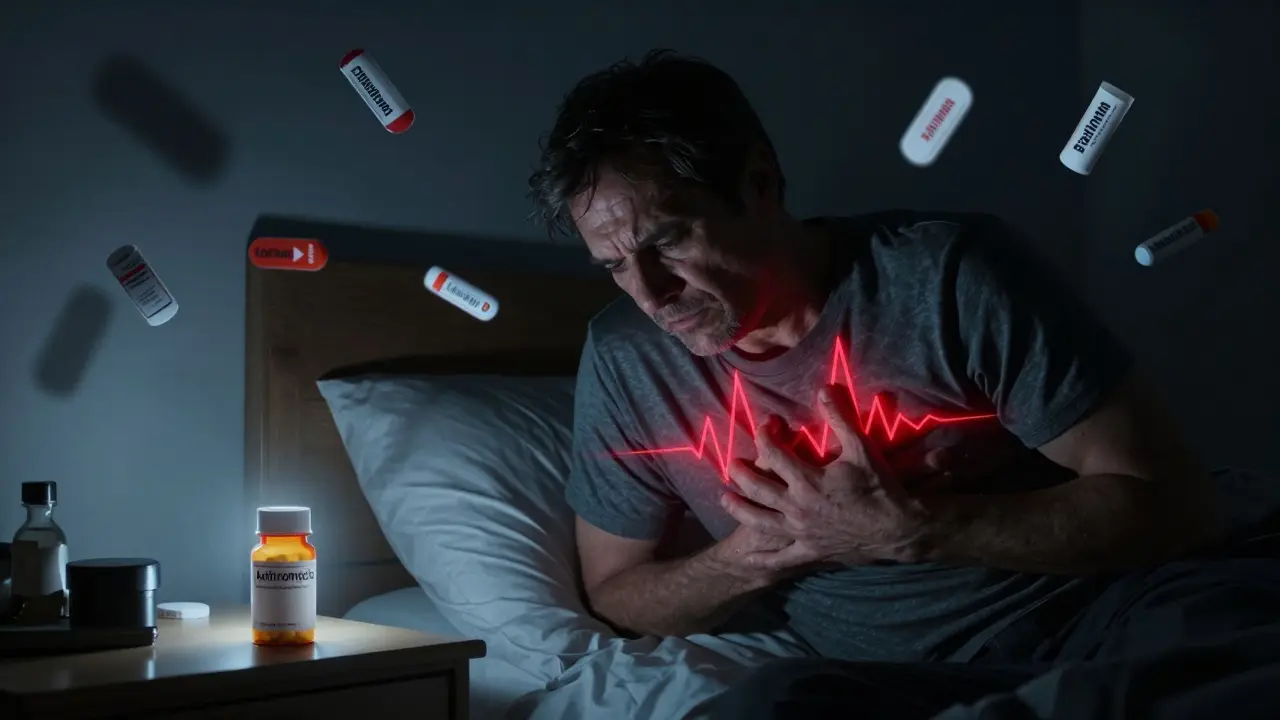
It’s not just old-fashioned heart medicines that can mess with your rhythm. Today, even common prescriptions - from antibiotics to antidepressants - can trigger dangerous heart arrhythmias. You might not realize it until you feel your heart skip, race, or suddenly slow down. And in some cases, it’s life-threatening. The truth is, medication-induced arrhythmia is more common than most people think, and it’s often preventable if you know what to watch for.
What Exactly Is a Drug-Induced Arrhythmia?
An arrhythmia is when your heart beats too fast, too slow, or irregularly. When it’s caused by a medication, it’s called a drug-induced arrhythmia. This isn’t rare. Over 400 medications - including ones you take daily - can interfere with your heart’s electrical system. The most dangerous type is QT prolongation, where the heart takes longer than normal to recharge between beats. This can spiral into torsades de pointes, a chaotic rhythm that can cause sudden cardiac arrest. It’s not just about heart drugs. Even something as simple as an antihistamine for allergies, an antibiotic for a sinus infection, or an antidepressant for anxiety can be the trigger. The problem? Many people don’t connect their symptoms to their meds. They think the fluttering in their chest is just stress - until it’s not.Which Medications Are Most Likely to Cause Problems?
Some drugs are well-known culprits, but others fly under the radar. Here’s what to watch for:- Antibiotics: Macrolides like azithromycin and fluoroquinolones like levofloxacin can prolong QT. Risk spikes in the first week of use.
- Antidepressants and antipsychotics: Citalopram, escitalopram, quetiapine, and risperidone carry black box warnings from the FDA for arrhythmia risk.
- Anti-nausea drugs: Ondansetron (Zofran) and metoclopramide are common in hospitals and clinics - and both can trigger dangerous rhythms.
- Diabetes meds: Some sulfonylureas and newer GLP-1 agonists have been linked to increased atrial fibrillation risk.
- Cholesterol drugs: Statins rarely cause arrhythmias directly, but they can lower magnesium levels, which increases risk.
- Even heart rhythm drugs: Ironically, drugs like amiodarone and flecainide can cause the very arrhythmias they’re meant to treat.
Warning Signs You Can’t Ignore
If you’re on any of these meds, pay attention to these symptoms:- Palpitations: Feeling like your heart is fluttering, pounding, or skipping beats - reported by 70-80% of people with drug-induced arrhythmias.
- Dizziness or lightheadedness: Especially if it happens suddenly when standing up.
- Fatigue: Not just being tired - feeling drained even after a full night’s sleep.
- Chest discomfort: Not always sharp pain. Sometimes just pressure, tightness, or a strange ache.
- Fainting or near-fainting: This is a red flag. If you’ve passed out or felt like you were about to, get checked immediately.

Who’s at Highest Risk?
Not everyone who takes these meds will have problems. But certain factors make it much more likely:- Age 65 or older: Over 60% of severe cases happen in seniors. Kidneys and liver don’t clear drugs as well, so levels build up.
- Low potassium or magnesium: These minerals keep your heart’s electrical system stable. Diuretics (water pills), vomiting, or poor diet can drain them. Target levels: potassium above 4.0 mEq/L, magnesium above 2.0 mg/dL.
- Heavy alcohol use: More than three drinks a day increases risk by 200-300%.
- Genetic factors: About 15% of people of African ancestry and 12% of East Asians carry gene variants that make them extra sensitive to QT-prolonging drugs. This isn’t routinely tested - but if you’ve had a family member with sudden cardiac arrest or unexplained fainting, it’s worth mentioning.
- Multiple meds: Taking three or more drugs that affect heart rhythm? Your risk jumps dramatically.
How Doctors Diagnose and Monitor
If you’re starting a high-risk medication, your doctor should do a baseline ECG. That’s a simple, painless test that records your heart’s electrical activity. After starting the drug, a repeat ECG within 72 hours is standard - especially for QT-prolonging drugs. Blood tests for potassium and magnesium are also key. Many people don’t realize their levels are low until they’re in the hospital. If you’re on diuretics or have kidney issues, ask for these tests every few months. Some hospitals now use tools that flag risky drug combinations before they’re even prescribed. In 2024, the American College of Cardiology rolled out a new clinical decision support system that looks at your age, meds, electrolytes, and even genetic risk - giving a personalized arrhythmia score before a prescription is filled.
What Happens If You Develop an Arrhythmia?
The good news? Most cases can be reversed if caught early. Here’s how doctors handle it:- Stop or switch the drug: In 75-85% of cases, simply changing or stopping the medication fixes the problem. For example, switching from citalopram to sertraline often resolves QT prolongation.
- Correct electrolytes: If potassium or magnesium is low, IV or oral supplements can quickly stabilize the heart.
- Use magnesium sulfate: In life-threatening cases like torsades, IV magnesium is the first-line treatment - and it works fast.
- Pacemaker or ablation: If you need a drug like beta-blockers for atrial fibrillation but it causes dangerous bradycardia, a pacemaker may be needed. Catheter ablation is used in 5-10% of persistent cases.
- Surgery: Required in less than 2% of cases - only when other options fail.
How to Protect Yourself
You can’t always avoid meds - but you can reduce your risk:- Know your meds: Ask your pharmacist or doctor: “Is this drug linked to heart rhythm problems?”
- Don’t mix and match: Avoid combining multiple QT-prolonging drugs unless absolutely necessary.
- Watch your diet: Eat potassium-rich foods like bananas, spinach, sweet potatoes, and beans. Include magnesium sources like almonds, pumpkin seeds, and dark chocolate.
- Limit alcohol and caffeine: More than two drinks a day or more than 400mg of caffeine (about 4 cups of coffee) can tip the balance.
- Stay active: Regular walking or light exercise helps your heart stay resilient.
- Get your ECG checked: If you’re on a new medication and feel odd, don’t wait. Get an ECG - it takes 5 minutes and could save your life.
The Bigger Picture
Drug-induced arrhythmias cause an estimated 100,000 to 150,000 hospitalizations in the U.S. every year. The cost? Over $1.2 billion. And it’s not just about money - it’s about lives. Studies show that 65-75% of severe outcomes could be prevented with better symptom awareness and earlier intervention. The future is getting smarter. Genetic testing for S1103Y and R1193Q variants is becoming more accessible. In the next five years, experts predict a 30-40% drop in serious cases thanks to better screening and personalized prescribing. But right now, your best defense is knowledge. Know your meds. Know your body. And don’t ignore the warning signs.Can over-the-counter medications cause heart arrhythmias?
Yes. Even common OTC drugs like antihistamines (e.g., diphenhydramine in Benadryl), decongestants (pseudoephedrine), and some cough syrups (containing dextromethorphan) can prolong the QT interval. People with existing heart conditions or those taking other arrhythmia-triggering meds are at higher risk. Always check labels and ask a pharmacist before taking new OTC drugs.
Are herbal supplements safe if I’m on heart medication?
Not always. St. John’s wort can interfere with blood thinners and antidepressants, increasing arrhythmia risk. Licorice root can lower potassium levels, which can trigger dangerous rhythms. Green tea extract in high doses has been linked to QT prolongation. Always tell your doctor about every supplement you take - even if you think it’s "natural" or "harmless."
How long does it take for a drug-induced arrhythmia to go away after stopping the medication?
It varies. For mild QT prolongation, the heart rhythm often returns to normal within days after stopping the drug. In cases of severe arrhythmia or electrolyte imbalance, it may take a week or longer. If the arrhythmia persists beyond two weeks, further evaluation is needed - it may indicate an underlying heart condition unrelated to the medication.
Can caffeine cause dangerous arrhythmias?
Caffeine alone rarely causes life-threatening arrhythmias. But it can trigger palpitations in sensitive people - about 25-30% of patients report symptoms after coffee or energy drinks. In those with existing heart disease or on QT-prolonging drugs, caffeine can worsen the risk. Limiting intake to under 400mg per day (about 4 cups of coffee) is generally safe for most people.
Should I get genetic testing before taking heart medications?
Routine genetic testing isn’t standard yet - but if you’ve had unexplained fainting, a family history of sudden cardiac death, or a prior drug-induced arrhythmia, it’s worth discussing. Tests for variants like S1103Y and R1193Q are becoming more available through specialized cardiac clinics. Some hospitals now offer pre-prescription screening for high-risk patients.
Nancy Kou
December 21, 2025 AT 07:46My grandma was on amiodarone for AFib and started fainting every time she stood up. The doctor brushed it off as 'old age' until her ECG showed QT prolongation. We switched her to sotalol and she's been fine for two years now. Never ignore the fluttering - it's not just stress.
Know your meds. Know your body. Simple as that.
Laura Hamill
December 22, 2025 AT 21:07THIS IS ALL A BIG PHARMA SCAM 😤
They make you take 12 pills a day just so they can sell you MORE pills to fix the damage. Why don't they just tell you to eat real food and stop taking poison? I took Zofran for nausea after chemo and my heart went nuts - they said 'it's rare' but it happened to ME. They don't want you to know how many drugs are just slow poison. 🚨
Stop trusting doctors who get paid by Big Pharma. Ask for natural alternatives. Your heart will thank you.
Dikshita Mehta
December 23, 2025 AT 02:58Great breakdown. One thing missing: the interaction between fluoroquinolones and corticosteroids. That combo is a silent killer - especially in older patients on diuretics. I've seen three cases in my clinic in the last year. Always check for concurrent steroid use when prescribing antibiotics like levofloxacin. Potassium and magnesium levels should be drawn before the first dose, not after symptoms appear.
Also, remind patients: don't swap OTC meds without checking. Diphenhydramine + citalopram = bad news.
pascal pantel
December 24, 2025 AT 15:58Let’s be real - this is just another glorified pharmacovigilance pamphlet. The real issue is that 80% of prescribers don’t know the QT-prolonging potential of the drugs they’re writing. No one runs a baseline ECG unless the patient is over 70 and on five meds. And even then, it’s often skipped because 'it’s not cost-effective.'
Meanwhile, the FDA’s black box warnings are meaningless if the prescribing population doesn’t understand them. We need mandatory CDS integration at the EHR level - not just 'recommendations.'
Also, statins lowering magnesium? That’s a stretch. It’s hypomagnesemia from diuretics + poor diet that’s the problem, not the statin itself. Don’t blame the wrong drug.
Hussien SLeiman
December 26, 2025 AT 01:54Look, I get it - you want people to be cautious. But let’s not turn every little palpitation into a cardiac emergency. I’ve been on escitalopram for six years. My ECGs are clean. My potassium is 4.2. I drink coffee, I take Zyrtec, I eat bananas. Nothing’s happened. The fear-mongering here is worse than the actual risk.
Yes, some drugs are dangerous in the right (or wrong) combination. But the average person isn’t taking five QT-prolonging meds with low magnesium and a genetic variant. Most of us are just trying to survive Monday morning without a panic attack.
Don’t scare people into stopping their antidepressants because a blog post says so. If you’re asymptomatic and your labs are normal, you’re probably fine. Let’s not create a generation of hypochondriacs who refuse all meds because they read one Reddit thread.
Gloria Parraz
December 27, 2025 AT 08:21I was on ondansetron after surgery and felt like my heart was trying to escape my chest. I thought I was having a panic attack - until I Googled it and found this exact post. I went to urgent care and they did an ECG right away. QT was prolonged. They stopped the drug, gave me IV magnesium, and I was fine in 4 hours.
Don’t wait. Don’t assume it’s anxiety. Don’t wait for your next appointment. If your heart feels off, get checked. It’s five minutes. It could save your life.
You’re not overreacting. You’re being smart.
Sahil jassy
December 27, 2025 AT 22:27St johns wort is a trap. I took it with my antidepressant and my heart went crazy. No one warned me. Natural doesn't mean safe. Always tell your doctor everything. Even that tea you think is harmless.
And yes caffeine can trigger it if you're already on the edge. I cut down to one cup a day and my palpitations stopped. Simple changes work.
Stay alert. Stay healthy.
❤️
Allison Pannabekcer
December 28, 2025 AT 01:54To everyone saying 'just stop your meds' or 'it's all Big Pharma' - let’s not lose sight of the fact that these drugs save lives. Antidepressants keep people alive. Antibiotics stop sepsis. Anti-nausea drugs help cancer patients eat. The goal isn’t to avoid all meds - it’s to use them wisely.
Ask your doctor: 'What’s the risk here?' 'Are there alternatives?' 'Should I get an ECG?' That’s the middle path. Not fear. Not blind trust. Just smart questions.
And if you’re on multiple meds, keep a list. Write it down. Bring it to every appointment. Even if you think it’s obvious - it’s not. We’re all human. We forget. But your heart doesn’t.
You’re not alone in this. We’re all learning together.