

When someone says they take medication for anxiety or depression, the response isn’t always support. Sometimes it’s silence. Sometimes it’s a raised eyebrow. Or worse - a joke about being on drugs. This isn’t just awkward. It’s dangerous. Stigma around mental health medications keeps people from getting the care they need. And it’s not just from strangers. It comes from family, coworkers, even doctors.
Why Medication Stigma Is Different
Stigma around mental health isn’t new. But stigma around medication is its own beast. People might accept that someone has depression. But when they hear that person takes an antidepressant, suddenly it’s seen as weakness, laziness, or even addiction. The truth? Antidepressants work about as well as blood pressure pills work for hypertension - 40% to 60% of people see real improvement. Yet, 25% of patients stop taking them within 30 days because they’re ashamed. This isn’t about misunderstanding illness. It’s about misunderstanding medicine. Many people don’t see psychiatric drugs as real medicine. They think of them like street drugs - something that changes your mind, not something that fixes a chemical imbalance. But your brain is part of your body. If insulin balances blood sugar, then SSRIs balance serotonin. Both are medications. One is treated like life-saving care. The other? Like a secret you shouldn’t admit to.How Language Fuels the Shame
Words matter. A lot. The National Institute of Mental Health found that using terms like meds, pills, or drugs increases negative attitudes by 41%. Say medication instead. Say treatment instead of being on something. Replace she’s on antidepressants with she’s taking medication for her depression. Small change. Big difference. In clinics, providers who switched their language saw a 27% drop in patient shame. Patients didn’t feel like they were being judged for being weak - they felt like they were getting care. That’s the goal. Not to hide the medication. But to treat it like any other treatment.Three Steps to Talk About Medication Without Shame
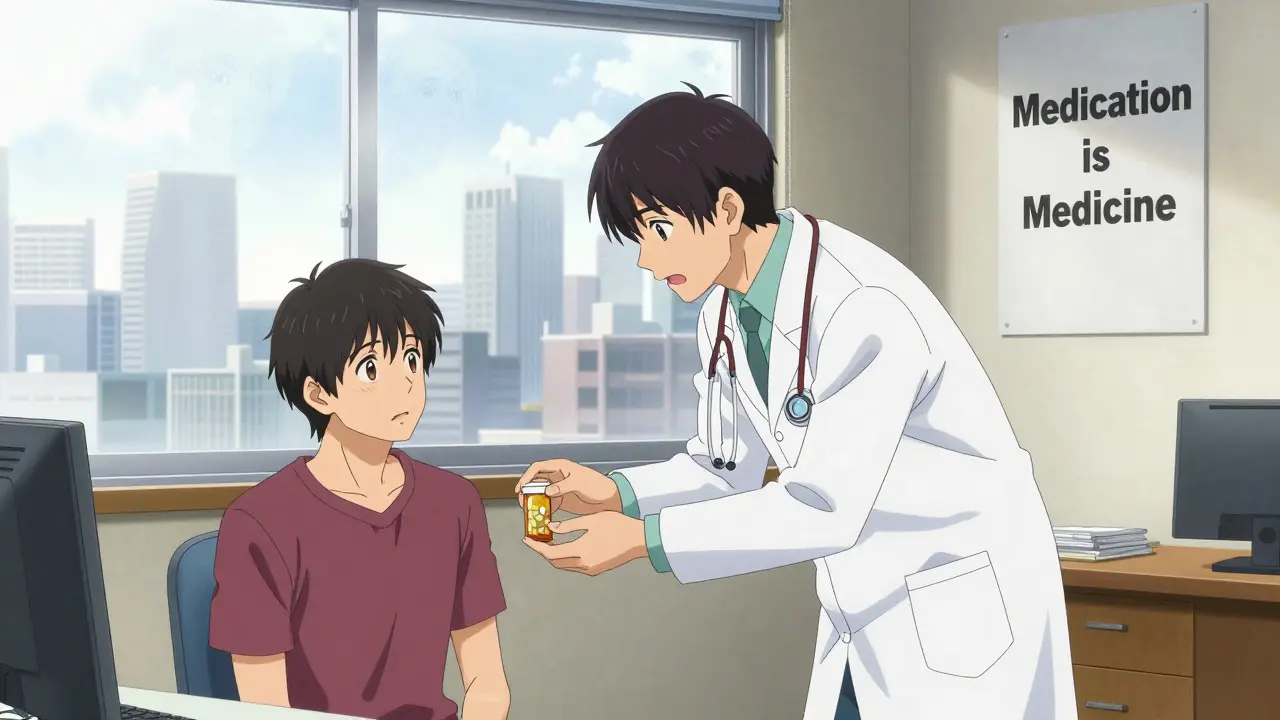
Talking about mental health meds doesn’t have to be a battle. Here’s how to do it simply:- Normalize it. Say: “Lots of people take medication for mental health, just like others take pills for diabetes or high blood pressure.” This isn’t a stretch. The CDC says over 75% of people don’t see mental health conditions as chronic illnesses. That’s the gap. Close it with facts.
- Explain it. Say: “This helps my brain chemistry work better. It’s not about changing who I am - it’s about letting me be myself again.” Compare it to something familiar. Insulin. Thyroid pills. Blood pressure meds. These aren’t optional. They’re necessary. So is this.
- Personalize it. Say: “Before I started this, I couldn’t get out of bed. Now I can work, see friends, sleep. It’s not magic. But it’s helping.” Stories beat statistics. People remember how you felt. Not the name of the drug.
This approach comes from the Mayo Clinic’s communication guidelines - and it works. People respond better when they hear a real story, not a textbook definition.
What Providers Can Do Better
Doctors aren’t immune to stigma. A 2021 study found that 22% of primary care physicians have negative feelings about patients who ask for psychiatric meds. Some think patients are “looking for a quick fix.” Others worry about dependency. But the data doesn’t back that up. Antidepressants aren’t addictive. They don’t get you high. They don’t make you numb. They help you feel like yourself again. Providers who take 8+ hours of cultural competency training reduce stigma by 29%. That training includes learning how to ask the right questions:- “How do you feel about taking medication for your condition?”
- “What worries you about these meds?”
That’s called the Two-Question Approach. It opens the door instead of shutting it down. And it leads to 33% higher adherence rates. Patients feel heard. They’re more likely to stick with treatment.
And here’s something powerful: when doctors talk about their own medication use - even if it’s for high blood pressure or thyroid issues - patients feel less alone. A 2024 JAMA study showed that medical students exposed to videos of doctors discussing their own meds showed a 37% drop in stigma. Role modeling works.
When the Stigma Comes From Home
Family members might say things like: “You don’t need that. Just pray more.” Or: “Back in my day, we didn’t take pills for feelings.” It’s hard to respond. But you don’t have to argue. Try this: “I get that you care. I’m not taking this because I’m weak. I’m taking it because my brain needs help, just like my knee needed surgery.” Comparing it to physical health makes it real. In some communities, especially among Asian Americans, stigma is even stronger. One study found 47% lower antidepressant adherence compared to white Americans. Cultural beliefs matter. But education helps. When people learn that depression isn’t a moral failing - it’s a medical condition - attitudes shift.Workplace Stigma Is Real - And Dangerous
A 2022 Mental Health America survey found 43% of people experienced workplace discrimination after disclosing they took psychiatric meds. 18% were passed over for promotions. That’s not rare. That’s systemic. You don’t have to tell your boss. But if you choose to, frame it like this: “I’m managing a health condition, and my treatment helps me show up as my best self at work.” You’re not asking for special treatment. You’re explaining how you stay productive. Employers who offer mental health benefits see higher retention and fewer sick days. But they won’t know unless people speak up. And they won’t change unless they hear real stories.
What Works: Real Solutions That Help
There are proven ways to fight stigma - and they’re not just theory.- Contact-based interventions: When people hear from someone who takes meds and lives a full life, stigma drops. A 2023 study showed 22% increase in willingness to take medication after hearing peer stories.
- Integrated care: When mental health meds are managed in primary care - not just in a psychiatrist’s office - stigma falls by 38%. Why? Because it’s treated like regular health care.
- Peer support: Programs that hire people who’ve taken psychiatric meds as peer specialists see 28% higher long-term adherence. They’ve been there. They get it.
- Digital tools: The SAMHSA ‘Medication Conversation Starter’ app has been downloaded over 150,000 times. It gives you ready-to-use responses to stigmatizing comments. It’s like having a script for tough conversations.
And it’s working. The CDC’s ‘Medications as Medicine’ campaign in California increased positive attitudes by 21% in just one year. People started seeing psychiatric meds as part of chronic disease care - like insulin, asthma inhalers, or heart meds.
What Doesn’t Work - And Why
Not every attempt to fight stigma helps. Some backfire. For example, simulation exercises that try to make people “feel what it’s like to have hallucinations” sometimes increase fear. A 2023 study found they raised stigma by 15% when not paired with education. Empathy without context can create fear, not understanding. And don’t assume everyone wants to be public. Some people need privacy. That’s okay. The goal isn’t to force disclosure. It’s to remove the shame so people feel safe to choose.The Future Is in Primary Care
Right now, 52% of antidepressant prescriptions come from primary care doctors. By 2026, that number is expected to hit 65%. Why? Because when mental health is treated like any other health issue - in the same clinic, by the same doctor - stigma fades. The American Medical Association sees this as the biggest shift in mental health care in a decade. No more “mental health wing.” No more “psychiatric patient” labels. Just care. And that’s the point. You don’t need to be brave to take a pill. You just need to know it’s okay.Medication isn’t a failure. It’s a tool. And like any tool - a cane, an inhaler, a hearing aid - it’s meant to help you live better. There’s no shame in using what works.
Why do people feel ashamed to take mental health medication?
People feel ashamed because of misinformation and cultural myths - like thinking psychiatric meds are for ‘weak’ people, or that they’re addictive like street drugs. In reality, these medications correct chemical imbalances, just like insulin for diabetes. The stigma is fueled by language - calling them ‘pills’ or ‘drugs’ - and by the fact that mental illness isn’t treated like physical illness in public perception.
Is it better to tell people I’m on medication or keep it private?
There’s no right answer - it depends on your safety and comfort. You don’t owe anyone an explanation. But if you do choose to share, using clear, normalizing language like ‘I take medication for my brain health’ reduces stigma and helps others understand it’s not a choice, it’s treatment. Keep it private if you need to. Your health comes first.
Can mental health medication really be compared to diabetes or heart disease meds?
Yes. Depression and anxiety involve chemical imbalances in the brain, just like diabetes involves insulin imbalance or heart disease involves cholesterol. Medications help restore balance. They don’t cure the condition, but they manage it. The CDC and American Psychiatric Association both frame psychiatric meds as chronic disease treatment - not a sign of failure.
What should I say if someone says, ‘You don’t need that - just meditate or pray’?
You can say: ‘I appreciate your concern. Meditation and prayer help some people, but for me, medication is part of what keeps me stable - just like someone with high blood pressure takes pills. It’s not either/or. It’s what works for my body.’ You’re not arguing. You’re explaining your needs.
How can I help someone who’s embarrassed to take their medication?
Start by listening without judgment. Then normalize: ‘Lots of people take meds for mental health - it’s as common as taking pills for thyroid issues.’ Share facts: ‘These meds help brain chemistry, not change your personality.’ And if they’re open to it, suggest peer stories or apps like SAMHSA’s Conversation Starter. You don’t fix their shame - you help them feel less alone.
Do mental health medications make you feel numb or like a zombie?
That’s a common myth - but it’s not what most people experience. When prescribed correctly, these medications reduce symptoms like sadness, panic, or brain fog - not personality. If someone feels numb, it often means the dose is too high or the wrong drug. A good provider adjusts until it feels right. The goal isn’t to feel nothing - it’s to feel like yourself again.
Are mental health medications addictive?
No. Antidepressants, anti-anxiety meds like SSRIs and SNRIs, and mood stabilizers are not addictive. They don’t create a high or craving. You don’t build tolerance like with opioids or alcohol. Some people need to taper off slowly to avoid withdrawal - but that’s not addiction. It’s the body adjusting. The FDA has approved over 150 psychiatric medications, all with safety data showing low risk of dependence.
Joie Cregin
January 16, 2026 AT 14:27Man, I wish more people saw meds like insulin instead of some shady secret. I’ve got a cousin who takes sertraline and she’s the most grounded, hilarious person I know. She doesn’t ‘turn into a zombie’-she finally stopped crying in the shower every morning. That’s not weakness. That’s winning.
waneta rozwan
January 17, 2026 AT 10:49Let’s be real-people are scared of what they don’t understand. You take a pill for your heart? Cool. You take one for your brain? Oh no, you’re ‘crazy.’ It’s 2025 and we still treat mental health like a moral failing. Pathetic. And don’t even get me started on the ‘just pray’ crowd. I’ve got a friend who’s diabetic and someone told her to ‘pray away the sugar.’ She laughed in their face. You should too.
Henry Ip
January 17, 2026 AT 18:43I’ve been on an SSRI for 5 years. I used to think it made me weak. Then I realized I was the one who was weak for believing that lie. Now I tell people I take it like I take my vitamins. No shame. No drama. Just health. And honestly? My productivity went up. My relationships improved. It’s not magic. It’s medicine.
Isabella Reid
January 18, 2026 AT 14:11As someone who grew up in a household where ‘mental health’ was whispered like a curse word, I get it. My mom thought therapy was for people who couldn’t ‘handle life.’ Then she saw me come back from a dark place-calm, present, actually laughing. She didn’t get it at first. But when I said, ‘Mom, this is like your blood pressure pill-it keeps the system running’-she finally nodded. It’s not about changing you. It’s about letting you be you again.
Ryan Hutchison
January 19, 2026 AT 04:49Look, I’m a veteran. I’ve seen guys come back from deployment with PTSD and refuse meds because they’re ‘not real soldiers.’ Bullshit. If you broke your leg, you’d get a cast. If your brain’s broken, you get meds. Same damn thing. And if you’re too proud to take a pill that lets you sleep without nightmares, you’re not tough-you’re just stupid. America needs to stop romanticizing suffering. We’ve got the science. Use it.
Kasey Summerer
January 19, 2026 AT 08:10Bro. I took Lexapro for 8 months. Felt like a robot at first. Then I realized-I wasn’t numb. I was finally *me*. The version of me that didn’t cry during grocery store commercials. I told my boss I was managing a chronic condition. He said, ‘Cool, same as my thyroid meds.’ We didn’t say another word. And guess what? I got promoted. Stigma dies when you just… live your life.
kanchan tiwari
January 21, 2026 AT 01:27They’re not even hiding it anymore. Big Pharma is pushing these pills like candy. You think your brain needs a chemical fix? Or are you just being manipulated by ads and doctors who get kickbacks? My cousin took them for anxiety and now she’s on five different meds and can’t even make coffee without feeling ‘off.’ It’s a trap. They want you dependent. Not healed.
john Mccoskey
January 21, 2026 AT 02:57Let’s cut through the performative empathy. You say ‘medication is just like insulin’-but insulin is life-or-death. Antidepressants? They’re statistically effective in 40-60% of cases. That’s not a cure. That’s a coin flip. And you’re telling people to treat it like a chronic disease? What if you’re one of the 60% it doesn’t help? What then? Are you still going to take it for life? And don’t get me started on the ‘peer stories’-anecdotes aren’t data. This whole movement is emotional manipulation dressed as science. We need real solutions, not feel-good slogans.
swarnima singh
January 21, 2026 AT 13:18u just dont get it. its not about pills. its about the system. the church, the family, the media-they all told us to suffer in silence. and now when someone says ‘i take meds’ they’re still judged. i used to feel like a broken thing. now i know: my brain was never broken. it was just ignored. and that’s the real illness. not the pills. the silence.
Stephen Tulloch
January 23, 2026 AT 02:11Look, I’m from Montreal. We don’t whisper about SSRIs here. We talk about them like we talk about coffee. ‘You good?’ ‘Nah, still on sertraline, but it’s working.’ No drama. No shame. It’s just… health. The US is still stuck in the 90s with this ‘mental illness = weakness’ nonsense. We’ve got universal healthcare and we still treat brain health like it’s optional. Sad. Real sad. 🤷♂️
Riya Katyal
January 25, 2026 AT 01:54Ohhh so now we’re supposed to say ‘medication’ instead of ‘pills’? And that’s supposed to fix everything? Sweetheart, if your mom says ‘just pray,’ no word change is gonna make her suddenly get it. You think language fixes deep cultural shame? LOL. Try telling a Hindu grandma in Delhi that antidepressants are like insulin. She’ll laugh so hard she’ll drop her chai. This whole thing is performative activism. Real change? That’s harder.
Cheryl Griffith
January 25, 2026 AT 08:11I used to hide my meds like they were contraband. Then I started saying, ‘I take something for my brain, just like you take something for your blood pressure.’ My coworker said, ‘Oh, I take lisinopril.’ We didn’t say another word. But we started having coffee together. That’s how it starts-not with speeches. With quiet, normal moments.
Nicholas Gabriel
January 25, 2026 AT 22:34Let me just say this: I’m a doctor. I’ve prescribed SSRIs for over 15 years. I’ve seen people come in crying, unable to get out of bed. I’ve seen them leave smiling, holding their prescription like it’s a key. And yes, I’ve had patients tell me, ‘I’m ashamed.’ I always say, ‘Then don’t tell anyone. But take it anyway.’ Your health doesn’t need an audience. It just needs you. And if you’re taking it, you’re already brave.