
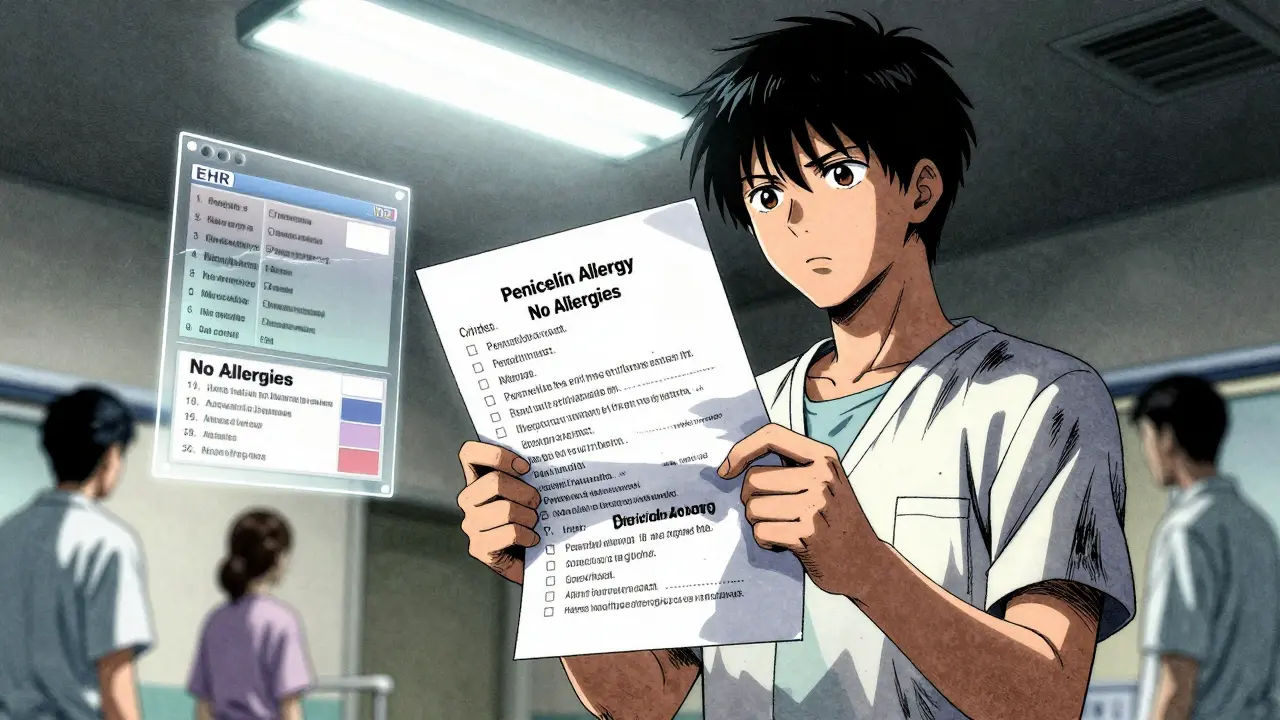
Every time you visit a new doctor, pharmacist, or emergency room, they ask: Do you have any allergies? It seems simple. But if your allergy list isn’t updated across all your providers, that answer could be wrong - and it could put your life at risk.
Over 5% of hospitalized patients suffer an adverse drug reaction because someone thought they were allergic to penicillin - when they weren’t. In some cases, that mistake leads to death. The problem isn’t that patients lie. It’s that allergy information gets lost, outdated, or misrecorded between systems. A 2022 study found that nearly 1 in 8 patients had an incorrect or outdated allergy listed in their electronic health record. That’s not a glitch. It’s a systemic failure.
Why Your Allergy List Isn’t Automatic
You might assume your allergy info follows you from one provider to the next. It doesn’t. Even if your doctor uses Epic or Cerner - the two biggest electronic health record (EHR) systems - your allergy list only travels if both providers use the same system and have it turned on. Most don’t. And even when they do, the data often arrives as a flat list: “Penicillin allergy.” No details. No context. No verification.
Here’s what’s missing:
- Was the reaction a rash? Swelling? Trouble breathing?
- When did it happen? A week ago? 20 years ago?
- Was it confirmed by a test - or just assumed because you felt sick after taking a pill?
Without this, doctors treat your allergy like a hard rule - even if it’s outdated. That means you might get a less effective, more expensive, or more dangerous antibiotic just because someone wrote “penicillin allergy” on a form 15 years ago.
What a Proper Allergy List Looks Like (2025 Standards)
As of January 2025, all certified EHR systems in the U.S. must follow the United States Core Data for Interoperability (USCDI v3) rules for allergies. That means your allergy record must include:
- Verification status: Is it patient-reported, unverified, or confirmed by testing?
- SNOMED CT code: A standardized medical code that tells the system exactly what you’re allergic to - not just “penicillin,” but “Amoxicillin, hypersensitivity.”
- Reaction details: “Hives, 30 minutes after taking pill, resolved with antihistamines.”
- Severity: Mild, moderate, severe, life-threatening.
This isn’t bureaucracy. It’s safety. If your allergy is coded properly, a pharmacist’s system can flag that you’re not actually allergic to amoxicillin - just to penicillin. And if you’ve had a negative challenge test since then, that new info can override the old label.
How to Fix Your Allergy List - Step by Step
You can’t wait for your providers to fix this for you. You have to take control. Here’s how:
- Get your current list - Log into your patient portal (MyChart, Epic, etc.) and download your full allergy record. Don’t trust what your doctor says. Look at the actual document. If it just says “Penicillin allergy” with no details, that’s a red flag.
- Compare across providers - If you’ve seen multiple doctors, get records from each. Do they all say the same thing? If one says “allergic to penicillin” and another says “no known drug allergies,” someone’s wrong. That’s your next step.
- Clarify what you’re really allergic to - Did you get a rash after amoxicillin as a kid? That doesn’t mean you’re allergic to all penicillins. Many people outgrow allergies. Ask your doctor about an allergy challenge test - especially for penicillin. It’s safe, quick, and covered by most insurance. Only 17 such tests were done at Parkland Health over 20 months before they started fixing their records. You don’t have to wait.
- Update your portal - Once you know the truth, go into your patient portal and edit your allergy list. Most portals let you add, remove, or change allergy details. Write the full reaction: “Amoxicillin - hives, 2018, resolved with Benadryl. Not tested, but no reaction since.”
- Bring it to every appointment - Print it or show it on your phone. Say: “Here’s my current allergy list. I updated it after reviewing my records. Can you confirm this is in your system?”
What Your Doctor Should Be Doing (But Probably Isn’t)
Good clinics now use allergy reconciliation tools - software that scans your entire medical record: notes, lab results, pharmacy fills, past prescriptions - to spot mismatches. At Mass General Brigham, this system caught 37 cases last month where patients had negative penicillin tests but were still labeled allergic. That’s life-saving.
But here’s the catch: only 40% of U.S. healthcare systems have these tools. Most still rely on manual checks. So even if your doctor has a fancy EHR, they might not be using the smart features.
Ask your provider: “Do you use an automated allergy reconciliation tool?” If they look confused, you’re on your own. Don’t wait for them to catch up.
What to Do If You’re Labeled Allergic - But You’re Not
Many people are mislabeled. Especially with penicillin. Studies show over 90% of people who think they’re allergic to penicillin aren’t - they just had a rash as a child or got sick with the flu while taking antibiotics.
If you suspect you’ve been mislabeled:
- Request a penicillin skin test or oral challenge - done by an allergist in a controlled setting.
- Ask for a letter or note confirming you’re not allergic.
- Submit that to your EHR portal and ask your primary care doctor to update your record.
- Send a copy to any specialist, pharmacy, or hospital you use.
One study found that after patients got their penicillin allergy removed, they were 23.6% less likely to get a broad-spectrum antibiotic - which means fewer side effects, lower costs, and better outcomes.
What About Food or Environmental Allergies?
Most EHR systems barely handle these. Only 32.6% of systems correctly document food or environmental allergies. If you’re allergic to peanuts, shellfish, or pollen, don’t rely on your EHR to flag it. Keep a separate list - on your phone, in your wallet, printed out. Tell every provider: “I have a food allergy to peanuts. I carry an EpiPen.”
There’s no standard code for “peanut allergy” in most EHRs. That’s a gap. Until it’s fixed, treat it like your emergency contact - you don’t trust the system to remember it for you.
What’s Changing in 2025 and Beyond
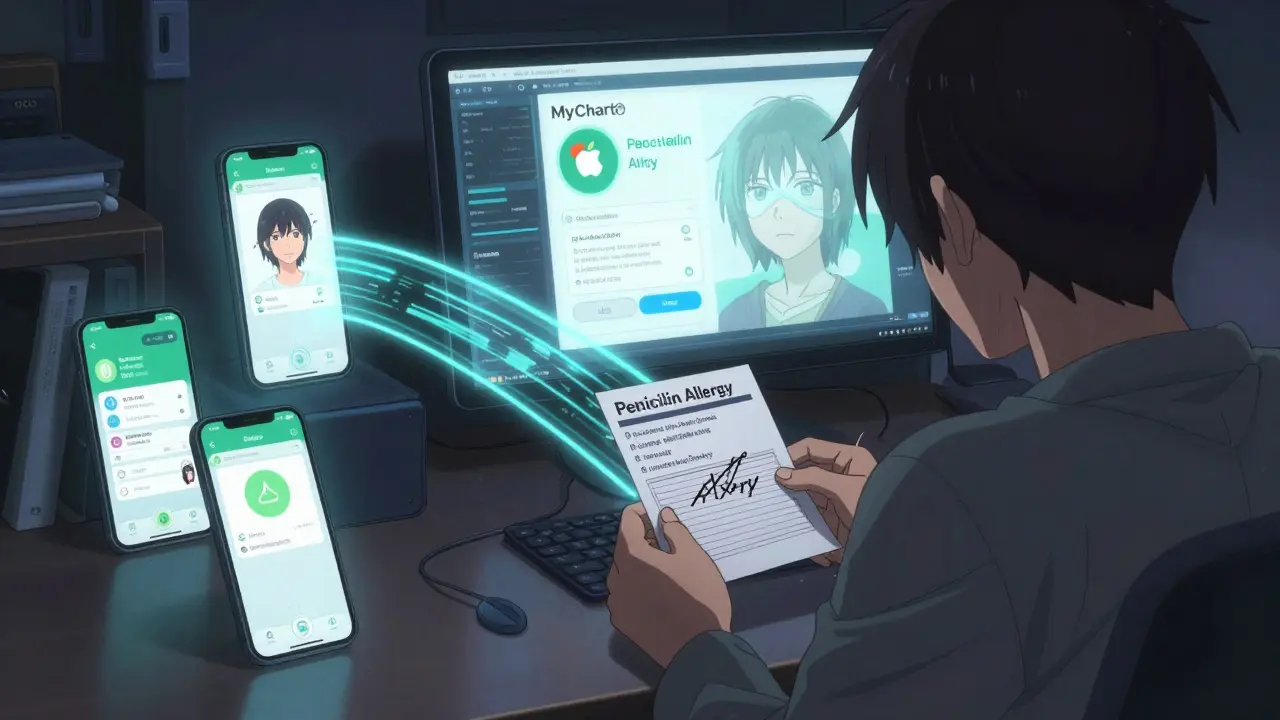
Starting in 2026, hospitals will lose part of their Medicare reimbursement if their allergy documentation is inaccurate. That’s forcing change. Also, new rules now let you update your own allergy list directly across providers through MyHealthEData - a government-backed system that lets you share your records via secure API.
Soon, you’ll be able to update your allergy list in your Apple Health app or Google Health, and it will sync to your doctor’s system. But that’s still rolling out. Don’t wait for it. Do it now.
Bottom Line: Your Allergy List Is Your Responsibility
Healthcare systems aren’t designed to keep your allergy list accurate. They’re designed to bill, code, and document. You have to be the keeper of your own safety.
Do this today:
- Check your patient portal for your allergy list.
- Write down every reaction - date, symptom, drug, outcome.
- Call one provider and ask: “Is my allergy list up to date?”
- If you’ve ever had a reaction to penicillin - get tested.
- Print your updated list and carry it.
It takes 15 minutes. It could save your life.
Can I update my allergy list online through my patient portal?
Yes, most major patient portals - like MyChart, Epic, and Cerner - let you edit your allergy list directly. Look for a section called "Allergies," "Medications," or "Health Summary." You can add, remove, or change details like reaction type, date, and severity. Always save your changes and print or screenshot a copy. Then confirm with your doctor that the update synced to their system.
What if my doctor says I’m allergic but I’ve never had a reaction?
Many people are mislabeled - especially with penicillin. If you’ve never had a confirmed reaction (like hives, swelling, or trouble breathing), ask for an allergy test. A simple skin test or oral challenge under medical supervision can prove you’re not allergic. Over 90% of people who think they’re allergic to penicillin turn out to be fine. Removing a false label means you can use safer, cheaper antibiotics in the future.
Do pharmacies know about my allergies?
Sometimes. Pharmacies pull from your EHR, but only if your doctor’s system shares data with them - and even then, the info is often incomplete. Always tell your pharmacist your full allergy history when picking up a new prescription. Don’t assume they see it. If you’re allergic to sulfa drugs, for example, and your record just says "drug allergy," they won’t know which one.
Why do different providers have different allergy lists?
Because most systems don’t talk to each other properly. A specialist might note a reaction in their notes but not update the official allergy list. A primary care doctor might copy an old list from a previous visit without verifying. Studies show 68% of allergy mismatches come from differences between specialists and primary care. Always reconcile your list yourself - don’t trust the system to do it.
Is there a way to make sure all my providers have the same list?
Not perfectly - yet. But you can get close. Update your list in your patient portal, print a copy, and bring it to every appointment. Ask each provider: "Can you confirm this is in your system?" Also, use apps like Apple Health or Google Health to store your allergies - they’re starting to sync with EHRs under new 2025 federal rules. For now, your printed list is your best backup.
Joanne Smith
December 26, 2025 AT 01:17So let me get this straight - we’re asking patients to be medical data janitors now? 🤦♀️ I spent 45 minutes last week correcting my own EHR because my 2010 ‘penicillin rash’ was still flagged as ‘life-threatening’ - and the system didn’t even let me delete it, only ‘mark as inactive.’ Meanwhile, my doctor’s office still prints paper forms with a single checkbox: ‘Allergies? ☐ Yes ☐ No.’ We’re literally living in the future… but the software’s stuck in 1998.
Lori Anne Franklin
December 26, 2025 AT 16:55omg i just checked my chart and it says i’m allergic to ‘antibiotics’ like that’s a thing?? 🤯 i’ve never had a reaction to anything but i guess the doc just wrote it down when i said ‘i get sick sometimes’ after a zpack. i’m gonna go fix it right now thx for the nudge!!
Ryan Cheng
December 26, 2025 AT 21:12Great breakdown - and seriously, this is one of those things that should be automatic, but isn’t. If you’ve ever had a reaction to penicillin, even as a kid, get tested. It’s not scary, it’s not expensive, and it takes 30 minutes. I had mine done last year - turned out I was never allergic. Now I take amoxicillin like it’s candy, and my last UTI treatment cost $12 instead of $180. That’s not just convenience - that’s justice.
Ellie Stretshberry
December 28, 2025 AT 14:56i had no idea this was even a thing until i read this
my mom got sick once after penicillin when she was 8 and now every doctor thinks she’s allergic to everything
she’s 67 and still gets cipro when she has a bladder infection because they’re scared to give her the good stuff
we’re gonna make an appointment for her next week
thank you for saying this
Zina Constantin
December 30, 2025 AT 04:22As a global health advocate, I’ve seen this play out in rural clinics in India, Kenya, and rural Appalachia - the same problem. Patients don’t know their own records. Systems don’t talk. But here’s the beautiful part: you can fix it. Print your list. Carry it. Say it out loud. Your voice is the only interoperability tool that never fails. Keep speaking up. We’re all in this together.
Jay Ara
December 30, 2025 AT 05:27i had a rash after amoxicillin when i was 12 and now every time i go to the hospital they give me vancomycin like im about to die
its crazy how one little thing from 20 years ago ruins your treatment now
im gonna call my doc this week
thanks for the push
Kuldipsinh Rathod
December 31, 2025 AT 18:59why do we even have these systems if they dont work
my cousin died because they gave him penicillin even though his chart said ‘allergic’
the system just ignored it
its not a glitch its a crime
SHAKTI BHARDWAJ
January 2, 2026 AT 04:04oh wow so now i have to be my own nurse AND my own IT SUPPORT AND my own lawyer??
why dont you just ask me to memorize every drug in the pharmacopeia while i’m at it
THIS ISN’T HEALTHCARE THIS IS A TERRIFYING GAME OF CHAOS MONKEY
carissa projo
January 3, 2026 AT 14:16There’s something deeply human about this - the way we’ve outsourced our bodily autonomy to databases that can’t even spell ‘penicillin’ correctly. We’re not data points. We’re not checkboxes. We’re the ones who lived through the rash, the swelling, the panic. And yet, the system treats our lived experience as ‘unverified.’ Maybe the real allergy isn’t to penicillin… it’s to responsibility. To care. To listening.
When was the last time a doctor sat with you and asked, ‘Tell me what happened’ - not ‘Check the box’? I miss that. I miss being seen.
josue robert figueroa salazar
January 4, 2026 AT 05:51