

By early 2025, the line between flu and COVID-19 blurred more than ever. For the first time since the pandemic began, influenza caused more hospitalizations and deaths than COVID-19 in the U.S. That shift didn’t mean one was harmless-it meant the rules had changed. What worked last year might not work now. If you’re sick, unsure whether it’s the flu or COVID-19, or wondering how long to stay home, this guide cuts through the noise with 2025’s latest data.
How to Tell Them Apart-Because Symptoms Overlap Too Much
Both viruses hit with fever, cough, fatigue, and body aches. You can’t tell them apart by feel alone. But there are clues.
Loss of taste or smell? That’s far more common with COVID-19-happening in 40% to 80% of cases. With flu, it’s rare, under 10%. If you suddenly can’t taste your coffee or smell your soap, think COVID-19.
Flu symptoms usually show up fast-within 1 to 4 days after exposure. COVID-19 creeps in slower. Symptoms might not appear until 2 to 14 days later. That delay is why someone can spread COVID-19 before they even feel sick.
And here’s something most people miss: bacterial co-infections. Severe flu often comes with secondary bacterial pneumonia. About 30% to 50% of serious flu cases involve bacteria. With COVID-19, it’s lower-15% to 25%. That’s why doctors often prescribe antibiotics for flu patients but rarely for COVID-19.
Testing: What Works, What Doesn’t
Rapid antigen tests for flu and COVID-19 are convenient, but they’re not perfect. Flu tests catch about 75% to 85% of cases. COVID-19 antigen tests are a bit better-80% to 90% accurate.
But here’s the problem: if you test negative on a rapid test early on, you might still have it. That’s especially true for COVID-19. A nurse in Boston told me last February: “We had 30% of patients with flu-like symptoms test negative on day one, then positive on day three.”
That’s why most hospitals now use multiplex PCR tests. These panels check for flu A, flu B, COVID-19, and RSV all at once. By 2025, 87% of U.S. hospitals had switched to these. They cut diagnosis time by nearly two days.
At-home combo tests are now widely available. BinaxNOW’s combined flu/COVID test, approved by the FDA in December 2024, detected both viruses with 89% accuracy. If you’re sick and can’t get to a clinic, this is your best bet.
Treatment: Antivirals Are Key-But Timing Matters
For flu, oseltamivir (Tamiflu) is the go-to. It works best if taken within 48 hours of symptoms. The CDC says it cuts hospitalization risk by 70% when given early. Many people skip it because they think, “I’ll just rest.” But if you’re over 65, pregnant, or have asthma or diabetes, it’s not optional.
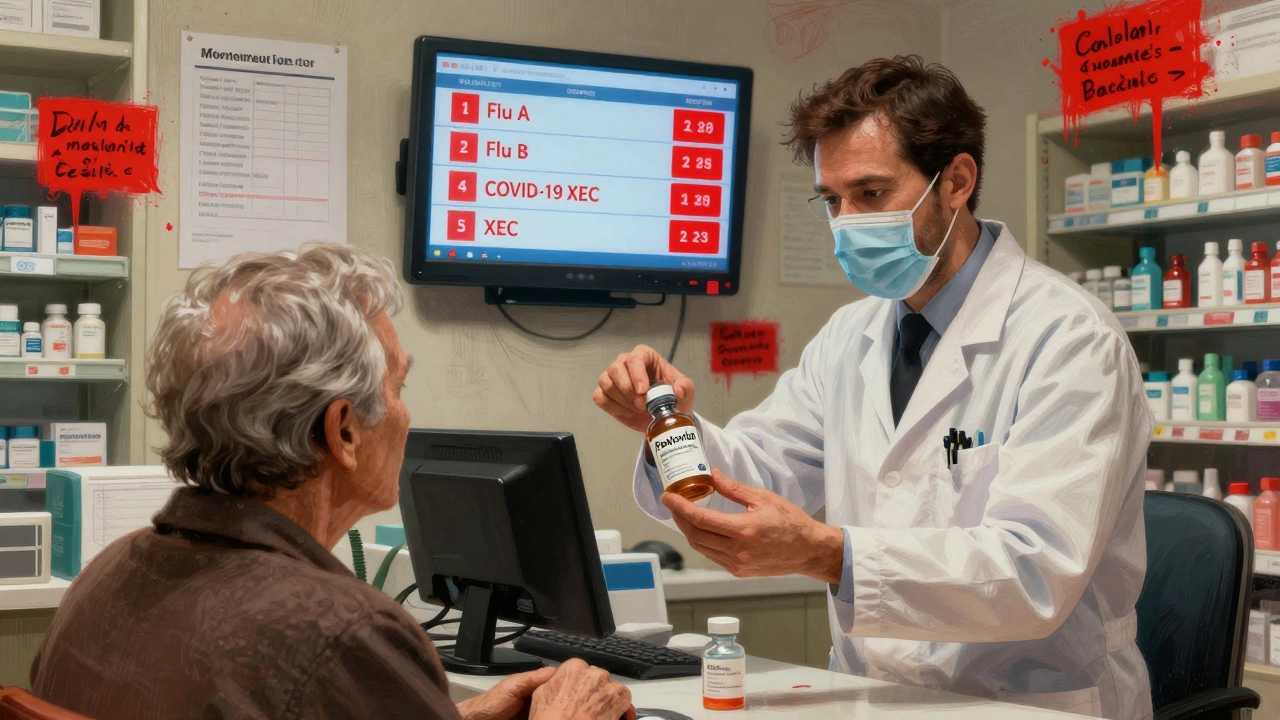
For COVID-19, Paxlovid (nirmatrelvir/ritonavir) is the main antiviral. It reduces hospitalization by 89% if taken within five days. But here’s the catch: it interacts with many common meds-blood thinners, statins, some heart drugs. Your pharmacist needs to check your list before you take it.
And here’s something surprising: fewer COVID-19 patients get antivirals than flu patients. In 2025, only 41% of hospitalized COVID-19 patients received antivirals within the right window. For flu, it was 63%. Why? Partly because doctors still think COVID-19 is “just a bad cold” for healthy people. It’s not. The FDA expanded Paxlovid eligibility in February 2025 to include mild cases with risk factors-like obesity, heart disease, or being over 50.
New options are coming. In January 2025, the FDA approved a new flu antiviral-a prodrug of zanamivir-with 92% effectiveness against the dominant H1N1 pdm09 strain. It’s not everywhere yet, but it’s rolling out.
Isolation: 5 Days Isn’t the Same for Both
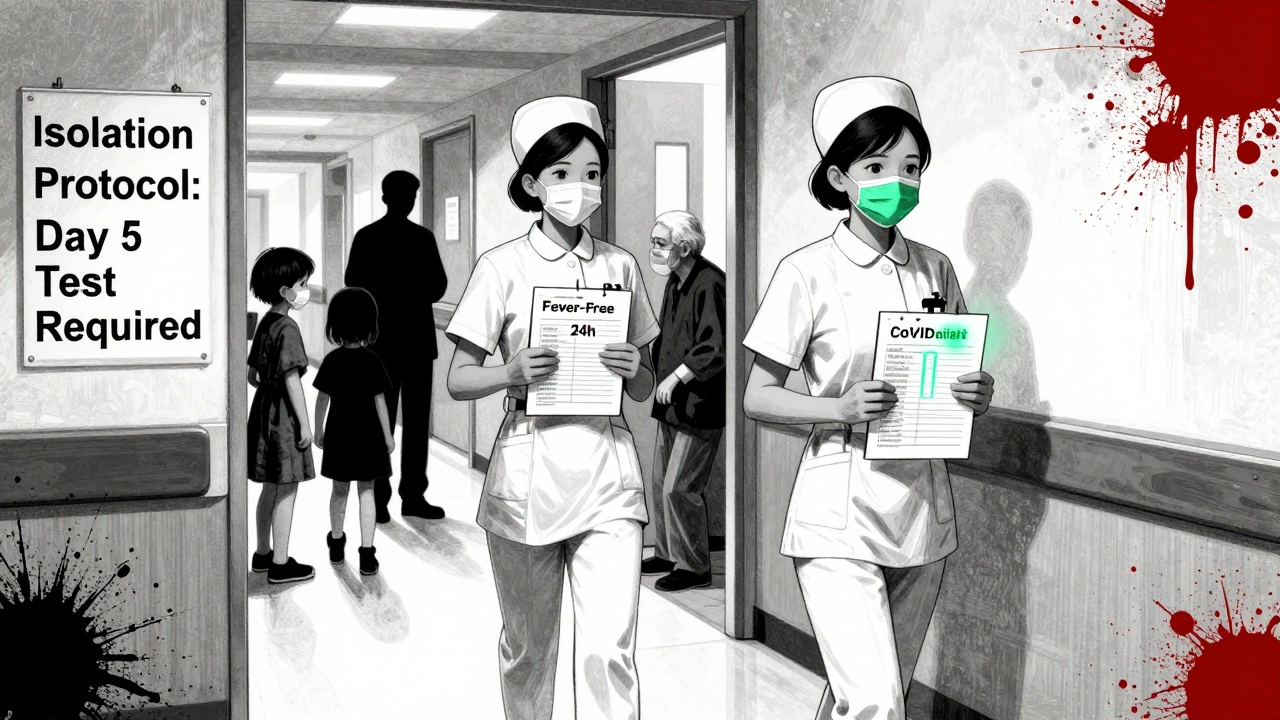
The CDC says isolate for 5 days for both. But that’s where the similarity ends.
For flu: you can stop isolating after 24 hours without fever (no fever-reducing meds) and when symptoms are improving. You might still be shedding virus-but you’re no longer contagious enough to spread it widely.
For COVID-19: you need a negative rapid antigen test on day 5. If you test positive, keep isolating until day 10. Why? The XEC subvariant sticks around longer. Studies show it can be detected in the nose for up to 10 days, even after symptoms fade.
Healthcare settings treat them differently too. In 2025, 92% of hospitals required N95 masks for staff around COVID-19 patients. Only 68% did for flu. Why? Because COVID-19 spreads more easily in hospitals. Healthcare-associated pneumonia was 28% in COVID-19 patients versus 12% in flu patients.
And kids? They shed flu virus longer-up to 14 days. If your child has the flu, keep them home until they’re fever-free for 24 hours and feeling like themselves again. Don’t rely on the 5-day rule.
Who’s at Highest Risk?
Flu hits hard-but it often hits people without chronic illnesses. In 2025, 42% of hospitalized flu patients had no underlying conditions. That’s unusual. Most assume only high-risk people get sick. Not true.
COVID-19 hospitalizations were more common in people with chronic kidney disease, cancer, autoimmune disorders, or those on immunosuppressants. Men were also more likely to end up in the hospital with COVID-19 than flu.
And vaccination? It made a difference. In 2025, 67% of flu patients had been vaccinated in the past year. Only 49% of COVID-19 patients had the latest booster. That gap helped explain why flu deaths dropped so sharply last season.
What’s Changed in 2025?
The big shift: flu is now the bigger threat in the short term. But that could flip again.
The CDC’s 2025-2026 outlook warns: if a new immune-evading variant of SARS-CoV-2 emerges, hospitalizations could spike again. The model predicts a peak of 6.7 to 9.5 hospitalizations per 100,000 people-higher than last season.
Hospitals are adapting. 94% now use integrated respiratory pathogen systems that track flu, COVID-19, and RSV together. That means faster decisions, fewer delays, and better resource use.
Insurance coverage still lags. 87% of people with private insurance got full coverage for flu antivirals. Only 63% got it for Paxlovid. If you’re denied, appeal. Many insurers now cover it for high-risk patients.
What to Do Right Now
- If you’re sick: test with a combo rapid test. If negative but symptoms persist, retest in 48 hours.
- If you’re high-risk (over 65, pregnant, chronic illness): call your doctor within 24 hours of symptoms. Don’t wait.
- If you test positive for flu: start Tamiflu within 48 hours.
- If you test positive for COVID-19: start Paxlovid within 5 days if eligible. Check drug interactions first.
- Isolate for 5 days. For flu: stop after 24 hours fever-free. For COVID-19: test on day 5. If positive, keep going.
- Get vaccinated. The 2025-2026 flu shot covers the H1N1 pdm09 strain. The updated COVID-19 vaccine targets the XEC variant.
Can you have flu and COVID-19 at the same time?
Yes. Co-infections happen, though they’re not common. A 2025 study found about 3% of patients testing positive for one virus also had the other. Symptoms are worse when both are present. That’s why multiplex testing is critical-it catches both at once.
Is Paxlovid still effective against newer COVID-19 variants?
Yes. Paxlovid works by blocking a viral enzyme that doesn’t change much across variants, including XEC. Clinical data from early 2025 shows it maintains 87%+ effectiveness in preventing hospitalization when taken early. It’s still the gold standard for high-risk patients.
Why do some people test negative for COVID-19 but still feel sick?
Viral load matters. Early in infection, there’s not enough virus to trigger a rapid test. That’s why a negative test on day 1 doesn’t rule out COVID-19. Wait 48 hours and test again. PCR tests are more sensitive, but if you’re at home, retesting with a rapid antigen test later is the best option.
Should I take antibiotics if I have the flu?
Only if a bacterial infection develops. Flu is viral, so antibiotics won’t help the virus itself. But 30-50% of severe flu cases lead to bacterial pneumonia. If your fever returns after improving, or you start coughing thick yellow/green mucus, see a doctor. They’ll check for secondary infection.
How long am I contagious after symptoms go away?
For flu: you’re mostly done after 5 days, but kids and older adults can shed virus for up to 14 days. For COVID-19: you’re likely contagious for 8-10 days, even after symptoms fade. That’s why day-5 testing is required. If you’re still positive, stay home until day 10 or until you test negative.
Final Thoughts: Don’t Guess-Test and Act
The era of treating flu and COVID-19 the same is over. They’re different viruses with different rules. Testing quickly, starting antivirals early, and following the right isolation guidelines saves lives. Don’t wait for a doctor’s appointment if you’re at risk. Call your pharmacy-they can help you get tested and prescribed antivirals faster than you think.
Gwyneth Agnes
December 5, 2025 AT 19:43Flu’s worse now? Whatever. I’m not taking some lab-made pill just because the CDC says so.
Shayne Smith
December 6, 2025 AT 17:21I had both at once last year. Worst week of my life. The multiplex test saved me. Just get it done.
Kay Jolie
December 7, 2025 AT 17:04Let’s be real-the pharma-industrial complex is just rebranding last year’s panic. Tamiflu? Paxlovid? They’re all just repackaged placebos with fancy acronyms. The real cure? Rest, hydration, and a damn good Netflix binge.
Dan Cole
December 8, 2025 AT 02:02The data is clear: viral kinetics differ fundamentally between influenza A/H1N1 pdm09 and SARS-CoV-2 XEC. The 48-hour window for oseltamivir is pharmacokinetically optimal due to neuraminidase binding affinity, whereas nirmatrelvir’s protease inhibition remains effective against conserved 3CLpro domains-even in immune-evasive strains. Yet, public health messaging remains catastrophically oversimplified. We’re treating complex virology like a grocery list.
Mansi Bansal
December 8, 2025 AT 15:38As a medical professional from Mumbai, I must say: the Western fixation on antivirals ignores the global reality. In rural India, we rely on clinical judgment, not PCR panels. Antibiotics are overprescribed, yes-but not because doctors are careless. It’s because fever + cough + no access to diagnostics = you treat for everything. The 87% hospital statistic? It’s meaningless when 80% of our population never sees a lab.
Jackie Petersen
December 9, 2025 AT 02:08They say flu’s worse now? Funny. Last year, the CDC admitted they miscounted COVID deaths by including people who died WITH it, not FROM it. Now they’re doing the same with flu. Who’s really counting? Who’s funding the labs? And why is Paxlovid still so hard to get? Someone’s making money off this fear. I’m not falling for it.
Arjun Deva
December 9, 2025 AT 18:24Wait… so now the government says flu is worse than COVID… but last year it was the other way around? And now they’re pushing a new vaccine for XEC? But XEC was just a variant from last year? And the CDC changed isolation rules AGAIN? This isn’t science-it’s a reset button. They’re resetting the narrative every season. What’s next? Are we gonna be told next year that the flu was a hoax and COVID was the real threat? They’re playing us. I’m not getting any shots. I’m not taking any pills. I’m not isolating. I’m done.
Ashish Vazirani
December 10, 2025 AT 23:52My cousin in Delhi got sick in January-tested negative for flu, negative for COVID… then died two weeks later. The hospital said ‘unknown respiratory failure.’ No autopsy. No answers. Now they’re telling us to trust these combo tests? Who made them? Who approved them? Why does BinaxNOW have a U.S. patent but no availability in India? This isn’t medicine-it’s a border. Rich people get the test. Poor people get the coffin.
Clare Fox
December 11, 2025 AT 02:09i think we’re all just tired. tired of being told what to do, tired of the tests, tired of the fear. i got the flu last year and just stayed home. didn’t test. didn’t take anything. slept for three days. felt better. maybe the answer isn’t more science… maybe it’s just letting people breathe again.
joanne humphreys
December 11, 2025 AT 17:23I appreciate the nuance here. The distinction between isolation guidelines for flu and COVID-19 is actually really important. I’ve seen too many people go back to work on day 5 because ‘they feel fine’-only to spread it to their immunocompromised coworker. Testing on day 5 for COVID is a small ask for a big win. And yes, Paxlovid interactions are a nightmare-I had to get my pharmacist to cross-check 12 meds. But it’s worth it if you’re high-risk. Don’t be ashamed to ask for help.