
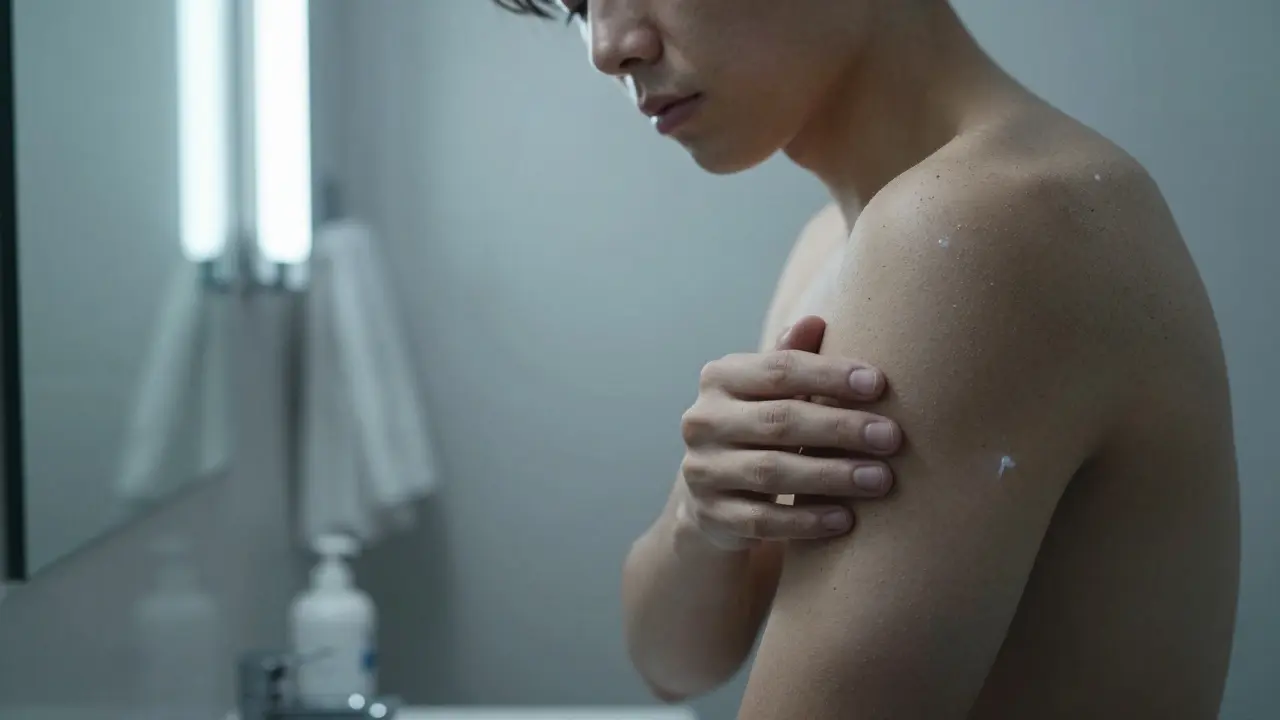
Most people don’t realize how common keratosis pilaris really is. You’re not alone if you’ve looked in the mirror and seen tiny, rough bumps on your upper arms-like goosebumps that never go away. This isn’t acne. It’s not an allergy. It’s not even a rash. It’s keratosis pilaris, or KP, a harmless but frustrating skin condition that affects up to 70% of teenagers and 40% of adults. It’s not dangerous, but it can make you self-conscious, especially in summer when you want to wear shorts or sleeveless tops.
What Keratosis Pilaris Actually Is
Keratosis pilaris happens when your skin makes too much keratin-the same protein that makes up your hair and nails. Instead of shedding normally, this keratin builds up around hair follicles and forms tiny, hard plugs. These plugs trap the hair beneath the skin, creating those small, sandpaper-like bumps. They’re usually skin-colored, but can look red or brown, especially on darker skin tones.
The most common places? Upper arms (in 92% of cases), followed by thighs (70%), and sometimes the buttocks or cheeks. You won’t feel pain, but the texture is unmistakable. Run your hand over your arm-it feels like fine sandpaper. And it gets worse in winter. When humidity drops below 40%, your skin dries out, and those bumps become more noticeable.
There’s no single cause, but genetics play a big role. If one of your parents had KP, you have a 50-70% chance of getting it. Studies link it to mutations in the filaggrin gene, which weakens the skin’s natural barrier. That’s why people with eczema or ichthyosis often have KP too-about half of eczema patients do.
Why Treatments Don’t Always Work
Here’s the hard truth: there’s no cure for keratosis pilaris. Not now, not likely ever. But that doesn’t mean you’re stuck with it. The goal isn’t to make your skin perfect-it’s to make it smoother and less noticeable. And that’s totally possible with the right routine.
Most people try scrubs, loofahs, or harsh exfoliants first. Bad idea. A 2022 study found that 68% of people who used rough scrubs made their KP worse. The friction causes inflammation, which leads to dark spots and even more roughness. You’re not scrubbing away the bumps-you’re irritating them.
Instead, dermatologists recommend two key steps: gentle exfoliation and deep hydration. The best ingredients? Lactic acid, urea, and salicylic acid. These don’t just remove dead skin-they help break down the keratin plugs so they can shed naturally.
What Actually Works: The Science-Backed Treatments
Let’s cut through the noise. Not all creams are created equal. Here’s what the data says works:
- 10-12% lactic acid (like AmLactin): Improves texture by 40-60% in 4-6 weeks. A Reddit thread with over 1,200 users found 62% saw clear improvement with twice-daily use. Some feel a slight sting at first, but it fades after a few days.
- 10-20% urea cream: Works even better on thick, dry patches. One study showed 65% of users had reduced scaling after 8 weeks. Urea also pulls moisture into the skin, which is why it’s so effective.
- 8-12% glycolic acid: A type of alpha-hydroxy acid (AHA). Takes longer-about 12 weeks-but gives 30-50% smoother skin. Paula’s Choice 8% AHA Lotion has over 1,800 reviews with 68% saying they saw results in 4 weeks.
- Retinoids (tretinoin 0.025-0.1%): These are prescription-strength and can improve skin by 70%. But here’s the catch: 73% of users quit within 6 weeks because of redness and peeling. If you stick with it, you’ll see results-but patience is everything.
And don’t forget moisturizers. Ceramide-rich creams are critical. Dr. Hadley King from Weill Cornell says consistent moisturizing gives 30% better results than exfoliants alone. That’s because KP is a barrier disorder. You’re not just treating bumps-you’re fixing your skin’s defense system.
How to Apply Treatments Right
It’s not just what you use-it’s how you use it.
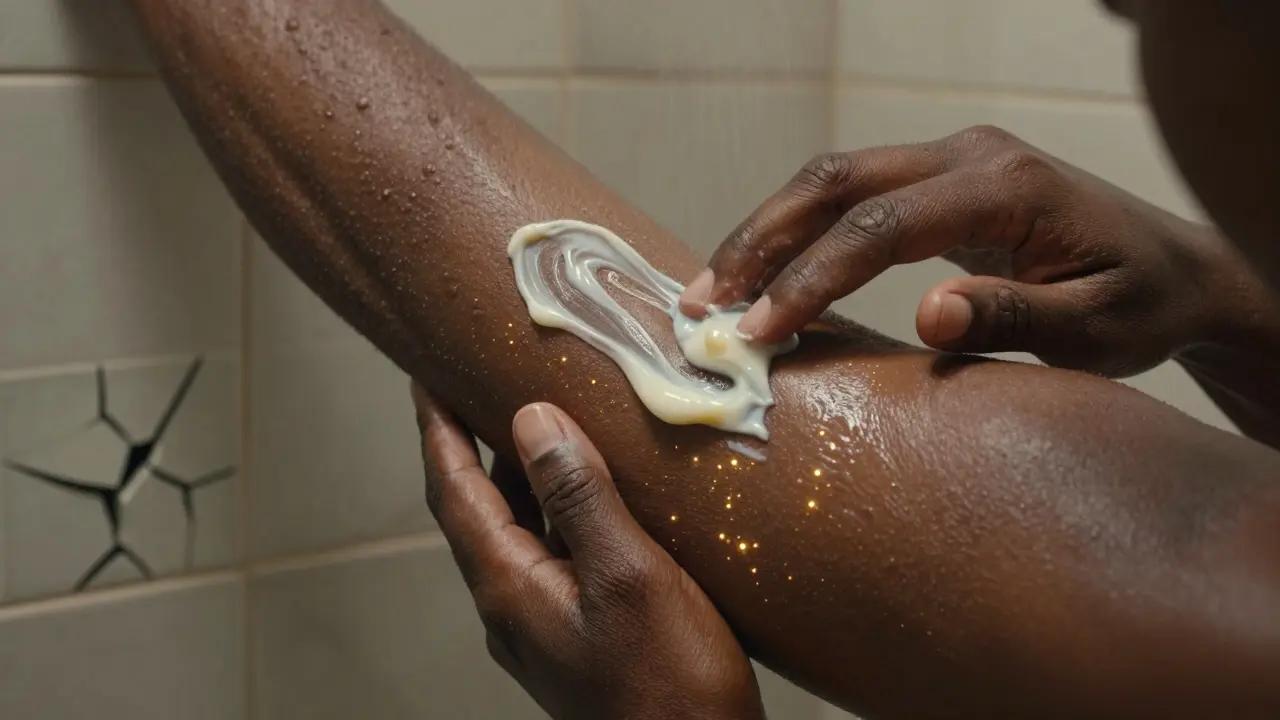
- Apply after bathing. Your skin is most absorbent within 3 minutes of getting out of the shower. That’s when the top layer is 50% more permeable. Pat your skin dry, don’t rub.
- Use exfoliants at night. Lactic acid, glycolic acid, and retinoids make your skin more sensitive to the sun. Apply them in the evening.
- Moisturize immediately after. Wait 1-2 minutes after applying the exfoliant, then slap on a thick ceramide cream. CeraVe SA Lotion is a top pick-79% of users say it works best when used right after bathing.
- Be consistent. You won’t see results in a week. It takes 8-12 weeks. And if you stop? The bumps come back in 2-4 weeks. This isn’t a quick fix-it’s a lifelong habit.
What to Avoid
Stop doing these things:
- Hot showers. They strip your skin. Lukewarm water reduces flare-ups by 45%.
- Harsh scrubs, loofahs, or body brushes. They cause inflammation and dark spots.
- Over-the-counter products that promise a “cure.” The FDA sent 17 warning letters in 2022-2023 to companies making those claims.
- Wearing tight synthetic fabrics. Cotton lets your skin breathe and cuts friction-related irritation by 72%.
When to See a Dermatologist
You don’t need to see a doctor just because you have KP. But if:
- Your skin is itchy, inflamed, or bleeding
- It’s spreading to your face or torso
- Over-the-counter products haven’t helped after 3 months
…then it’s time. A dermatologist can prescribe stronger retinoids or recommend laser therapy. Pulsed-dye laser can reduce redness by 50-75% in patients with inflamed KP. But it’s expensive-£300-£500 per session-and not covered by the NHS. It’s a cosmetic option, not a medical one.
The Realistic Outlook
Most people think KP will vanish by age 30. And for many, it does. But a 2023 study of over 2,000 patients found only 28% had complete clearance. 41% saw big improvement. 31% still had symptoms. That’s not failure-that’s normal.
What works for one person might not work for another. Some people swear by AmLactin. Others need a retinoid. A few find relief with LED light therapy devices, which were cleared by the FDA in 2023 and show a 35% reduction in bumps after 8 weeks. New treatments are coming-like microbiome-balancing creams and genetic tests to match your skin’s needs.
But here’s the bottom line: you don’t need perfect skin. You need skin that feels comfortable, looks smoother, and doesn’t make you avoid the mirror. With consistent care, that’s totally achievable.
Is keratosis pilaris contagious?
No. Keratosis pilaris is not contagious. It’s a genetic skin condition caused by excess keratin buildup, not a virus or bacteria. You can’t catch it from someone else, and you can’t spread it to others through touch or shared towels.
Can keratosis pilaris go away on its own?
Yes, for many people. About 28% of patients experience complete clearance by age 30, and 41% see major improvement. But for 31%, it persists long-term. Even if it fades, it can return during dry seasons or hormonal changes. Maintenance skincare helps keep it under control.
Why does KP get worse in winter?
Low humidity dries out your skin, making it harder for keratin to shed naturally. When indoor humidity drops below 40%, your skin’s barrier weakens, and the bumps become more visible and rough. Using a humidifier and applying moisturizer right after bathing can cut winter flare-ups by 60%.
Are there any side effects from KP treatments?
Yes. Lactic acid and glycolic acid can cause stinging or redness, especially at first-this usually fades after 1-2 weeks. Retinoids often cause peeling, dryness, and irritation, which is why 73% of users quit before seeing results. Always start slow, use moisturizer, and avoid sun exposure without sunscreen.
Do I need to use prescription products?
No. Most people see good results with over-the-counter creams containing lactic acid, urea, or salicylic acid. Prescription retinoids are more effective but come with more side effects. They’re best if OTC products haven’t worked after 3 months of consistent use.
Tatiana Barbosa
February 8, 2026 AT 16:31Finally someone broke down KP like it’s a science experiment and not a personal failure. I’ve been using AmLactin for 10 weeks and my arms actually feel smooth now-not perfect, but I can wear tank tops without mentally bracing for stares. No more scrubbing. No more shame. Just consistency.
And yes, moisturizing right after the shower is non-negotiable. I use CeraVe SA and it’s the only thing that keeps the winter flakes at bay. Stop fighting your skin. Start working with it.
Ken Cooper
February 10, 2026 AT 12:06sooo… i tried the urea cream and it burned like hell at first?? like, i thought i’d ruined my skin but then after 3 days the sting went away and now?? my elbows are actually soft?? like, i can’t believe it. i thought i was stuck with sandpaper arms forever. also, i’m not using a loofah anymore. big mistake. just my hands. gentle. like, really gentle. wow.
Joseph Charles Colin
February 12, 2026 AT 00:01The keratin plug mechanism is fundamentally a follicular hyperkeratosis event driven by filaggrin deficiency. The efficacy of lactic acid and urea stems from their keratolytic and humectant properties, respectively. Lactic acid, at 10–12%, downregulates desmosomal adhesion in the stratum corneum, while urea at 10–20% disrupts keratinocyte cohesion and enhances transdermal hydration. Retinoids act via RAR/RXR nuclear receptors to normalize follicular keratinization. But compliance is the bottleneck-73% dropout rate on retinoids isn’t about efficacy, it’s about poor tolerability protocols. Start with 0.025% every third night, buffer with ceramide emollient, and you’ll survive the purge.
John Sonnenberg
February 12, 2026 AT 02:40I spent 14 years trying everything. Every cream. Every scrub. Every YouTube hack. I even tried raw honey and coconut oil. Nothing. Then I found out my mom had it too. And my grandma. And my aunt. And now I know it’s not me. It’s my genes. And I stopped trying to fix it. I started accepting it. My skin isn’t broken. It’s just… different. And that’s okay. I wear short sleeves now. I don’t care what you think.
Joshua Smith
February 13, 2026 AT 14:12Thanks for this. I’ve been using glycolic acid for 6 weeks and was starting to doubt if it was working. The study numbers help-30–50% improvement sounds way more realistic than the ‘miracle cure’ ads. I’ll keep going. Also, the point about lukewarm showers? That’s a game-changer. I always thought hot showers were relaxing. Turns out they’re just drying me out.
John Watts
February 13, 2026 AT 18:16Let me tell you something-KP doesn’t care if you’re rich, famous, or have 10 skincare routines. It’s just there. And that’s okay. I’m from the Midwest. We don’t have fancy dermatologists. We have drugstore creams and a stubborn attitude. I started with AmLactin, moved to urea, added ceramides, and now I can wear shorts without a second thought. It’s not gone. But I’m not hiding anymore. That’s the win. And if you’re reading this and still scared to show your arms? You’re not alone. But you’re also not broken. You’re just human. And humans have skin. And sometimes that skin is rough. And that’s fine.
Randy Harkins
February 15, 2026 AT 15:45This is the most helpful thing I’ve read in years. Thank you. I’ve been dealing with this since I was 12. I used to cry in the shower because I hated my arms. Now I’m 29 and I still have KP, but I don’t hate it anymore. I moisturize every night. I use CeraVe. I avoid hot showers. And I actually feel proud of how I’ve learned to care for myself. You’re not just treating bumps-you’re learning to love your skin. And that’s everything.
THANGAVEL PARASAKTHI
February 17, 2026 AT 00:50i live in india and here humidity is always high but still i get kp on my arms. i tried urea cream from local pharmacy and it worked better than any fancy brand. also no need to spend money on expensive stuff. simple things work. just be consistent. dont give up. also cotton clothes. always.
Frank Baumann
February 19, 2026 AT 00:12Let me tell you what happened when I ignored this advice. I went on vacation last summer. I wore a tank top. I didn’t moisturize. I didn’t avoid the sun. I didn’t use any product. I thought, ‘I’m done with this.’ And then I got sunburned on my arms. And guess what? The KP turned into these angry red welts. I looked like I had some kind of allergic reaction. People asked if I was okay. I had to explain I had KP. I looked like a science experiment gone wrong. Don’t be like me. Don’t ignore the basics. Moisturize. Avoid the sun. Wear cotton. Please. For your own sanity.
Chelsea Deflyss
February 19, 2026 AT 14:40Urea? Lactic acid? You’re still using *topicals*? Have you tried microneedling? Or laser? Or even just… not caring? Because honestly, if you’re still trying to ‘fix’ this, you’re putting too much energy into it. It’s not acne. It’s not a disease. It’s just… skin. And you’re treating it like it’s your job to make it perfect. Maybe the real treatment is just… letting go. Stop buying creams. Stop reading blogs. Just live. Your skin will be fine.
Scott Conner
February 19, 2026 AT 21:42so i tried the retinoid thing for 3 weeks and my skin peeled off like a snake. i panicked and stopped. then i read the part about 73% of people quit. i was like… oh. i’m not alone. i’m gonna try again. slower. maybe once a week. and i’ll use ceramide cream after. i’m not giving up. just… taking it easy now.
Alex Ogle
February 21, 2026 AT 11:57I’ve had KP since I was 14. I’m 37 now. It’s still there. Not as bad. But still there. I used to hide my arms. Now I just… don’t care. I wear what I want. I don’t explain it. I don’t apologize for it. I don’t even think about it anymore. The treatments helped, sure. But the real change? When I stopped fighting it. When I stopped seeing it as a flaw. It’s just part of me. Like freckles. Or my laugh. Or the way I trip over my own feet. It’s not perfect. But it’s mine. And that’s enough.