

Every year, millions of workers wake up with a quietness they didn’t have the day before. Not because they’re getting older. Not because they listened to too much music. But because their job exposed them to noise that slowly, silently, destroyed their hearing. Noise-induced hearing loss isn’t rare. It’s common. And it’s completely preventable-if we stop treating it like an unavoidable part of the job.
What Happens When Noise Hits Your Ears
Your inner ear is full of tiny hair cells. They move when sound waves hit them, turning vibrations into signals your brain understands as sound. These cells don’t grow back. Once they’re damaged by loud noise, the hearing loss is permanent. There’s no surgery to fix it. No pill to restore it. Just silence where there used to be clarity. This isn’t about earaches or ringing after a concert. This is about years of exposure to machinery, tools, engines, and equipment that run at 85 decibels (dBA) or higher. That’s the level of a lawnmower or heavy traffic. At that volume, your ears can handle about eight hours. But every time the noise goes up by just 3 dBA, your safe exposure time cuts in half. At 88 dBA? Four hours. At 91 dBA? Two hours. At 94 dBA? Just one hour. And here’s the kicker: you won’t notice it happening. There’s no pain. No warning. Just a slow fade-like a volume knob being turned down in the background. By the time you realize you’re asking people to repeat themselves, or you’re turning up the TV too loud, the damage is done.Who’s at Risk? The Industries That Don’t Quiet Down
Some jobs come with dust. Others come with chemicals. Some come with noise that never stops. Construction workers face jackhammers, saws, and nail guns that regularly hit 100-110 dBA. Factory workers stand near presses, conveyors, and assembly lines that hum at 90-100 dBA. Miners deal with drills and ventilation systems that push past 100 dBA. Even farmers aren’t safe-tractors, grain dryers, and chainsaws all carry the same risk. According to CDC data from 2021, about 22 million U.S. workers are exposed to dangerous noise levels each year. In 2022, the Bureau of Labor Statistics recorded nearly 20,000 cases of hearing loss that forced workers to take time off. That’s not just a number. That’s 20,000 people who can no longer hear their kids laugh, their phone ring, or their own name called across a room.The Rules Are Broken
You’d think the government would have this figured out. But the rules are outdated. OSHA, the agency that sets workplace safety standards, says it’s okay to expose workers to 90 dBA for eight hours. That’s the legal limit. But NIOSH-the research arm of the CDC-says 85 dBA is the real threshold where damage begins. That’s not a small difference. It’s a 16-fold difference in the amount of noise energy your ears can safely handle. Why does it matter? Because 85 dBA isn’t a safe level. It’s the line where hearing loss starts. And OSHA’s 90 dBA limit lets companies legally expose workers to noise that causes damage. It’s like saying it’s okay to smoke 20 cigarettes a day as long as you don’t go over 25. Even worse, OSHA uses a 5-dB exchange rate, meaning they let exposure double every 5 dB increase. NIOSH uses a 3-dB rate-the same rate used in the European Union. That means under EU rules, a worker exposed to 88 dBA gets only four hours of safe exposure. Under OSHA? They’d get eight hours. That’s a huge gap in protection. And it’s not just about limits. A 2023 study in Nature concluded that current occupational noise limits don’t prevent hearing loss. They just delay it.What Works? The Hierarchy of Control
There’s a proven way to stop noise-induced hearing loss. It’s called the hierarchy of controls. And it’s not about earplugs. The best solution? Eliminate the noise. Replace loud machines with quieter ones. That’s the top of the list. In 2023, NIOSH launched the “Buy-Quiet” initiative-a database of over 1,200 low-noise tools and machines. A drill that runs at 85 dBA instead of 95? That’s a 10-dB reduction. That means workers can be exposed for 16 times longer before reaching danger. Next? Engineering controls. Put noise behind barriers. Enclose machines. Install sound-absorbing panels. In one mining case study, adding barriers dropped noise from 98 dBA to 82 dBA. Workers didn’t just hear better-they reported less fatigue and better focus. Then? Administrative controls. Rotate workers so no one is exposed all day. Limit time near loud equipment. But these are unreliable. A 2016 Cochrane review found effectiveness varied by 25% to 75% depending on how well they were managed. And then? Hearing protection.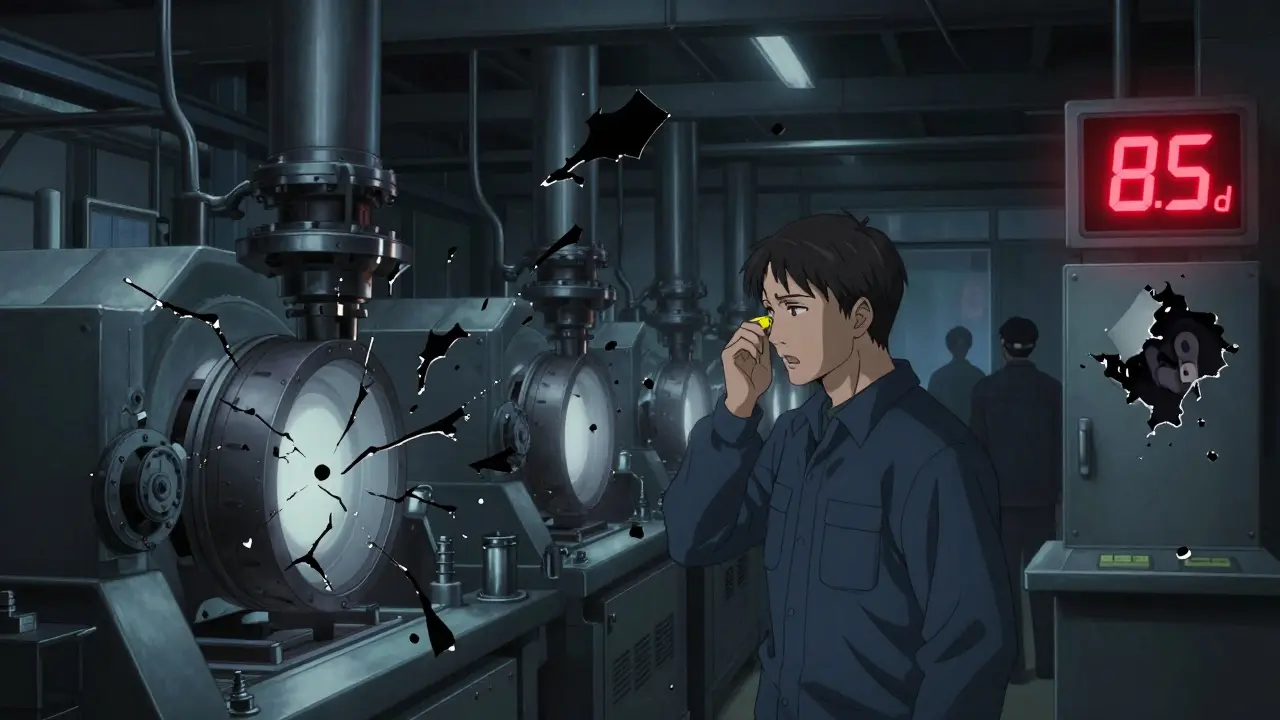
Hearing Protection: The Last Resort
Earplugs and earmuffs are the go-to fix. But they’re the weakest link. Foam earplugs are cheap. They’re everywhere. But most workers insert them wrong. A 2017 Cochrane review found only 15-20 dB of real-world protection from foam plugs-even though they’re rated for 30+ dB in labs. Why? Because people don’t roll them properly. They don’t hold them in long enough. They pull them out too soon. Custom-molded earplugs work better. They fit snugly. They offer 25-30 dB of protection. But they cost more. And they’re not always available. Even when they’re worn, they’re often taken off. A 2021 NIOSH survey found only 38% of workers in high-noise jobs wore hearing protection all day. Why? Because they couldn’t hear coworkers, alarms, or equipment warnings. One construction worker on Reddit said, “Most guys take their earplugs out because they can’t hear the machine breaking down.” And discomfort? 67% of workers said their earplugs hurt after two hours. That’s not a small issue. It’s a safety hazard. The solution? Fit-testing. Real Ear Attenuation at Threshold (REAT) measurements. This isn’t guesswork. It’s a test that measures exactly how much noise each worker’s earplugs block. It’s not common. But where it’s used, compliance and protection jump.What Should Happen at Work?
A good hearing conservation program isn’t just handing out earplugs and calling it a day. It’s five steps:- Noise monitoring-Use calibrated sound level meters to measure exposure. Not once. Every year.
- Engineering controls-Fix the noise at the source. Buy quieter tools. Install barriers.
- Proper hearing protection-Offer multiple types. Fit-test each worker. Train them to use them right.
- Audiometric testing-Annual hearing tests at 500, 1000, 2000, 3000, 4000, and 6000 Hz. A 10-dB drop at 2000-4000 Hz over baseline? That’s a standard threshold shift. Time to act.
- Training-Not a 10-minute video. A 15-minute, one-on-one session on how to insert earplugs. Studies show 75% of people do it wrong the first time.
The Real Barrier? Management
The biggest reason hearing loss keeps happening isn’t because workers don’t care. It’s because management doesn’t prioritize it. A 2023 survey by the American Industrial Hygiene Association found 71% of safety professionals say worker compliance is the biggest problem. But 89% say the real issue is lack of management commitment. Successful programs? They have leaders who show up. Who ask for noise data. Who approve quieter equipment. Who listen to workers when they say the earplugs don’t work. In one plant, workers helped pick the new hearing protection. Compliance jumped from 40% to 87%. In another, a supervisor started wearing earplugs with his team. Suddenly, no one felt singled out. The numbers don’t lie. NIOSH found a $5.50 return for every $1 spent on a full hearing conservation program. That’s from fewer workers’ comp claims, less absenteeism, and fewer accidents caused by missed warnings.
What’s Changing? The Future of Hearing Protection
The tide is turning. Slowly. California now requires employers to try engineering controls before relying on earplugs. The EU lowered its exposure limit to 80 dBA. NIOSH is drafting new guidelines that may lower the recommended limit to 80 dBA by 2025. New tech is helping too. Smart earplugs like 3M’s PELTOR TS3+ now track exposure in real time. They record when you’re in danger. They can even let you hear speech while blocking harmful noise. Researchers at USC are testing biomarkers-tiny biological signs-that show hearing damage before it shows up on a hearing test. That could mean catching problems before they’re permanent. But tech alone won’t fix this. People will.What You Can Do
If you’re exposed to loud noise at work:- Ask for a noise assessment. If your employer doesn’t do one, ask why.
- Try different hearing protection. Foam plugs aren’t the only option.
- Get your hearing tested annually. Don’t wait until you notice a problem.
- Speak up if your earplugs hurt or if you can’t hear warnings.
- Know that your hearing loss isn’t inevitable. It’s a failure of systems-not your body.
- Don’t wait for OSHA to inspect you. Test noise levels now.
- Invest in quieter tools. The “Buy-Quiet” database is free.
- Train workers individually. Don’t rely on posters or videos.
- Make hearing protection comfortable and convenient. Let workers choose.
- Track your results. If hearing loss cases drop, you’re doing something right.
Final Thought
Noise-induced hearing loss doesn’t happen because someone didn’t try hard enough. It happens because we accepted it as normal. We don’t let workers breathe toxic fumes without protection. We don’t let them stand on unstable scaffolds. But we let them sit next to machines that slowly steal their hearing-and call it part of the job. It’s not. It’s preventable. Every single case. Every single day. All it takes is the will to act.Can noise-induced hearing loss be reversed?
No. Once the hair cells in your inner ear are damaged by loud noise, they don’t regenerate. Hearing loss from noise exposure is permanent. That’s why prevention is the only effective strategy. There are no medications, surgeries, or devices that can restore lost hearing from noise.
Is 85 dBA really dangerous for hearing?
Yes. While OSHA allows 90 dBA as a legal limit, NIOSH and the CDC say 85 dBA is the level where hearing damage begins. At 85 dBA, your ears can handle about eight hours of exposure. Every 3 dB increase cuts that time in half. So at 88 dBA, you’re only safe for four hours. The idea that 85 dBA is “safe” is a dangerous myth. It’s the threshold for damage-not protection.
Why don’t workers wear hearing protection?
Many workers remove hearing protection because it blocks important sounds-like alarms, warnings, or coworkers calling out. Others find foam earplugs uncomfortable after a few hours. Some don’t believe they need them if they don’t feel pain. And many are given cheap, poorly fitting plugs that don’t work well. Training, better options, and fit-testing improve compliance.
Are custom earplugs worth the cost?
Yes, for workers in high-noise jobs who wear protection daily. Custom-molded earplugs provide consistent 25-30 dB of attenuation, fit comfortably for long shifts, and allow better communication than foam plugs. While they cost more upfront, they reduce the risk of hearing loss and improve compliance. For workers exposed to noise over 90 dBA for more than 4 hours a day, they’re a smart investment.
How often should workers get their hearing tested?
Annual testing is required by OSHA for workers exposed to 85 dBA or higher. The test should measure hearing at 500, 1000, 2000, 3000, 4000, and 6000 Hz. A shift of 10 dB or more at 2000, 3000, and 4000 Hz compared to baseline is a warning sign. Early detection means early action-before the damage gets worse.
What’s the most effective way to prevent noise-induced hearing loss?
The most effective way is to reduce noise at the source. That means buying quieter equipment, installing sound barriers, or enclosing noisy machines. Hearing protection is the last line of defense. Even the best earplugs fail if they’re not worn correctly or consistently. Engineering controls are proven, reliable, and long-lasting. They protect everyone in the area-without relying on individual behavior.
Is noise-induced hearing loss covered by workers’ compensation?
Yes. In 2022, the Bureau of Labor Statistics reported nearly 20,000 cases of hearing loss that required workers to take time off. The average workers’ compensation claim for hearing loss was $14,700. However, many cases go unreported because workers don’t realize their hearing loss is job-related. Employers who implement strong hearing conservation programs reduce these claims and save money.
Wesley Pereira
January 5, 2026 AT 15:36Man, I work in construction and this hits different. We got guys who’ve been on jackhammers for 20 years and now they can’t hear their grandkids say 'hi' at family dinners. And yeah, the earplugs? Most of us take 'em out after 10 minutes 'cause you can’t hear the foreman yell 'WATCH OUT!' when the crane swings. We need better gear, not just more plastic plugs.
Also, why the hell is OSHA still using 90 dBA? That’s like saying it’s fine to drive 80 in a 55 zone as long as you don’t hit 85. We’re not racing, we’re trying to keep our hearing.
Buy-Quiet database? I just printed it out. Gonna show it to my boss tomorrow. Maybe he’ll finally stop buying the loudest damn saws just because they’re on sale.
Rachel Wermager
January 7, 2026 AT 13:34Let’s be clear: the 3-dB exchange rate isn’t just a recommendation-it’s physics. Sound energy doubles every 3 dB, not 5. OSHA’s 5-dB rule is a relic from the 1970s when unions were weaker and liability was cheaper. NIOSH’s 85 dBA threshold is backed by decades of longitudinal audiometric studies. The fact that we’re still debating this is criminal. And don’t get me started on 'administrative controls'-rotating workers doesn’t fix the noise, it just spreads the damage around like a bad buffet.
Real solution? Engineering controls. Enclosure. Damping. Isolation. These aren’t buzzwords-they’re acoustical engineering principles that have been proven since the 1980s. If your plant still uses unenclosed hydraulic presses in 2025, you’re not saving money-you’re just delaying a lawsuit.
Leonard Shit
January 8, 2026 AT 00:52My uncle was a miner. Lost his hearing by 45. Never complained. Said, 'It’s just part of the job.' But now he sits in silence while the TV’s on full blast, and he just smiles like he’s listening. That’s the worst part-not the loss, but how quietly you accept it.
Also, I tried those custom plugs. Felt like my ears were full of warm clay. But after two weeks? I didn’t even notice I was wearing them. And I heard the damn compressor sputter before it died. That’s worth the price.
Management just needs to care. Not the safety guy. The guy who signs the checks.
Gabrielle Panchev
January 8, 2026 AT 12:22Actually, I think you’re all missing the bigger picture-this isn’t just about noise levels or earplugs or even OSHA regulations; it’s about the entire cultural normalization of bodily sacrifice in the name of productivity, which is a direct extension of capitalist alienation, where the worker’s body is treated as a disposable instrument of capital accumulation, and hearing loss is just one more metric on the balance sheet of human cost versus profit margin, and if we don’t reframe this as a systemic failure of labor ethics rather than a technical compliance issue, we’re just rearranging deck chairs on the Titanic while the water rises and the workers keep showing up, deaf to their own suffering, because they’ve been conditioned to believe that silence is just the price of a paycheck, and that’s not just tragic-it’s a moral collapse.
Also, I read the NIOSH study. The 16-fold difference in noise energy is terrifying. Like, if you’re exposed to 90 dBA for 8 hours, you’re getting the same energy dose as 128 hours at 85 dBA. That’s not a policy gap. That’s a massacre.
Cam Jane
January 9, 2026 AT 04:53Just got my annual hearing test. 10-dB shift at 4000 Hz. My boss didn’t even blink. But I’m not mad-I’m motivated. I printed out the Buy-Quiet list, highlighted 3 tools we use, and put it on his desk with a sticky note: 'This could save your team’s hearing. Or your next workers’ comp claim.'
Also-try silicone earplugs. They’re not as cheap as foam, but they don’t itch after 2 hours. And yes, fit-testing is a game-changer. My shop started doing it last year. Compliance went from 30% to 85%. People actually wear them now. Because they work. Not because they were told to.
You don’t need a revolution. You just need one person to care enough to speak up.
Dana Termini
January 9, 2026 AT 16:23I’ve worked in factories for 28 years. I’ve seen the same cycle: new guy comes in, gets earplugs, doesn’t use them, complains about not hearing coworkers, gets yelled at, then quits. We never fix the noise. We just replace the ears.
But last year, my plant installed acoustic baffles on the assembly line. Noise dropped from 94 to 82 dBA. No one had to do anything different. We just… heard better. Felt less tired. People started talking more. It wasn’t magic. It was engineering.
Why do we keep treating hearing like it’s optional?
Lily Lilyy
January 10, 2026 AT 10:49Every worker deserves to hear their child’s voice. Every worker deserves to hear the birds in the morning. This is not a technical issue. It is a human issue.
Let us choose kindness over cost. Let us choose care over convenience. Let us choose to protect what cannot be replaced.
Quiet machines are not a luxury. They are a promise.
Susan Arlene
January 10, 2026 AT 15:50we’ve been told for decades that hearing loss is just part of aging. but it’s not. it’s part of being a worker in america.
my ears are fine for now. but i know people who lost theirs before 40. no one talks about it. like it’s embarrassing.
maybe we should stop calling it 'hearing loss' and start calling it 'noise violence.'
then maybe people would stop shrugging.
Joann Absi
January 10, 2026 AT 19:54AMERICA IS WEAK. 🇺🇸
Other countries fix this. EU? 80 dBA. California? Engineering first. We? We give workers foam plugs and call it a 'program.'
My cousin works in a factory. He’s 32. Can’t hear his wife when she whispers. He says, 'It’s fine, I just lean in.'
NO. IT’S NOT FINE. YOU’RE BEING TORTURED BY YOUR JOB AND NO ONE CARES.
STOP BEING SOFT. STOP ACCEPTING THIS. THE SYSTEM IS DESIGNED TO BREAK YOU. DON’T LET IT.
✊🎧🔥
Mukesh Pareek
January 10, 2026 AT 22:30As a safety consultant in India, I can tell you this: the problem is not lack of tech or policy. It’s lack of discipline. Workers here don’t even know what dBA means. They wear earplugs as fashion accessories. Management thinks a poster is a program.
Real change requires training. Not PowerPoint. One-on-one. With translation. With demonstration. With consequences.
And yes-custom plugs work. But only if someone checks if they’re actually worn. No one checks. So nothing changes.
Stop blaming OSHA. Start building culture.