

Imagine a patient walks into your pharmacy to pick up a life-saving oncology medication, but the pills inside the bottle are nothing more than chalk and cornstarch. This isn't a hypothetical nightmare; it's a global reality. With over 6,400 incidents of pharmaceutical counterfeiting reported in 2024 alone, the risk is higher than ever. As a pharmacist, you aren't just a dispenser of medicine-you are the counterfeit drug detection expert and the last line of defense between a criminal organization and a vulnerable patient.
Key Takeaways for Pharmacy Professionals
- The Threat: Criminals target high-value therapeutic areas, particularly oncology and biologics.
- Modern Tools: Spectral analysis and AI are replacing manual paperwork for authenticity verification.
- Red Flags: Extreme price discounts and non-authorized distribution channels are primary warning signs.
- Global Standards: The WHO and FIP provide competency-based curricula to standardize detection skills worldwide.
Why Traditional Verification No Longer Works
For decades, pharmacists relied on "paper trails"-checking invoices and making phone calls to wholesalers. But counterfeiters have evolved. They now produce high-quality forged documents and mirror legitimate packaging with alarming precision. Relying on a visual check of a box is like trying to spot a fake banknote by looking at it from across the room; it's simply not enough.
The shift toward digital tracking, such as the standards set by the Drug Supply Chain Security Act (DSCSA) in the US, has created a more secure environment. However, the gaps remain, especially in developing regions. This is why specialized education is moving away from "what to look for" and toward "how to verify using technology."
Modern Training Methods and Tools
Education in this field now splits into two main camps: academic foundational knowledge and point-of-care technological training. You need both to be effective.
Academic and Competency-Based Learning
The International Pharmaceutical Federation (FIP) and the World Health Organization (WHO) have developed a bilingual, competency-based curriculum. Instead of just reading about fakes, students learn specific skill sets to identify SF products. This approach was piloted in sub-Saharan Africa (Cameroon, Senegal, and Tanzania) and showed a measurable jump in how well students could spot falsified medicines.
Tech-Integrated Verification
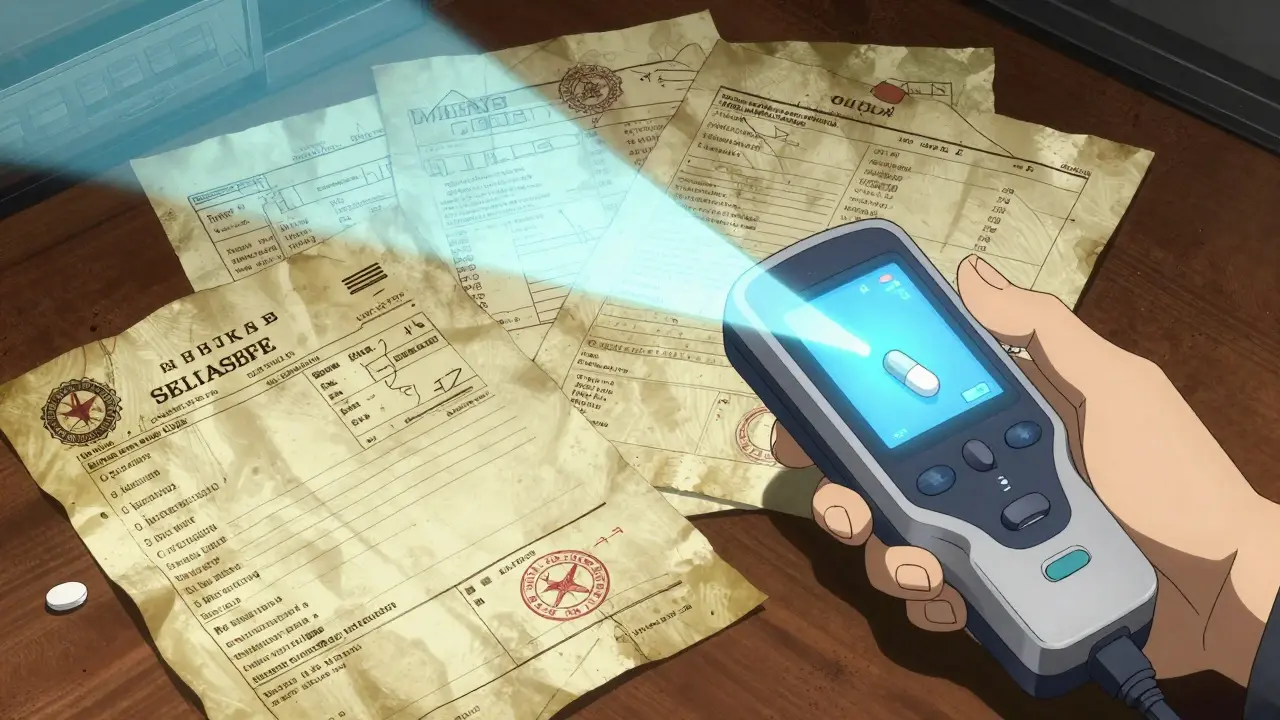
The most exciting leap in pharmacist education is the use of handheld verification devices. Companies like RxAll provide training on spectral analysis. These devices use light to "read" the chemical signature of a pill and compare it against a database of genuine products using AI algorithms. Instead of guessing, a pharmacist gets a "Green/Red" light in seconds. This removes the human error inherent in visual inspections.
| Approach | Primary Tool | Best For | Speed of Result |
|---|---|---|---|
| Academic (WHO/FIP) | Curriculum/Case Studies | Foundational Knowledge | Slow (Conceptual) |
| Regulatory (CMS/FWA) | Online Modules | Legal Compliance | Moderate |
| Tech-Driven (RxAll) | Spectral Analysis/AI | Real-time Verification | Instant |
Practical Red Flags: What Every Pharmacist Should Watch For
While technology is great, your intuition-informed by proper training-is your first filter. The Partnership for Safe Medicines suggests several concrete warning signs that should trigger an immediate investigation:
- The Price Trap: If a supplier offers a specialty drug at a price significantly below the wholesale acquisition cost, it is almost certainly a fake. Genuine high-value meds don't have "flash sales."
- Distribution Anomalies: Specialty drugs usually travel through a very narrow set of authorized channels. If a medication arrives from a distributor you've never heard of, or one that isn't listed on the manufacturer's official site, stop the shipment.
- Packaging Nuances: Look for slight variations in font, spelling errors on the insert, or a lack of holographic security features that the manufacturer recently implemented.
The Global Battle: Operation Pangea and Beyond
Counterfeiting is a corporate crime on a global scale. To understand the stakes, look at Interpol's Operation Pangea XVI in 2025. This wasn't just a small police action; it involved 90 countries. They shut down 13,000 illegal online platforms and seized over 50 million counterfeit doses.
This highlights a growing threat: online pharmacies. Modern pharmacist education now includes training on how to identify illegal digital storefronts. The updated WHO toolkit focuses heavily on the online sale of SF products, as criminals use the anonymity of the web to slip fakes into the legitimate supply chain.
Implementing a Detection Protocol in Your Pharmacy
If you're managing a pharmacy, you can't just hope your staff knows what to do. You need a formal system. Start by integrating continuing education (CE) credits that focus on "Fakes in the Pharmacy." Use resources that explain the global prevalence of counterfeiting to keep your team vigilant.
- Verify the Source: Use manufacturer websites to confirm every wholesaler is authorized.
- Adopt Technology: If your budget allows, implement spectral analysis tools for high-risk medications like biologics.
- Staff Training: Ensure every new hire undergoes fraud, waste, and abuse (FWA) training within their first 90 days.
- Report Immediately: Establish a clear line of communication with law enforcement and regulatory bodies if a fake is detected.
How can I tell if a drug is counterfeit if the packaging looks perfect?
When packaging is perfect, visual inspection fails. The most reliable method is using spectral analysis technology, which analyzes the chemical composition of the drug. If you don't have this technology, focus on the supply chain: verify the wholesaler via the manufacturer's website and check for any pricing anomalies that seem too good to be true.
Which types of medications are most commonly counterfeited?
Criminals target high-profit medicines. This includes oncology drugs, biologics, and vaccines. In 2024, data showed that over 2,400 distinct medicines across various therapeutic areas were involved in counterfeiting incidents.
Is the DSCSA enough to stop counterfeit drugs?
The DSCSA provides a powerful tracking system in the U.S., but no system is foolproof. Counterfeiters constantly look for gaps in the chain. Therefore, technological tracking must be paired with pharmacist education and vigilance at the point of dispensing.
What is the WHO/FIP curriculum?
It is a competency-based training program developed by the World Health Organization and the International Pharmaceutical Federation. It is designed to give pharmacy students and professionals the practical skills needed to identify and prevent the distribution of substandard and falsified medical products.
What should I do if I suspect a shipment is fake?
Immediately quarantine the product so it cannot be dispensed. Do not return it to the supplier without first notifying the appropriate regulatory authorities and law enforcement. Document the source, batch number, and the specific reasons for your suspicion.
Next Steps for Your Practice
Whether you are a student or a seasoned pharmacist, the goal is to move from passive awareness to active detection. If you are in a region with less infrastructure, start by studying the WHO's latest toolkit on SF products. For those in high-volume pharmacies, look into AI-powered verification tools to reduce the time spent on manual checks and increase patient safety.
Anmol Garg
April 16, 2026 AT 22:28It's really heartening to see these competency-based curricula being rolled out in sub-Saharan Africa. Access to safe medication is a fundamental human right, and empowering local pharmacists with these skills creates a sustainable shield for the community. We should all think about how we can support these global initiatives to bridge the gap between developed and developing healthcare systems.
Colleen Tankard
April 18, 2026 AT 17:46This is so important! 💊✨ Keep the patients safe! ❤️
Randall Barker
April 19, 2026 AT 11:23The fact that we even need
Randall Barker
April 20, 2026 AT 13:29The fact that we even need to discuss this in a developed nation proves that our systemic greed has completely eroded the moral fabric of the pharmaceutical industry. It's absolutely disgusting that corporate profit margins are prioritized over human lives to the point where criminals can slip chalk into oncology meds. We don't just have a "counterfeit problem," we have a spiritual bankruptcy in the way we handle medicine. If you're a pharmacist and you're not outraged by this, you're part of the problem. We need a total overhaul of the supply chain, not just some handheld scanner to tell us if we're being lied to. The existence of these fakes is a testament to a failed society that treats health as a commodity rather than a right. Absolute failure across the board.
Rock Stone
April 20, 2026 AT 17:17Let's all stay positive and keep pushing for these tech upgrades in our shops! 🚀
Adele Shaw
April 22, 2026 AT 07:19Typical. We spend all this money on fancy tech when our own borders are wide open and we're probably importing this garbage from overseas anyway. Why are we training people to spot fakes when we should be shutting down the sources in countries that don't even have basic regulations? It's a joke. I'm sick of seeing my tax dollars go toward "global standards" while the actual quality of medicine in our own backyard is slipping because we're too soft on international trade. Get it together.
Joshua Nicholson
April 24, 2026 AT 00:32spectral analysis sounds like a lot of work tbh, but i guess it's better than giving people chalk lol
Ben Ferguson
April 24, 2026 AT 04:22I must say, the integration of AI and spectral analysis is an absolutely breathtaking development in the field of pharmacy, and while some might find it overwhelming, I believe it represents a beautiful marriage of technology and healthcare that will ultimately save countless lives across the globe, especially when you consider the sheer volume of biologics being moved through these complex chains every single day, which makes the human eye completely obsolete in the face of such professional criminal forgery techniques that would baffle even the most seasoned expert in the business!