
When a doctor prescribes a generic drug, many assume it’s a simple step-just fill the script. But for providers across the U.S., that’s rarely the case. Even for low-cost, FDA-approved generics, prior authorization is often the hidden hurdle standing between the prescription and the patient’s medicine cabinet.
Why Generics Still Need Approval
You’d think generics, being cheaper and just as effective as brand-name drugs, would fly through the system. But insurance plans and pharmacy benefit managers (PBMs) use prior authorization to control how these drugs are used. It’s not about cost alone-it’s about control.Generics get flagged for prior authorization in specific situations: when there are multiple versions on the formulary and the plan favors one brand over another, when the quantity requested exceeds limits (like asking for a 90-day supply instead of 30), when the drug is prescribed longer than guidelines allow (like proton pump inhibitors beyond 8 weeks), or when it’s being used off-label. The Academy of Managed Care Pharmacy reports that 28% of all prior authorization requests involve generics, mostly because of these restrictions.
Unlike brand-name drugs, where prior authorization often means proving a cheaper option won’t work, with generics, the question is: Why this one? If the plan’s preferred generic is omeprazole 20mg, but the patient needs omeprazole 40mg due to a history of Barrett’s esophagus, the provider must prove it’s medically necessary-not just convenient.
The Step-by-Step Process
Securing approval isn’t guesswork. It’s a checklist-driven process with clear rules.- Check the formulary. Every payer has a Preferred Drug List (PDL). If the generic isn’t on it-or isn’t the preferred version-prior authorization is likely required.
- Gather clinical proof. You need documentation: lab results, diagnostic reports, clinic notes. For example, if a patient can’t tolerate metformin and needs sitagliptin, a note about GI side effects isn’t enough. You need the original prescription, the date of the reaction, and ideally, a follow-up note confirming the intolerance.
- Submit electronically. Over 78% of commercial insurers and 63% of Medicare Part D plans now require electronic submission through platforms like CoverMyMeds or Surescripts. Fax is fading fast-only 22% still accept it.
- Wait for response. Medicaid must respond within 24 hours for urgent cases and 14 days for standard ones. Commercial plans typically take 5-10 business days. But for generics, approvals often come faster-1 to 3 days-because the clinical bar is lower than for brand-name drugs.
- Handle denials. If denied, you get a reason. The most common? Lack of documentation (42%), failure to show medical necessity (38%), or not trying the preferred alternative first (20%).
Auto-approval is becoming more common. Judi Health found that 41% of generic prior authorization requests are approved automatically when the quantity is within limits and the system has a history of prior approved claims. That’s a win-if your system is set up right.
How Different Payers Compare
Not all insurance is the same. The rules vary wildly depending on who’s paying.| Payer Type | Requires PA for Generics? | Average Approval Time | Auto-Approval Rate |
|---|---|---|---|
| Medicaid Fee-for-Service | 67% | 1-3 days | 35% |
| Medicare Part D | 89% | 2-5 days | 40% |
| Commercial Insurance | 93% | 3-7 days | 41% |
Medicaid is often the fastest because of federal rules. Medicare Part D has tightened rules since the Improving Seniors’ Timely Access to Care Act took effect in January 2024-plans now must respond to standard requests within 72 hours. Commercial insurers are the most inconsistent. Some have streamlined systems; others still require handwritten letters.
What Providers Are Doing Right
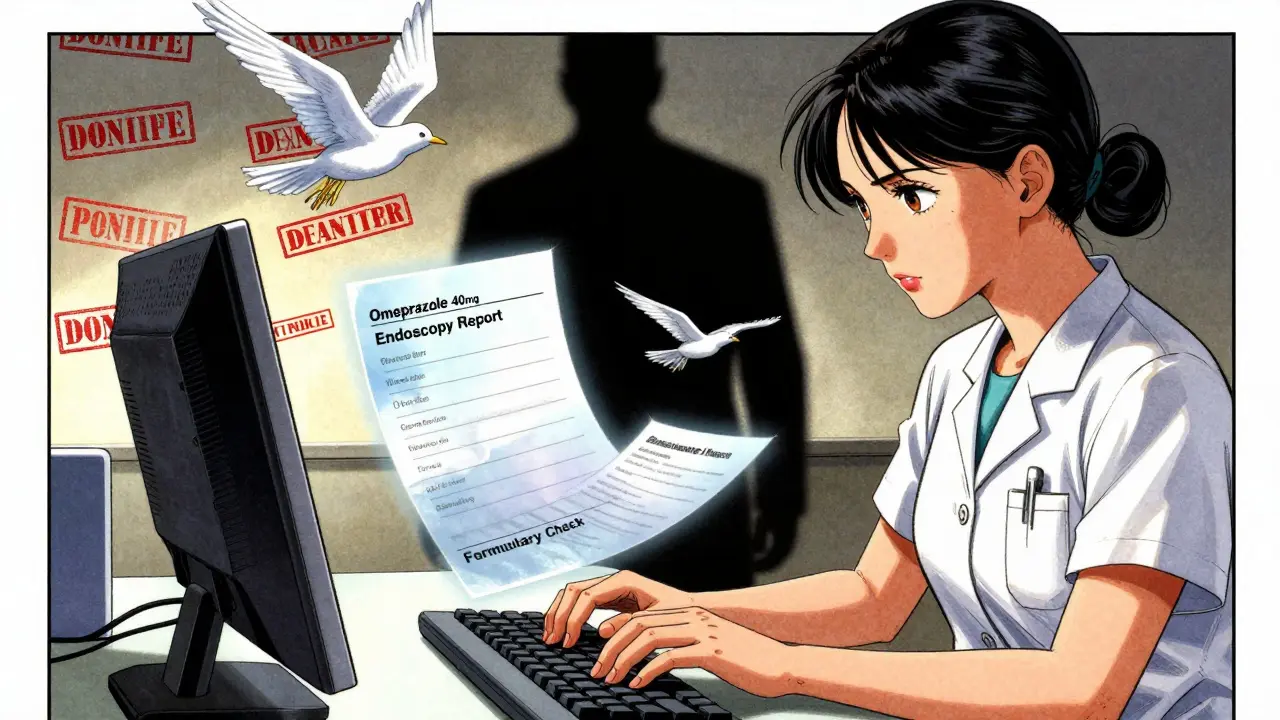
Successful practices don’t wait for the system to change-they adapt.Dr. Michael Chen, a primary care physician in Pennsylvania, got omeprazole 40mg approved in two days by attaching the endoscopy report showing intestinal metaplasia. He didn’t just write a note-he attached the evidence. That’s the difference.
Top-performing clinics have:
- A dedicated medical assistant handling prior authorizations full-time
- Standardized templates for common scenarios (e.g., PPIs, diabetes meds, statins)
- Payer-specific checklists (what each insurer requires, who to call, which portal to use)
- Relationships with payer reps-calling the right person can cut days off approval time
Capital Rx found that providers using templates see 32% faster approvals for generics. That’s not magic-it’s efficiency.
The Big Problems
Despite improvements, the system still breaks down often.One physician on Sermo reported a denial for generic sitagliptin because the insurer required proof of three failed diabetes meds-even though ADA guidelines say metformin intolerance alone justifies switching. That’s not clinical logic. That’s policy rigidity.
Patients suffer too. A National Community Pharmacists Association survey found 83% of pharmacists have had patients walk out because they couldn’t pay out-of-pocket while waiting for approval. A $5 generic becomes a $150 burden overnight.
Physicians spend an average of 16.1 hours a week on prior authorization. That’s nearly two full workdays. The American Medical Association says 78% of that time could be spent with patients instead.
What’s Changing in 2026
The tide is turning-slowly.As of July 2024, Medicaid managed care plans must use standardized electronic transactions, cutting processing time by an estimated 25%. CMS is pushing for more automation. Express Scripts reported a 40% increase in auto-approvals for generics in 2023. And McKinsey predicts that by 2026, 75% of generic prior authorization decisions will be handled by AI systems, reducing turnaround to under 24 hours.
The AMA is pushing state laws to eliminate prior authorization for generics that have been on the market for over five years and have multiple manufacturers. That’s smart. If there are 12 versions of lisinopril, why does one need approval?
But the Congressional Budget Office warns: if nothing changes, provider administrative costs will jump $1.2 billion by 2026. That’s not savings-that’s waste.
What You Can Do Today
If you’re a provider, here’s how to cut through the noise:- Use electronic systems-no exceptions. Fax is a relic.
- Build a template library. Save approved responses for common drugs like metformin, omeprazole, atorvastatin.
- Track denials. If a payer denies the same request three times, call them. Ask why. Change your approach.
- Train your staff. Medical assistants who handle prior auths should know the top 20 drugs your practice prescribes and what each payer requires.
- Know your formulary. Don’t guess. Check it every quarter.
And if you’re a patient? Ask your provider: Is this going to need prior authorization? If yes, ask how long it usually takes. That knowledge helps you plan.
Do all generic medications require prior authorization?
No. Most generics don’t require prior authorization unless the insurance plan has specific restrictions-like preferring one generic brand over another, limiting quantity, or restricting duration. For example, a 30-day supply of generic lisinopril usually doesn’t need approval, but a 90-day supply might.
How long does prior authorization for generics usually take?
For generics, approval typically takes 1-3 business days if documentation is complete. Medicaid can approve urgent requests in 24 hours. Commercial insurers often take 3-7 days, especially if they request more info. Auto-approvals can happen in minutes if the system recognizes a prior approved claim.
Why is prior authorization harder for generics than brand-name drugs?
It’s not harder-it’s different. For brand-name drugs, you prove the generic won’t work. For generics, you prove why this generic is needed when another is preferred. It’s about formulary rules, not clinical need. That’s why documentation matters more: you’re not fighting effectiveness-you’re fighting policy.
Can patients pay out-of-pocket to avoid prior authorization?
Yes, but many can’t. Generic medications are often priced so low that insurers expect them to be covered. If a patient pays out-of-pocket while waiting, they may pay $150 for a $5 drug. Some pharmacies offer discount programs, but patients rarely know to ask. Providers should flag these cases and help patients explore options.
What’s the biggest mistake providers make with prior authorization for generics?
Waiting until the last minute. Many providers wait until the patient is at the pharmacy to start the process. That’s too late. Start the request as soon as the prescription is written. Also, using vague notes like "patient needs this medication" instead of specific clinical reasons leads to denials. Be precise: "Patient developed rash with preferred generic; this formulation is better tolerated."
Are there any new laws helping with generic prior authorization?
Yes. The Improving Seniors’ Timely Access to Care Act (2023) requires Medicare Advantage plans to respond within 72 hours for standard requests and 24 hours for urgent ones-effective January 2024. Medicaid now requires standardized electronic submissions. And several states are moving to eliminate prior authorization for generics with multiple manufacturers that have been on the market for over five years.
John O'Brien
January 27, 2026 AT 02:52Bro this is insane. I spent three days fighting for a 30-day script of generic metformin last month. The insurer said I needed proof the patient couldn't tolerate the other brand even though they're chemically identical. Meanwhile, the patient skipped doses and ended up in the ER. This isn't healthcare-it's bureaucratic warfare.
astrid cook
January 28, 2026 AT 00:48Of course it's this hard. Insurance companies don't want you to save money-they want you to suffer. They'd rather you pay $150 for a brand-name drug than let you get the $5 generic. It's not about cost control. It's about profit. And they know you'll give up and pay out of pocket.
April Williams
January 28, 2026 AT 14:46Let me guess-you're one of those providers who thinks the system is broken because you're too lazy to fill out the form properly. I've seen doctors submit one-line notes like 'patient needs it' and then act shocked when it gets denied. Stop blaming the system and start doing your job right. Documentation isn't optional-it's your armor.
Andrew Clausen
January 30, 2026 AT 05:47The article incorrectly conflates prior authorization requirements with formulary preferences. Prior authorization is a clinical gatekeeping mechanism; formulary tiering is a financial one. They are distinct processes with different regulatory frameworks. The 28% statistic cited refers to PA requests involving generics, not that generics are inherently subject to PA. Precision matters.
Kirstin Santiago
January 30, 2026 AT 18:00For anyone new to this-start with templates. I used to waste hours on every request until I built a library for the top 15 meds my clinic prescribes. Now I just plug in the patient's diagnosis and lab values, hit submit, and move on. It's not glamorous, but it saves hours. And yes, your MA can learn this. Train them like you'd train them on EHRs.
Conor Flannelly
February 1, 2026 AT 01:25Back home in Ireland, we just give the meds. If a doctor writes it, the pharmacy fills it. No forms, no calls, no waiting. We have a single-payer system, sure-but that’s not the only way. The US system feels like a Rube Goldberg machine built by people who hate patients. It’s not efficiency-it’s cruelty disguised as cost control.
Conor Murphy
February 2, 2026 AT 10:22My cousin’s dad had to wait 11 days for a generic statin because the system kept rejecting his form. He stopped taking it. Three weeks later, he had a mild heart attack. This isn’t policy. This is negligence. And the worst part? Nobody gets punished for it. Just patients who die quietly while waiting.
Marian Gilan
February 3, 2026 AT 23:49theyre all in on it. the big pharma and the pams and the insurance giants-theyre all one big cartel. you think they dont know this is killing people? they do. and they laugh. every time someone skips their meds because they cant afford the $150 out of pocket while waiting for approval, they get another bonus. its not broken. its designed this way.
Paul Taylor
February 4, 2026 AT 21:51Just use CoverMyMeds. That's it. No more faxing. No more handwritten notes. No more excuses. If you're still using paper you're not just inefficient-you're part of the problem. I've seen clinics cut approval time from 7 days to 12 hours just by switching systems. It's not magic. It's basic tech adoption.
Desaundrea Morton-Pusey
February 6, 2026 AT 05:54Ugh I'm so tired of this. Why do we even have generics if we still have to beg for them? This is why I hate American healthcare. Everything is a maze. Everything is a trap. Everything is designed to make you give up.
Murphy Game
February 8, 2026 AT 05:40They're not just delaying generics-they're testing your will to survive. Every denial is a psychological game. They know you'll eventually pick the brand name because you're exhausted. And then they charge you more. It's not a system. It's a trap.
Kegan Powell
February 9, 2026 AT 23:52Hey I get it. This is exhausting. But here’s what I’ve learned-every time you get a denial, write down why. Then call the rep. Not the automated line. The actual human. Ask them ‘what’s the one thing I could’ve done differently?’ Most of them will tell you. And then you fix it next time. You’re not fighting the system-you’re learning its language. One approval at a time 🙌