

Imagine spending millions developing a generic version of a blockbuster drug, only to have your application rejected because the manufacturing process isn't robust enough. That scenario used to be common when regulators relied mostly on end-product testing. But that world changed significantly around 2017 when the U.S. Food and Drug Administration made certain expectations mandatory. Today, relying on old-school recipe-based manufacturing is risky. You need to build quality into the system before a single tablet is pressed.
This shift represents Quality by DesignQbD. In the context of generic drug development, it has moved from being a "nice-to-have" innovation to a critical necessity for approval. With the landscape shifting towards continuous manufacturing and stricter bioequivalence standards in 2026, understanding these frameworks is vital for maintaining market access.
Defining the Standard: Beyond Testing Quality
Most people assume quality means inspecting the final bottle of pills. However, Quality by Designa systematic approach to development that begins with predefined objectives and emphasizes product and process understanding based on sound science flips that script entirely. Instead of detecting defects after production, you prevent them by understanding exactly how every variable affects the product.
The foundation of this methodology rests on the ICH Q8(R2) guideline established by the International Council for Harmonisation. While initially released in 2009, its application in generic development became strictly enforced following the 2011 FDA guidance. By 2017, all Abbreviated New Drug Applications (ANDAs) submitted had to include these elements. The goal wasn't just to pass a test; it was to define a scientific rationale for why your generic matches the Reference Listed Drug.
This distinction matters because traditional methods often failed during scale-up. A formulation that works perfectly in a 1kg lab batch might fail miserably in a 100kg production run if parameters aren't understood. QbD provides the map to navigate those changes safely.
The Five Pillars of Modern Generic Development
You can't just say you're using QbD. You have to prove it through five specific technical components. Think of this as constructing a house where the blueprint determines the structural integrity.
- Quality Target Product Profile (QTPP)A summary of desired quality attributes necessary to ensure safety and efficacy: This defines what the drug needs to do, such as dissolving within 30 minutes.
- Critical Quality Attributes (CQAs)Physical, chemical, biological properties affecting quality: These are measurable targets, like impurity levels or hardness, required to match the original brand-name drug.
- Critical Process Parameters (CPPs)Process variables having a direct impact on CQAs: Examples include granulation moisture or compression force.
- Design SpaceMultidimensional combination of input variables proven to deliver quality products: This allows you to change settings within approved ranges without notifying regulators.
- Control StrategyCoordinated set of controls derived from knowledge ensuring process control: Using tools like near-infrared spectroscopy for real-time monitoring.
A recent benchmarking study found that manufacturers utilizing these pillars typically document between 5 and 12 Critical Quality Attributes per product. For instance, dissolution rates are often monitored using an f2 similarity factor greater than 50 compared to the reference drug.

Comparing Traditional vs. Science-Based Approaches
| Feature | Traditional Fixed Recipe | Quality by Design (QbD) |
|---|---|---|
| Parameter Setting | Single-point fixed values (e.g., mix for 15 mins) | Optimized operating ranges with justification |
| Risk Management | End-product testing relies on luck | Proactive risk assessment (ICH Q9) |
| Process Changes | Requires regulatory submission for minor tweaks | Flexible adjustments within Design Space |
| Failure Rate | Higher deviation rates post-approval | Reduced deviations (reported ~85% drop) |
The data supports the shift. Generic applications built with QbD principles see approval timelines average 9.2 months compared to nearly 14 months for traditional submissions. Furthermore, Complete Response Letters-essentially rejections-are 31% less frequent when you provide a scientifically robust design space. While initial development costs can rise by 25%, the long-term flexibility saves significantly. Companies report saving up to $1.2 million annually per product in change management fees alone.
The Reality of Implementation: Costs and Complexity
Adopting these modern approaches isn't without hurdles. The biggest barrier remains expertise. Design of Experiments (DoE) requires scientists trained in multivariate statistics, skills that cost upwards of 80 hours to train effectively. Many facilities still lack the capital investment required for Process Analytical Technology (PAT) hardware, which typically demands over $500,000 in instrumentation for full implementation.
There is also the issue of proportionality. Experts warn against "over-engineering" simple generics. Spending hundreds of thousands on DoE for a basic immediate-release tablet makes little business sense. Dr. James Polli, a prominent academic voice, notes that applying complex QbD rigor to well-understood molecules creates unnecessary burden. The key is tailoring the depth of your investigation to the complexity of the product. Complex generics like modified-release tablets demand the full suite of QbD tools, whereas simpler products might benefit from reduced bracketing strategies.
However, for complex delivery systems-inhalers or transdermal patches-there is no alternative. Bioequivalence trials for these products are often unethical or technically impossible. In these scenarios, QbD serves as the primary proof mechanism to establish therapeutic equivalence without human clinical trials.
Navigating Regulatory Expectations in 2026
By 2026, the regulatory environment has tightened. The FDA's GDUFA III program explicitly encourages these methodologies, offering fast-track review channels for compliant applicants. Meanwhile, the European Medicines Agency (EMA) now mandates QbD for all complex generics submitted under their framework. The harmonization effort extends globally, with WHO prequalification programs now assessing candidates based on lifecycle management capabilities rather than static batch testing.
We see a clear trend toward "Lifecycle Management." You submit your initial approval, but the expectation is that you monitor the process continuously. The FDA tracks changes via the Post-Approval Change Management Plan (PACMP). Companies leveraging approved design spaces implement manufacturing changes 73% faster than those stuck in traditional reporting loops. During supply chain crises, this agility can mean the difference between keeping patients stocked with essential medication and facing shortages.
Future Trajectories: Continuous Manufacturing
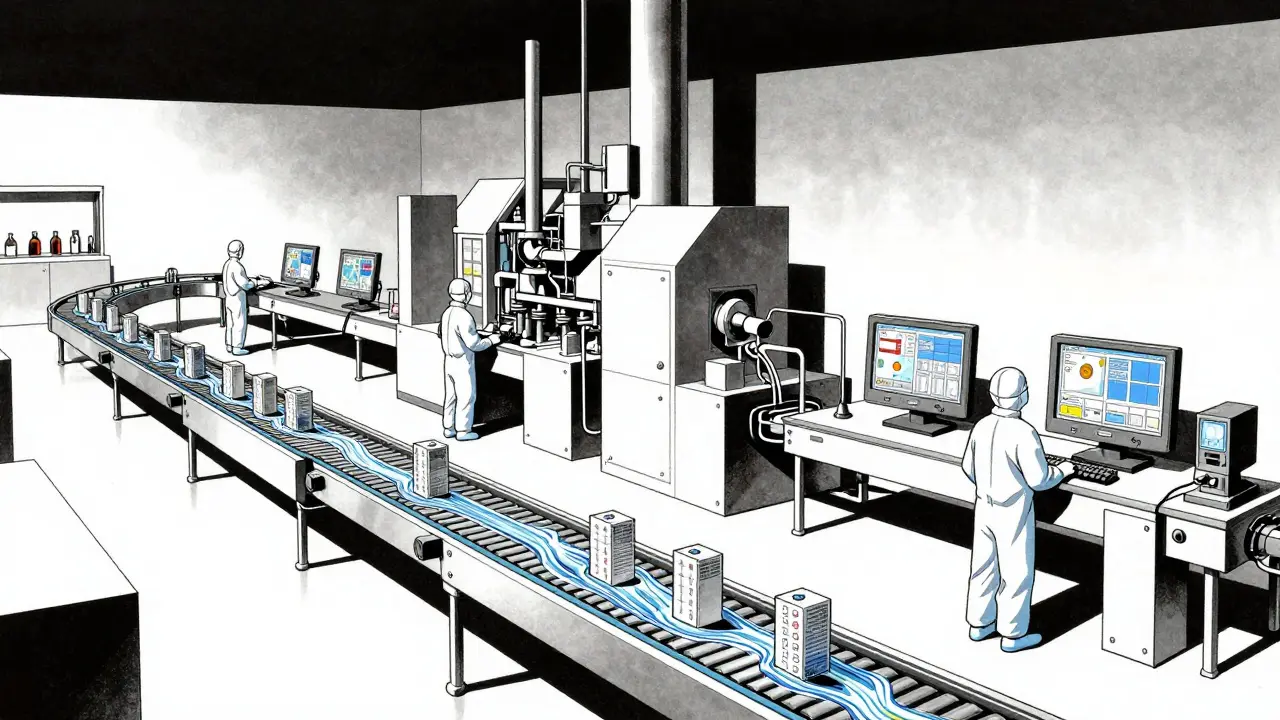
Looking forward, the synergy between QbD and continuous manufacturing technology is becoming the gold standard. Traditional batch processes rely on stopping, testing, and restarting. Continuous manufacturing allows materials to flow constantly while sensors monitor quality in real-time. This aligns perfectly with QbD goals because it generates massive amounts of process data to refine the design space further.
Recent pilot programs show that approximately 100% of continuous manufacturing applications incorporating QbD receive approvals. McKinsey predicts that by 2027, nearly all new generic approvals will feature some element of this design. As 3D-printed generics and complex biologics enter the pipeline, the reliance on rigid recipes will vanish entirely. We are moving toward an era where the "process" itself guarantees the "product".
What is the core difference between QbD and traditional quality control?
Traditional QC relies on testing the final product to see if it meets specs. QbD builds quality into the design phase, establishing known limits (Design Space) so the process consistently produces quality regardless of small fluctuations.
Is QbD required for all generic drug submissions?
Since October 2017, the FDA expects QbD elements in ANDAs. While strictness varies by product complexity, formal inclusion of elements like QTPP and CQAs is effectively mandatory for approval success.
Does implementing QbD always result in lower costs?
Initial development costs rise by 25-40%. However, long-term operational costs drop due to fewer batch failures, reduced testing needs, and the ability to make process changes without regulatory resubmission.
What are the most common reasons for QbD implementation failure?
According to EMA reports, 63% of failures stem from inadequate mechanistic understanding of the formulation. Without truly knowing how ingredients interact, defining a valid Design Space is impossible.
How does QbD impact bioequivalence demonstration?
QbD helps justify Biopharmaceutics Classification System (BCS) waivers. Strong in-vitro correlations established during QbD development can sometimes eliminate the need for costly clinical bioequivalence trials for certain simple drug products.
Molly O'Donnell
April 1, 2026 AT 23:28Stop reading blogs and actually look at the ICH guidelines yourself before posting nonsense.
Rod Farren
April 3, 2026 AT 02:12This aligns perfectly with what we saw during our recent DoE implementation phases. We found that mapping Critical Process Parameters directly to Critical Quality Attributes reduced our deviation rates significantly across the board. It isn't just about compliance anymore, folks, it's about robust process control via PAT integration. When you optimize your granulation moisture content against dissolution profiles, the entire lifecycle management strategy becomes infinitely more agile. Plus, the cost savings on batch failures alone justify the initial capital expenditure on NIR spectroscopy hardware within twelve months. Most facilities still fail because they try to copy recipe parameters without understanding the underlying chemistry mechanics. Without a valid design space, any minor equipment change triggers a complete regulatory re-submission nightmare. We invested heavily in multivariate statistical training for our formulation scientists last fiscal year. The return on investment appeared within the second quarter of continuous operation cycles. Traditional QC relies on detecting errors after the fact, which is inherently reactive rather than proactive. Modern QbD shifts the paradigm to predictability based on historical process data and modeling. Regulators now expect to see risk assessments embedded within the ANDA documentation packages explicitly. This includes identifying potential failure modes during the design stage before scale-up begins. Ignoring these principles leads to higher rejection rates for Complete Response Letters compared to standard submissions. Ultimately, embracing this methodology ensures market access remains secure against tightening global expectations in 2026.
Owen Barnes
April 4, 2026 AT 18:11Rod yure point regarding the capital expense is well taken indeed. It can seem daunting for smaller generc manufacturers to invest such large sums upfront. However the long term benefits of flexible adjustments without resubmission are truly worth the struggle. We shoud remember that not every product needs this level of rigorous engineering though. Simple immediate release tabs might not need the full suite of tools.
Callie Bartley
April 6, 2026 AT 11:17Another day another regulation to worry about honestly. It feels like the FDA just wants to keep us guessing with new requirements every single year. Sure fine for big pharma giants who have millions in the bank to burn on consultants. Small guys are getting squeezed dry while trying to keep prices down for patients too. Why does everything have to be so complicated when we just want clean meds?
Arun Kumar
April 6, 2026 AT 12:50I understand the frustration completely especially with rising operational costs globally. In many developing regions this complexity creates barriers for local production capabilities which hurts access. But we must see the quality assurance aspect as protecting the vulnerable populations primarily. It is not about bureaucracy for bureaucracy sake but ensuring consistent therapeutic equivalence everywhere. We need to support each other through these transitions rather than fearing the new standards.
Cara Duncan
April 6, 2026 AT 13:18It really is exciting to see the industry moving towards more continuous manufacturing processes! 🌟 Imagine how much faster we could get life saving drugs into people hands with this tech. Some people might worry about the cost but the future looks so bright with these innovations 😊. Plus fewer batch failures means less waste overall which is good for the planet too 🌍. Keep up the great work sharing this knowledge!
Russel Sarong
April 8, 2026 AT 03:52You are absolutely right!!! The potential here is MASSIVE!!!! Continuous manufacturing IS the future!!!! I cannot stress enough how vital real time monitoring is!!! 🚀 Every sensor counts!!! Let us embrace this change fully!!!
James DeZego
April 9, 2026 AT 07:35For those struggling with the design space concept, think of it like cooking with precise measurements instead of pinches. :) It makes scaling up to commercial batches much smoother and safer. Don't panic if your first DOE attempt hits a snag, it's part of the learning curve. Just ensure your critical attributes are properly defined early on. Hope this helps anyone feeling stuck in the planning phase. :-)
Rocky Pabillore
April 11, 2026 AT 06:49While most seem to struggle with the basics, the real issue is understanding the underlying science behind ICH Q8(R2). It requires a certain level of intellectual rigour that casual observers simply lack. True innovation comes from deep mechanistic understanding not just checking boxes for regulatory submission. Those relying on old methods should perhaps reconsider their career paths in formulation science. It is unfortunate but necessary evolution for the field.