
Medication Safety Risk Calculator
Risk Assessment
Input your medication details to calculate potential safety risks
How It Works
Understanding your medication safety risks
Risk Analysis Results
Enter your details to see your personalized risk assessment.
When you’re taking multiple medications, every pill matters. Missing one, doubling up, or mixing drugs that shouldn’t be taken together can lead to serious harm-sometimes hospitalization. But there’s a simple, proven way to cut those risks dramatically: use one pharmacy for all your prescriptions.
It sounds basic, but most people don’t do it. About 37% of Medicare Part D users spread their prescriptions across two or more pharmacies. Why? Price. They shop around for the cheapest fill on a specific drug. But what they’re trading for savings is safety. Studies show patients using multiple pharmacies face a 34% higher risk of dangerous drug interactions than those who stick with one. That’s not a small number. That’s millions of people at avoidable risk.
How One Pharmacy Stops Dangerous Drug Interactions
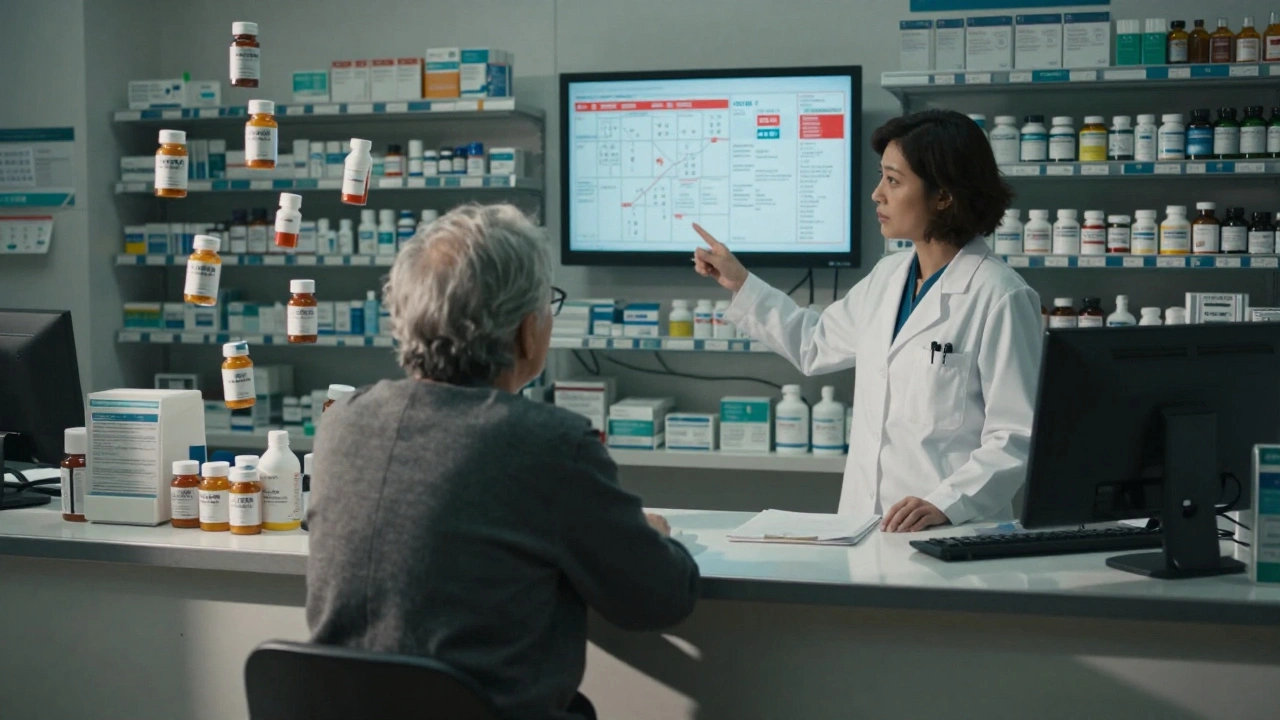
Pharmacists aren’t just people who hand out pills. They’re medication experts trained to spot conflicts between drugs. When you use one pharmacy, that pharmacist sees your full list-every prescription, every over-the-counter pill, every herbal supplement. That’s the key.
Modern pharmacy systems scan every new prescription against your entire history in seconds. They check for interactions between blood thinners like warfarin and common painkillers like ibuprofen. They flag when two different doctors have prescribed the same active ingredient-like metformin for diabetes-leading to accidental double dosing. One study found therapy duplication happens in 7% of patients using multiple pharmacies. At a single pharmacy? It drops to 0.3%.
These aren’t hypothetical risks. There are real cases. A patient in Cleveland was hospitalized with serotonin syndrome after two different pharmacies filled antidepressants that shouldn’t have been taken together. The pharmacist at each location only saw half the picture. Together, they created a dangerous mix.
Med Sync: The Secret Weapon for Adherence
One pharmacy doesn’t just help avoid bad combinations. It helps you take your meds right. That’s where medication synchronization, or “med sync,” comes in.
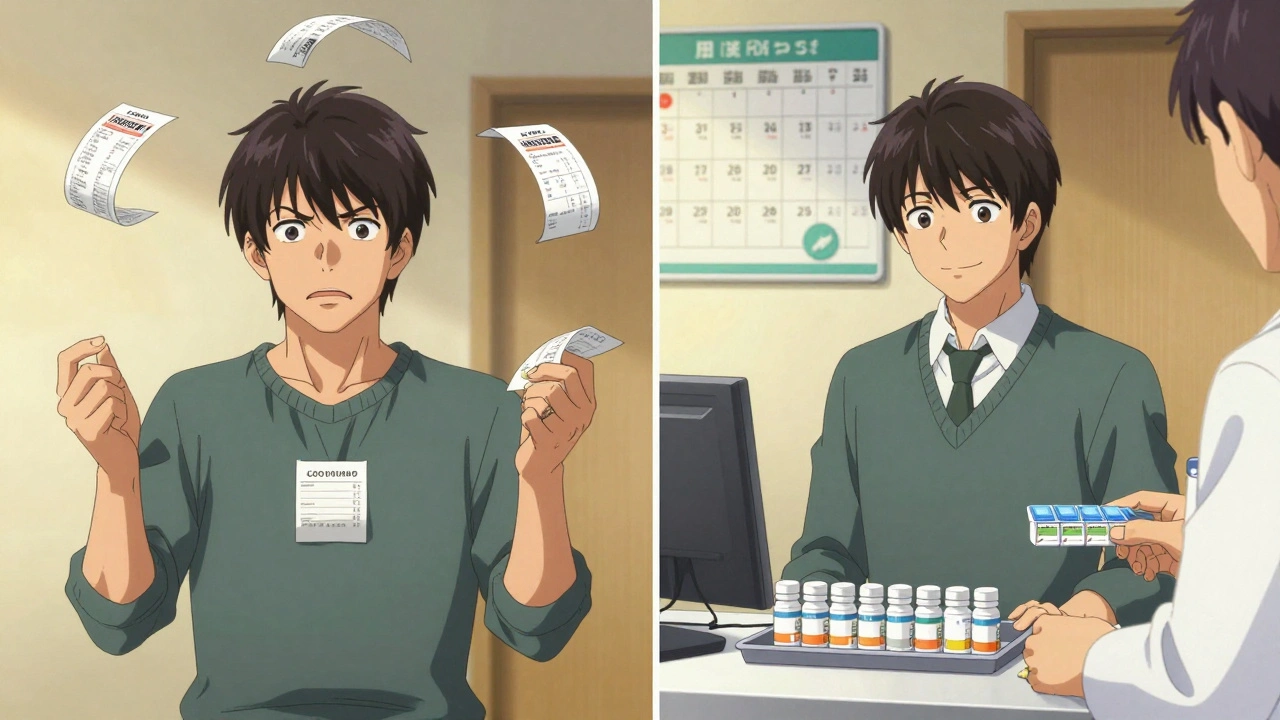
Med sync means all your prescriptions are set to refill on the same day each month. No more juggling 3 different refill dates. No more forgetting which pill you’re supposed to take today. It’s a four-step process: you enroll, your pharmacist reviews everything you take, they adjust your refills with short-term fills if needed, and then you pick up everything at once-every month.
Big pharmacy chains like CVS and Walgreens run these programs. Their internal data shows 85-90% of patients stick with their meds when enrolled. Why? Because it’s easier. You don’t have to remember a dozen different dates. You don’t have to call in refills. You get one appointment, one stop, one conversation with your pharmacist.
And that conversation matters. When you see the same pharmacist every month, they remember your name, your routine, your concerns. They notice if you’re skipping doses or if a side effect has popped up. That kind of relationship is impossible when you’re bouncing between stores.
The Cost Myth: Why Saving a Few Bucks Isn’t Worth the Risk
The biggest reason people use multiple pharmacies? Price. A 2022 Consumer Reports study found patients can save $150-$300 a year by switching pharmacies for cheaper fills. That’s real money.
But here’s what most people don’t realize: the cost of a single preventable adverse drug event is about $8,750. That’s the average hospital bill from a bad interaction-something that could have been caught by one pharmacist reviewing your full list.
And the savings aren’t even guaranteed. Many insurance plans have fixed copays that don’t change much between pharmacies. Plus, some pharmacies offer price-matching. Ask your pharmacist. They often can match a competitor’s price if you show them the receipt.
For people on five or more medications-a group that makes up 15% of U.S. adults-the risk skyrockets. Fragmented care isn’t just inconvenient. It’s deadly. The University of Southern California’s Polypharmacy Research Group found that patients using multiple pharmacies are far more likely to end up in the ER because of medication errors.
How to Make the Switch (Without the Stress)
Switching to one pharmacy sounds hard. You’ve got scripts at three different places. You’re used to the drive-thru at the corner store. But it’s easier than you think.
Start by picking one pharmacy you trust. It doesn’t have to be the cheapest. Pick the one with good service, a pharmacist you feel comfortable talking to, and maybe even a drive-thru if that helps.
Call them. Ask them to transfer all your prescriptions. The National Community Pharmacists Association says transfers take 2-5 business days. That’s it. No paperwork. No hassle. They handle everything.
While you’re at it, ask about med sync. Tell them you’re on multiple meds and want everything on the same refill day. They’ll walk you through the steps. It usually takes 2-4 weeks to get everything aligned.
And while you’re at it, bring your full list. Not just prescriptions. Include vitamins, supplements, and over-the-counter stuff like antacids, sleep aids, or cold medicine. Many dangerous interactions happen with these “harmless” pills.
Who Benefits Most?
This isn’t just for seniors. It’s for anyone on more than three medications. That includes people with:
- Diabetes (often on insulin, metformin, blood pressure meds, and cholesterol drugs)
- Heart disease (multiple blood pressure, anti-clotting, and cholesterol meds)
- Depression or anxiety (antidepressants that can interact with other drugs)
- Chronic pain (opioids, NSAIDs, muscle relaxants)
- Autoimmune conditions (immunosuppressants with complex interaction profiles)
Diabetes Care Community’s 2022 guide calls single-pharmacy use a “critical safety measure” for people with chronic illness. Why? Because their meds are complex. One mistake can send blood sugar crashing or cause kidney damage.
Even if you’re healthy now, if you’re on multiple drugs, your risk is rising. The average American over 65 takes four prescriptions. That number keeps climbing. The sooner you consolidate, the safer you’ll be.
What’s Changing in 2025?
The system is starting to catch up. In 2023, the Pharmacy Quality Alliance made comprehensive medication reviews a key performance metric. Pharmacies are now incentivized to help patients stick with one provider.
In 2024, CMS proposed new rules offering bonuses to pharmacies that hit 90%+ med sync rates. That means more pharmacies will push this service.
And soon, AI tools will help. The University of Southern California is launching a decision-support tool in Q2 2025 that will analyze your full med list and predict not just risks, but also hidden benefits. It could recommend combining two pills into one if safe, or suggest a cheaper alternative that won’t clash with your other drugs.
But tech alone won’t fix this. Only you can choose to use one pharmacy. Only you can ask your pharmacist to review everything you take. Only you can say no to price shopping when your safety is on the line.
Final Thought: Safety Isn’t a Discount
You wouldn’t buy a used car without checking the brakes. You wouldn’t fly on a plane with a known mechanical issue. So why risk your health for a few dollars on a prescription?
Using one pharmacy doesn’t mean you’re locked in. You can still switch if your needs change. But once you do it, you’ll wonder why you didn’t start sooner. Peace of mind isn’t a luxury. It’s the result of smart, simple choices.
Take your meds. Know what you’re taking. And do it all in one place.
Colin Mitchell
December 3, 2025 AT 22:58Just switched my whole family to one pharmacy last month-best decision ever. My mom’s on 7 meds, and now she gets everything on the same day. No more frantic calls to three different stores. The pharmacist even caught a bad interaction between her fish oil and blood thinner before it became a problem. Seriously, if you’re on more than three pills, just do it.
Stacy Natanielle
December 5, 2025 AT 05:16While the premise is statistically sound, the article exhibits a concerning lack of critical engagement with pharmaceutical industry incentives. The promotion of single-pharmacy consolidation aligns too neatly with corporate pharmacy profit models-especially given that CVS and Walgreens dominate the med-sync market. One must ask: Is this truly patient-centered care-or a controlled ecosystem designed to maximize adherence metrics and reduce operational friction for Big Pharmacy? 🤔💊
kelly mckeown
December 6, 2025 AT 17:47i’ve been using one pharmacy for 3 years now and it’s been a lifesaver… i forget stuff all the time but my pharmacist just remembers everything. she even texted me last month when my blood pressure med was running low. i didn’t even ask. she just knew. thank god for good pharmacists 😊
Tom Costello
December 7, 2025 AT 00:15One pharmacy isn’t just about safety-it’s about continuity. The same pharmacist sees your trends, your side effects, your lifestyle changes. That’s clinical insight you can’t get from a digital algorithm or a drive-thru window. It’s human expertise, preserved in a system that’s increasingly automated. The real win isn’t the tech-it’s the relationship.
dylan dowsett
December 8, 2025 AT 09:14Wait-you’re telling me people actually DO this? Really? You’re not supposed to just hand over your entire medical history to some random guy in a white coat who doesn’t even know your name? What if they mess up? What if they’re lazy? What if they’re just trying to hit their corporate KPIs? You’re trusting your life to a system that’s been proven to be broken. I’ve seen it. I’ve seen the errors. Don’t be naive.
Susan Haboustak
December 10, 2025 AT 05:03It’s not just about one pharmacy-it’s about the lack of interoperability between EHR systems. If your doctors can’t talk to each other, why would you expect pharmacies to? This is a band-aid on a hemorrhage. The real solution is federal mandates for unified medical records-not pushing people to pick one pharmacy and hope for the best. Also, your ‘$8,750’ stat? That’s an average. Some cases cost $200K. You’re not addressing the systemic failure.
Chad Kennedy
December 11, 2025 AT 01:28Yeah but like… isn’t this just a way for big pharma to track us more? I mean, they already know everything. Why do I need to give them my whole med list? I just want my pills cheap. Also, my cousin went to one pharmacy and they gave him the wrong stuff. Twice. So… no thanks.
Siddharth Notani
December 13, 2025 AT 00:42As a pharmacist in India, I can confirm: single-pharmacy use drastically reduces errors. In our system, every patient has a centralized profile. Even OTC drugs are logged. We catch interactions daily. The U.S. system is fragmented because of insurance bureaucracy-not because of patient choice. The solution is structural, not behavioral. 🙏
Cyndy Gregoria
December 14, 2025 AT 16:21Just told my dad to switch. He’s 71, on 6 meds, and kept mixing up his pills. We did it last week. He’s already saying he feels calmer. No more panic at 7 a.m. wondering if he took his blood pressure pill. One stop. One conversation. One less thing to stress about. You’re not just saving money-you’re saving peace.
Akash Sharma
December 16, 2025 AT 06:20While the concept of consolidating prescriptions under a single pharmacy is intuitively appealing and supported by anecdotal evidence, one must consider the broader pharmacoeconomic landscape. The cost-benefit analysis presented assumes that all pharmacies operate with equal diligence and that the pharmacist-patient relationship is uniformly robust. However, in rural areas or underserved communities, access to a single pharmacy may be limited, and the quality of clinical review may vary significantly. Furthermore, the article overlooks the role of third-party pharmacy benefit managers (PBMs), who often dictate pricing and formulary restrictions independently of the local pharmacist’s discretion. Thus, while the recommendation is sound in theory, its implementation is contingent upon systemic reforms that ensure equitable access, consistent clinical oversight, and true transparency in pricing-all of which remain unaddressed in the current framework.
Justin Hampton
December 18, 2025 AT 03:16Yeah right. Like the pharmacy is gonna protect you. They’re just trying to get you hooked on their loyalty program. And what if they lose your file? Or get hacked? Or just don’t care? I’ve seen people get the wrong meds because the system glitched. You think one pharmacy makes you safe? Nah. It just makes you easier to track.
Chris Jahmil Ignacio
December 19, 2025 AT 16:02Single pharmacy? That’s just the first step. Next they’ll require biometric scans to get your meds. They already track your purchases, your location, your blood pressure readings through apps. This is how they build your profile. Soon you won’t be able to get insulin unless you’ve watched the corporate wellness video. This isn’t safety-it’s control. And they call it ‘care’.
Paul Corcoran
December 20, 2025 AT 16:53I used to shop around for cheap meds too. Then my sister had a bad reaction because two different pharmacies filled her antidepressants without knowing about her heart med. She ended up in the ER. We switched to one pharmacy. Now she gets a monthly check-in. The pharmacist remembers her dog’s name. That’s not just service-that’s care. Don’t wait for a crisis to realize what matters.
Mindy Bilotta
December 22, 2025 AT 11:10my pharmacist transferred all my scripts in 2 days. no drama. she even gave me a free water bottle with my name on it. small thing, but it made me feel seen. also-yes, bring your supplements. i forgot i was taking melatonin and it was messing with my blood pressure med. she caught it. thank u god for pharmacists 🙏
Michael Bene
December 23, 2025 AT 04:45Let me guess-you’re one of those people who thinks the pharmacy is your therapist now? Next thing you know, they’ll be asking about your childhood trauma before dispensing your statin. This isn’t healthcare-it’s performance art. And don’t get me started on med sync. You think they’re doing this for you? Nah. They’re trying to get you to show up once a month so they can upsell you vitamins, protein shakes, and that $40 ‘immune support’ spray you don’t need. It’s all a sales funnel disguised as safety.