
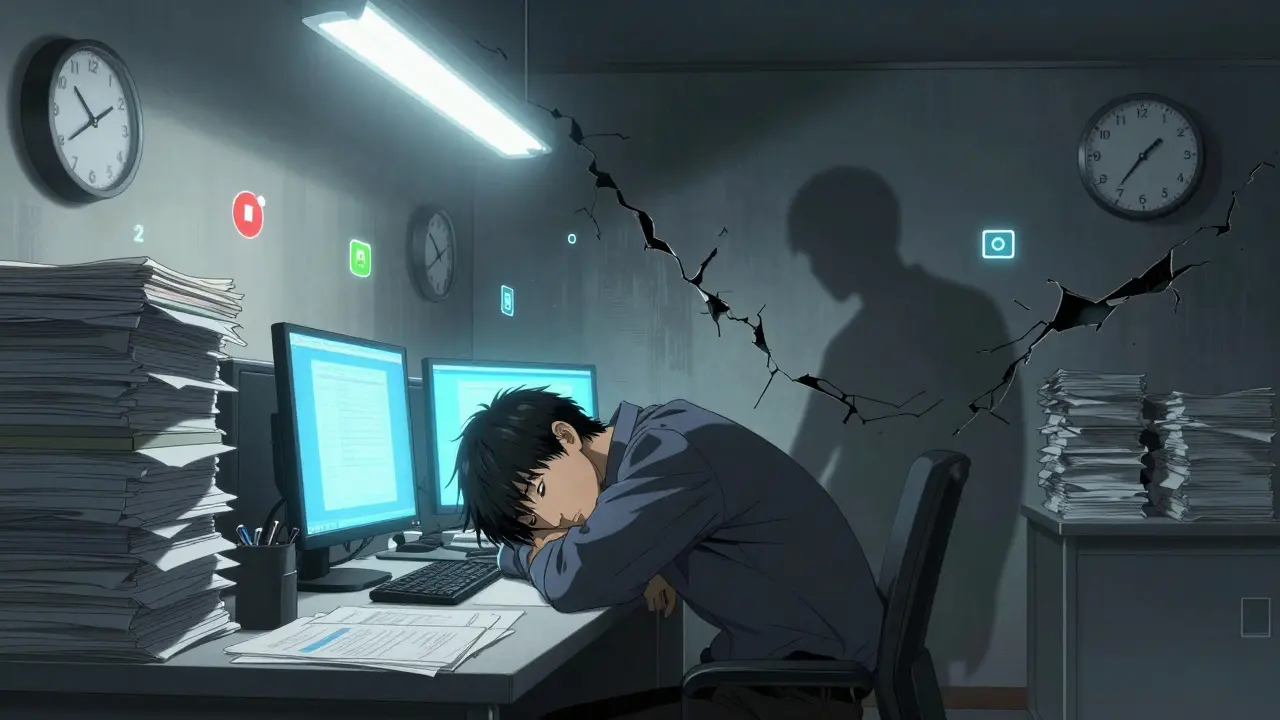
By 2026, nearly half of all workers globally say they feel stressed every single day. And one in five admit they’re burned out-constantly exhausted, emotionally detached, and feeling like their work doesn’t matter anymore. This isn’t just a personal problem. It’s a systemic one. Burnout isn’t about being weak or lazy. It’s what happens when the system doesn’t give you the space to breathe.
What Burnout Really Looks Like
Burnout isn’t just feeling tired after a long week. It’s a slow erosion. The World Health Organization officially classified it in 2019 as an occupational phenomenon, not a medical condition. That matters. It means the problem isn’t you-it’s the environment you’re in. The three signs are clear:- You’re constantly drained, even after rest.
- You’ve started to mentally check out-your job feels meaningless, or you’re cynical about it.
- You used to be good at what you did. Now, even simple tasks feel overwhelming.
Why Burnout Keeps Happening
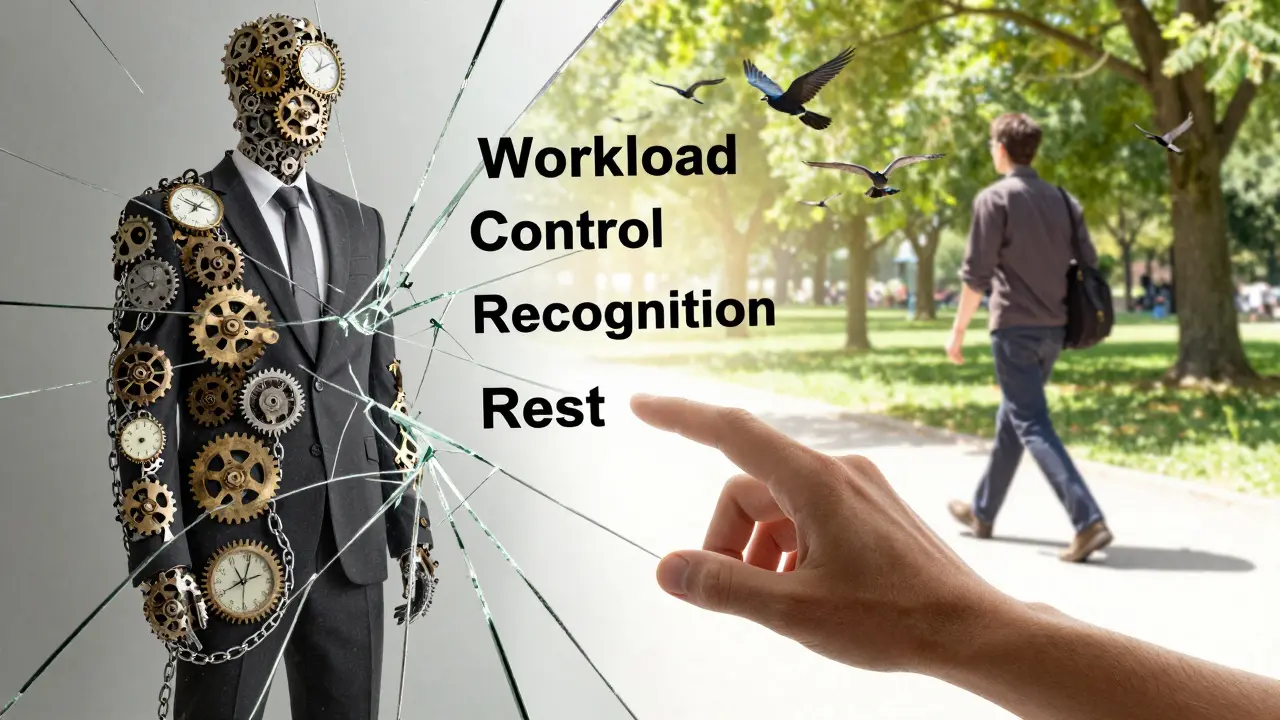
Burnout doesn’t happen because someone didn’t meditate enough or didn’t drink enough water. It happens because of how work is designed. The Job Demands-Resources model, developed by Arnold Bakker and Evangelia Demerouti, breaks it down into six key stressors:- Excessive workload (67% of workers say this is the biggest issue)
- Lack of control over how you do your job (49%)
- Not being rewarded fairly (42%)
- Feeling isolated or unsupported (38%)
- Perceiving unfair treatment (34%)
- Values that clash with your company’s actions (29%)
How Organizations Can Actually Prevent Burnout
The most effective prevention doesn’t come from HR brochures. It comes from changes in how work is managed. Workload audits every quarter-not once a year-are proven to stop 78% of burnout caused by overload. Companies like Salesforce and Microsoft are using AI tools to track task distribution and redistribute work before people break. That’s not surveillance. That’s responsibility. Flexible schedules work better than you think. A 2023 study found that companies allowing “Work-from-Home Wednesdays” and flexible start times saw a 27% drop in burnout. Why? Because people work better when they can match their energy to their tasks. If you’re a morning person, don’t force yourself into a 9 a.m. meeting you’re not ready for. Managers are the biggest factor. Gallup found that managers account for 70% of whether employees feel engaged or burned out. The top five conversations that reduce burnout are:- Discussing strengths
- Connecting work to purpose
- Talking about wellbeing
- Planning growth opportunities
- Recognizing effort
What You Can Do for Yourself
Organizations need to change. But you also need tools to protect yourself while that change happens. Set hard boundaries. If you stop checking emails after 6 p.m., your burnout risk drops by 39%, according to the American Psychological Association. Use your phone’s focus mode. Turn off notifications. Say no. It’s not rude-it’s survival. Use time-blocking. Instead of letting your day get hijacked by meetings, block out 90-minute chunks for deep work. Then take a 10-minute break. Harvard Business Review found this increases productivity by 13% and cuts burnout markers by 17%. It’s not about working harder. It’s about working smarter. Micro-breaks are non-negotiable. Every 90 minutes, step away. Walk around your office. Stare out the window. Stretch. Keystone Partners found that teams who do this regularly report less fatigue and better focus. You don’t need a meditation app. You just need to stop. Move your body. Walking meetings are used by 68% of Fortune 500 companies. Why? Because sitting all day is toxic. Even 27 extra minutes of movement per day makes a difference. If you work remotely, try a 15-minute walk before and after work. MIT’s 2024 study showed this “bookending routine” reduced stress by 22%. Track what you’ve done, not what’s left. Burnout makes you feel like you never finish anything. Start a list of small wins: “Finished the report,” “Had a real conversation with a colleague,” “Took a lunch break.” Keystone Partners found this simple shift speeds up recovery by over three weeks.How to Recover When You’re Already Burned Out
Recovery isn’t a vacation. It’s a structured reset. Gallup’s three-phase model works:- Recognition: Use tools like the Q12 survey to spot early signs-not just when someone quits.
- Intervention: Immediately reduce workload. Give temporary relief. Reassign tasks. Don’t wait.
- Restoration: Return slowly. Protect time. Don’t throw someone back into the same fire.
Why Most Burnout Programs Fail
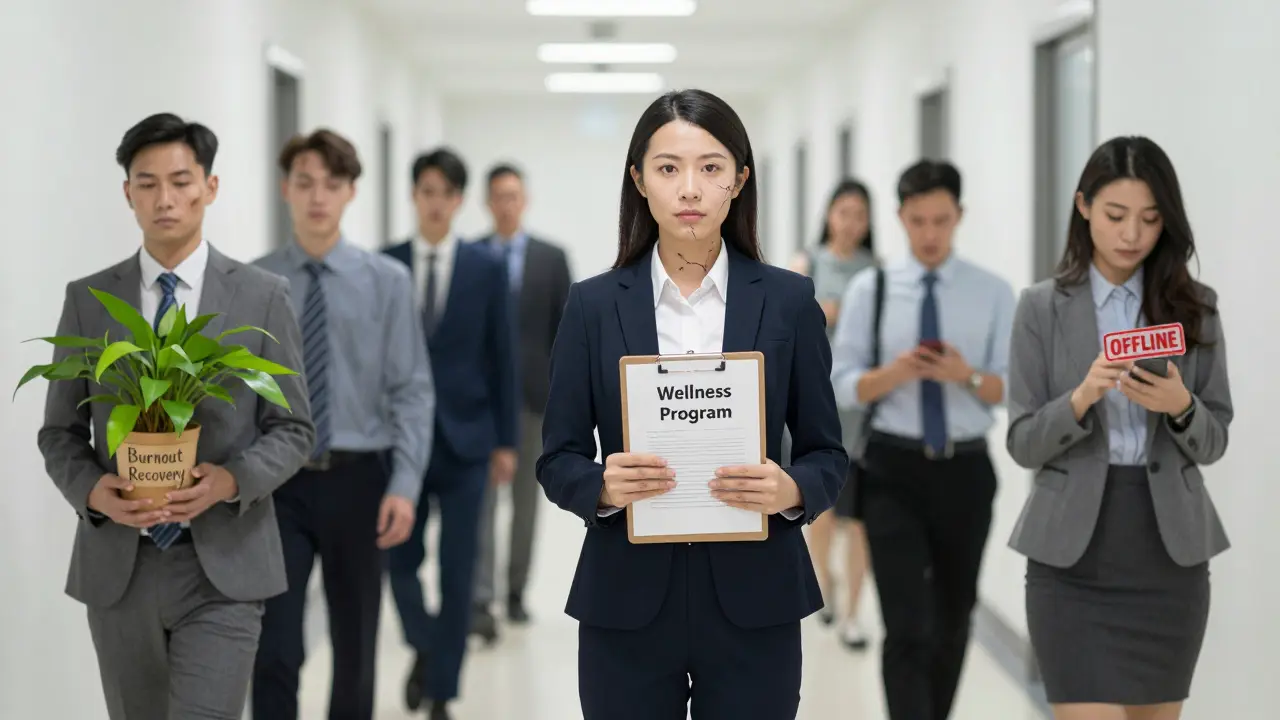
Companies spend billions on wellness apps, gym memberships, and resilience workshops. And yet, 68% of these programs fail. Why? Three reasons:- Managers aren’t held accountable. Wellbeing isn’t part of their performance reviews.
- Initiatives are one-offs. They launch in January, fade by March.
- They treat symptoms, not causes.
The Future Is Predictive, Not Reactive
The next wave of burnout prevention isn’t about therapy sessions or meditation apps. It’s about prediction. By late 2025, 65% of Fortune 500 companies will use AI to spot burnout before it happens. These systems analyze email patterns, meeting frequency, calendar gaps, and login times. They don’t spy. They warn. Companies like American Express and Procter & Gamble are already using integrated data-sick days, EAP usage, productivity drops-to generate burnout risk scores. Early adopters have reduced burnout incidence by 38%. Some are even testing HRV (Heart Rate Variability) monitors-devices that track your nervous system’s stress response. Pilot programs at Google and Intel showed 29% greater reduction in burnout than traditional methods. The future isn’t about fixing broken people. It’s about fixing broken systems.What You Should Do Today
You don’t need to wait for your company to get it right. Start here:- Block your last 30 minutes of the day to review what you actually accomplished-not what’s left.
- Set a hard stop for work emails. Use your phone’s Do Not Disturb feature.
- Ask your manager: “What’s one thing we could change to make this role more sustainable?”
- If your company offers mental health benefits, use them now-not when you’re at breaking point.
Is burnout the same as stress?
No. Stress is a short-term reaction to pressure-like a deadline or a big presentation. Burnout is long-term exhaustion from chronic, unmanaged stress. It’s when you feel empty, detached, and ineffective for weeks or months. Stress can be resolved with rest. Burnout requires systemic change.
Can I recover from burnout on my own?
You can manage symptoms alone-sleep better, take breaks, set boundaries. But true recovery requires support. Burnout is caused by workplace systems, not personal weakness. Without changes to workload, culture, or management, you’ll likely relapse. Use your company’s mental health resources. Talk to HR. Advocate for change. Recovery isn’t just about you-it’s about fixing the environment.
Do I need to quit my job if I’m burned out?
Not necessarily. Many people recover without leaving. But you need to address the root causes: excessive workload, lack of control, poor management. If your company refuses to change and you’ve tried everything, then yes-leaving may be the healthiest choice. But quitting should be a last resort, not the first. Focus first on what you can control: boundaries, communication, and support.
Are mental health apps helpful for burnout?
They can help with symptoms-like anxiety or sleep-but they don’t fix the cause. If you’re burned out because you’re working 60 hours a week with no support, no app will fix that. Apps are tools, not solutions. Use them as part of a broader strategy that includes changing your work environment.
How do I know if my manager cares about burnout?
Look at what they do, not what they say. Do they ask about your energy levels in 1:1s? Do they respect your time off? Do they adjust workloads when you’re overwhelmed? Do they model boundaries-like not sending emails after hours? If they’re only talking about productivity and never about wellbeing, they’re not helping. Real care shows in action, not slogans.
Is burnout more common in certain industries?
Yes. Tech companies lead in prevention, with 78% having formal programs. Healthcare and education have high burnout rates due to emotional labor and understaffing. Manufacturing and retail struggle with rigid schedules and low control. But burnout can happen anywhere-especially where long hours, unclear expectations, and poor communication are the norm.
What’s the most effective burnout prevention strategy?
The most effective strategy is combining organizational change with individual boundaries. Organizations must fix workload, fairness, and manager training. Individuals must set limits, take breaks, and track accomplishments. No single fix works alone. It’s the combination that reduces burnout by up to 40%, according to Well-being Works Better’s 2023 data.
ellen adamina
January 15, 2026 AT 00:49I used to think burnout was just me not trying hard enough. Then I started tracking my energy like a spreadsheet. Turns out, I was working 12-hour days with zero breaks and my manager never asked how I was feeling. Just told me to "hustle through it." I didn't need a meditation app. I needed someone to say, "Hey, this isn't sustainable."
Now I block my last 30 minutes to write down what I actually did. It’s tiny. But it helps me remember I’m not failing. The system is.
Diane Hendriks
January 16, 2026 AT 18:22Let me be clear: burnout is not a corporate buzzword. It is the inevitable consequence of a society that has abandoned virtue in favor of efficiency. Americans have traded dignity for productivity, and now they wonder why they feel hollow. No app, no flex schedule, no "digital sunset" will restore the moral fabric of work. You must reclaim discipline. You must stop blaming the system and start being a man-or a woman-who endures. Weakness is not systemic. It is personal. And it is unacceptable.
Nishant Garg
January 17, 2026 AT 08:41Back home in Delhi, my uncle works 14 hours a day at a call center-no benefits, no lunch break, no one asking if he’s okay. He doesn’t have Slack or Zoom. He has a broken phone and a boss who yells in Hindi. But he still smiles when he talks about his daughter’s school play. I think burnout isn’t just about workload-it’s about meaning. When you know your work matters, even if it’s hard, you find a way. Here, people have everything-flex hours, mindfulness apps, ergonomic chairs-and still feel empty. Why? Because no one ever told them why they’re here. Not just what they do-but why it matters.
Tom Doan
January 18, 2026 AT 22:46Oh wow. A 44% success rate with a 30-60-90 plan? How groundbreaking. Next you’ll tell me water is wet and gravity exists. Meanwhile, my manager sent me a Slack at 11:47 PM last night saying "Just checking in!" with a smiling emoji. The system is broken. But instead of fixing it, we’re selling $29.99 guided breathing exercises on the company portal. I’m not burned out. I’m just tired of the performance art of corporate wellness.
Sohan Jindal
January 18, 2026 AT 23:06They want us to blame the system? Nah. It’s the liberals. They turned work into a therapy session. Now we got people crying because they have to answer emails on time. Back in my day, we worked 80 hours a week and didn’t complain. We didn’t need no HR workshops. We had pride. Now? We got apps telling us to take naps. What’s next? Paid crying breaks? This country is falling apart because we don’t want to work anymore. Quit your job if you’re tired. Don’t make everyone else pay for your weakness.
Frank Geurts
January 19, 2026 AT 23:19As a long-standing advocate for organizational integrity and human capital optimization, I must express my profound appreciation for the nuanced, evidence-based articulation of systemic burnout dynamics presented herein. The confluence of empirical data from Gallup, Maslach, and Spring Health, coupled with the actionable framework of workload audits, digital boundaries, and managerial accountability, represents a paradigmatic shift in workplace ergonomics. It is imperative that institutions align their performance metrics with psychological safety indicators, lest they perpetuate the very attrition they seek to mitigate. One must not conflate wellness initiatives with structural reform-nor mistake corporate lip service for authentic cultural evolution. The data are unequivocal. The time for action is now.
Annie Choi
January 20, 2026 AT 03:13OMG YES. I just did the 48-hour digital detox last month. No emails. No Slack. Just me, my dog, and a stack of old paperbacks. I came back and my brain felt like it had been rebooted. I started time-blocking and now I’m actually getting stuff done without feeling like I’m drowning. Also-micro-breaks? I walk around the block every 90 mins. It’s not about being productive. It’s about being alive. If your company doesn’t get this, find one that does. Your mental health isn’t negotiable.
Arjun Seth
January 20, 2026 AT 14:13You think you’re special because you use time-blocking? Everyone’s burned out because they’re lazy. You don’t need a plan. You need discipline. I wake up at 4 AM. I work till 8 PM. I don’t need a manager to care. I care. And I don’t need apps or walks or lists of small wins. I need to stop making excuses. Burnout is for people who quit before they even started. If you can’t handle pressure, go sell lemonade. This isn’t daycare.
Mike Berrange
January 20, 2026 AT 19:03Interesting. So the solution to burnout is... more data? More tracking? More AI monitoring my calendar, my email patterns, my HRV? You’re not fixing the system-you’re turning every employee into a lab rat. If my company starts measuring my heart rate variability to prevent burnout, I’m not sure if that’s healthcare or surveillance. And who gets access to that data? HR? The CEO? The insurance company? You say it’s not spying. But if you’re watching me, you’re controlling me. And that’s the real burnout.